Beyond the Initial Sip: Decoding Whisky's Evolution
Discover how a dram transforms in your mouth and glass over time.
The Philosophy of the 'Living' Liquid
If you have ever spent an evening in a high-end whisky bar, you’ve likely seen two very different types of drinkers. At one end of the mahogany, there is the person who treats a pour of rare single malt like a shot of cheap tequila—tossed back in a single motion, gone before the bartender has even set the bottle back on the shelf. At the other end, you find the taster who sits in silence, cradling a glass for twenty minutes before the liquid even touches their lips. To the uninitiated, the latter might seem like they’re performing a pretentious ritual. In reality, they are simply respecting the chemical volatility of a "living" liquid.
Whisky is far more than just fermented grain and oak; it is a complex, chemically active solution that begins to transform the very microsecond it leaves the bottle. When we talk about how to taste whisky like a pro, we are really talking about patience. A bottle of whisky is a piece of bottled history, a liquid time capsule that has been trapped in a dark, oxygen-deprived environment for perhaps twelve, eighteen, or even fifty years. When that cork pops, the spirit undergoes a sudden, violent transition. The first thirty seconds of a pour are often the least representative of the spirit's true character because the volatile compounds are still "shouting" to get out of the glass.
You may have heard enthusiasts discuss the "Neck Pour" phenomenon. This is the anecdotal belief that the first dram from a fresh bottle never tastes quite as good as the third or fourth. While some dismiss this as myth, there is a scientific logic to it. The ratio of "headspace" oxygen to liquid in a full bottle is minimal. Once you pour that first ounce, you introduce a significant amount of fresh air into the bottle, initiating whisky oxidation in glass and in the bottle itself. This initial exposure begins to soften the more aggressive ethanol notes, allowing the underlying whisky tasting notes to emerge over the following weeks.
Within every drop of whisky, there are over 500 different flavor compounds known as congeners. These include esters, aldehydes, phenols, and fatty acids, each reacting differently to light, air, and temperature. This is why we advocate for the 'Temporal Tasting' method—a meditative approach where a single 1.5oz pour is treated as a 45-minute evolving experience rather than a fleeting beverage. When you slow down, you realize that the whisky you smell at minute one is a completely different creature than the one you sip at minute thirty.
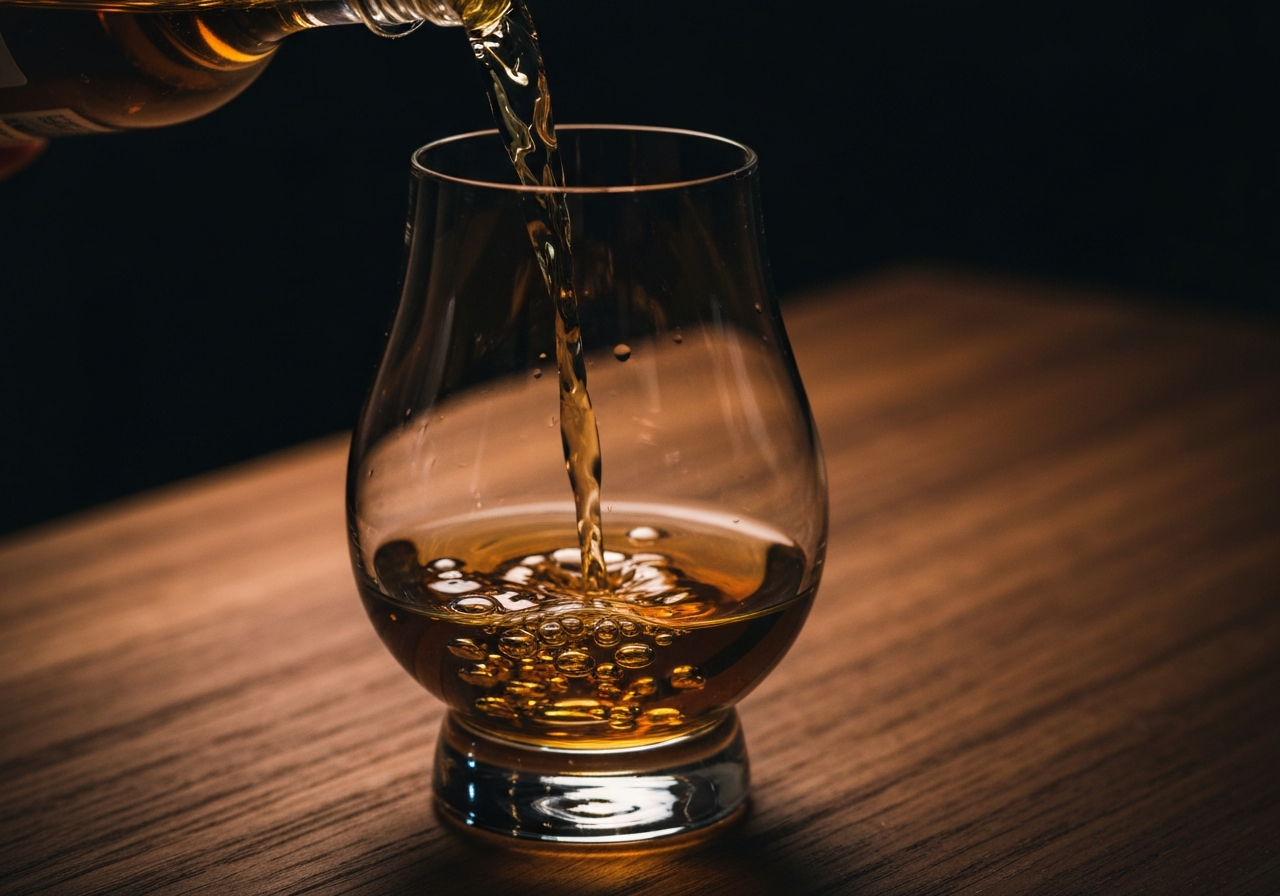
The Aeration Awakening: Oxygen’s First Contact
When you pour a high-ABV (Alcohol by Volume) whisky, especially one that is "cask strength," the first thing that hits your nose is often the "burn." This is the ethanol quite literally evaporating off the surface. If you dive in immediately, that ethanol can temporarily desensitize your olfactory receptors, masking the delicate fruit or floral esters you’re searching for. This is where whisky aeration becomes your best friend. By letting the spirit "stretch" in the glass, you allow the most volatile alcohol molecules to dissipate, clearing a path for the deeper aromatic compounds.
In the whisky world, there is a traditional rule of thumb often called the "minute-per-year" rule. The idea is simple: for every year the whisky spent maturing in the cask, you should let it rest in the glass for one minute before tasting. While not a hard scientific law, it’s a brilliant guideline. A 12-year-old Scotch has a different molecular density than a 25-year-old; the older spirit has spent decades integrating wood lignins and vanillins, and it often needs more time to "wake up" and shed its long-held confinement.
Oxidation also plays a critical role in managing sulfur compounds. Many whiskies, particularly those condensed in traditional "worm tubs" rather than modern column or shell-and-tube condensers, can have a heavy, slightly rubbery, or sulfurous note when first poured. Exposure to oxygen helps break these heavy compounds down, often transforming what felt like "burnt matches" into pleasant meaty, savory, or even floral notes. It is a chemical metamorphosis occurring right in the palm of your hand.
Furthermore, oxygen begins to interact with the vanillin and lignins extracted from the oak during maturation. Over the first ten minutes in the glass, you might notice the "harsh edges" of the wood tannins beginning to soften. The surface area-to-volume ratio in an open glass is massive compared to a closed bottle, accelerating these chemical shifts. This is why a whisky that seemed aggressive and "woody" upon the first sip can suddenly turn creamy and dessert-like after a brief rest.
The Olfactory Journey: From Volatiles to Base Notes
The human nose is capable of detecting thousands of distinct scents, far outperforming the palate. When exploring a dram, we talk about the "First Nose" versus the "Second Nose." The First Nose happens immediately after pouring—this is where you find the most volatile "top notes" like citrus zest, fresh pear, or light floral honey. These molecules are light and travel fast. However, if you return to the glass ten minutes later (the Second Nose), you’ll often find that the citrus has faded, replaced by "base notes" like old leather, tobacco leaf, or dark chocolate.
A common trap for tasters is "nose-blindness" or olfactory adaptation. If you keep your nose buried in the glass for too long, your brain eventually decides that the scent is "background noise" and stops reporting it to your consciousness. One of the best whisky tasting notes tips I can give you is to step away. Put the glass down, walk to another room, or even smell the crook of your elbow (neutral skin) for sixty seconds. When you return to the glass, the contrast will often reveal entirely new layers that your brain had previously filtered out.
Peat smoke is another fascinating element of the olfactory journey. Phenolic compounds, measured in Parts Per Million (PPM), can be quite unstable. In a freshly poured glass of a heavily peated Islay malt, you might get an "acrid campfire" or "burnt plastic" aroma. As the spirit oxygenates, these phenols shift. The smoke might become "sweetly medicinal," like old-fashioned cough syrup, or take on a briny, oceanic character. The "smoke" doesn't disappear; it simply evolves as different phenolic molecules interact with the air.
The temperature of the liquid also dictates which aromatics are released. This is why many pros use the "Hand-Warming" technique. By cupping the bowl of the glass in your palm, you gently raise the liquid's temperature by a few degrees. This thermal energy helps break the bonds of heavier molecules, releasing "bound" aromatics that remain stagnant at room temperature. This is also where Glencairn glass benefits shine; the tapered chimney of the glass is designed specifically to concentrate these rising molecules, directing them toward your nose rather than letting them escape into the room as they would in a wide-rimmed tumbler.
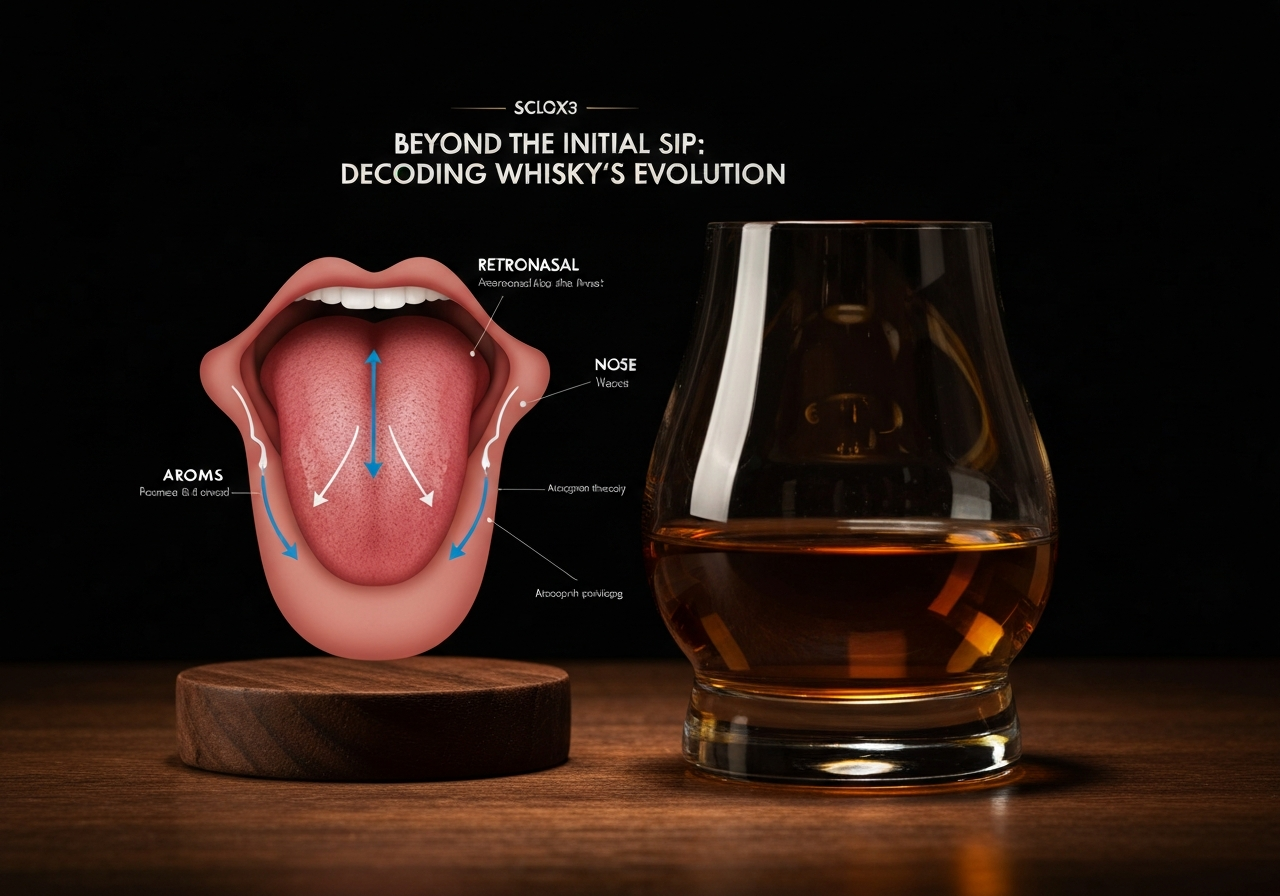
The Arrival: The Palate's Immediate Reaction
When the whisky finally hits your tongue, your body’s "Oral Somatosensory" system takes the lead. This isn't just about taste; it’s about "mouthfeel." Before your brain identifies "vanilla" or "smoke," it identifies texture. Is the liquid thin and watery, or is it oily and viscous? This "Arrival" is the first stage of the physical experience. However, if you’re tasting a high-proof spirit, your tongue might initially go into a bit of shock. The alcohol can have a slight anesthetic effect, numbing the very taste buds you’re trying to use.
This is why the first sip of any tasting session is rarely the most accurate. I call it the "calibration sip." It prepares your palate for the intensity of the alcohol. It’s only on the second sip that your mouth adjusts, the saliva begins to flow, and you can truly begin to analyze the whisky finish and arrival. During this phase, you’ll often notice a sweetness on the tip of the tongue—this is usually the work of American Oak vanillins, which are some of the first flavors to register.
One legendary technique for exploring the arrival is the "Kentucky Chew," famously pioneered by the late Booker Noe of Jim Beam. Instead of simply swallowing, you roll the whisky around your entire mouth, almost as if you were chewing it. This aerates the liquid inside your mouth and ensures it touches every taste bud region—sweet, sour, salty, and bitter. It’s a bit unrefined looking, sure, but it’s incredibly effective at uncovering the hidden depths of a dram.
Interestingly, your own biology plays a role here too. Saliva contains an enzyme called amylase, which begins to break down complex carbohydrates in the whisky as soon as they touch your tongue. If you hold the liquid in your mouth for 5 to 10 seconds, the chemical composition actually changes right there on your palate. What started as a spicy grain note might transform into a sweet, cereal-like flavor as the enzymes do their work. It is the definition of a dynamic experience.
The Mid-Palate Transition: The Heart of the Dram
As the whisky moves from the tip of the tongue to the center, you enter the "Development" phase. This is the mid-palate, where the complexity of the spirit truly reveals itself. This is often where the "spices" live—cinnamon, nutmeg, black pepper, or even ginger. These notes are frequently the result of the whisky’s interaction with the wood of the cask (the "wood spice").
During this phase, something called "Retronasal Olfaction" occurs. As the whisky warms in your mouth, vapors travel from the back of your throat up into your nasal cavity. This creates the illusion of "tasting" complex scents. You aren't just tasting the liquid; you are smelling it from the inside out. This is why a whisky might taste "peary" or "leathery" even though those aren't technically tastes that the tongue can register. It is the marriage of the palate and the nose working in perfect synchronicity.
The texture of the mid-palate is also heavily influenced by whether the whisky was chill-filtered. Non-chill filtered whiskies retain their natural lipids and fatty acids. These oils coat the palate, creating a "creamy" or "waxy" sensation that can actually buffer the perception of bitterness. In a dry, heavily tannic whisky, these oils act as a lubricant, allowing the flavors to glide across the tongue rather than feeling like they are scraping against it. This "Oily vs. Dry" dichotomy is a hallmark of high-quality craft distilling.
We also look for "Bridge" flavors in the mid-palate. These are notes that act as a transition between the initial sweetness and the final oaky structure. In a Sherry-cask matured whisky, for example, notes of dried raisins or plums often act as this bridge. Finally, keep an eye out for the "Tannic Grip." Much like a dry red wine, certain whiskies—especially those aged in European oak—will create a drying sensation on the sides of your tongue. This isn't a flaw; it’s a structural element that cleanses the palate and prepares you for the next wave of evolution.
The Science of Dilution: Why a Drop Changes Everything
Many beginners feel that adding water to whisky is a sign of weakness or an "insult" to the distiller. In reality, adding water to whisky science tells a very different story. In 2017, researchers Björn Karlsson and Ran Friedman published a study on a molecule called Guaiacol, which is responsible for much of the smoky, peaty aroma in whisky. They found that at higher alcohol concentrations, these flavor-carrying molecules tend to stay "trapped" in the bulk of the liquid. When you add a few drops of water, it decreases the solubility of these molecules, pushing them to the surface where they can evaporate and reach your nose.
This is known as a "Hydrophobic" reaction. Think of it like a crowded room where everyone is huddled in the center. Adding water is like opening the doors and windows; suddenly, the molecules have the energy and the space to move toward the surface and "blossom." If you’ve ever added water to a dram and felt like the aroma suddenly "exploded" out of the glass, you weren't imagining it—you were witnessing molecular physics in action.
You might also notice a physical change called "The Louche" or clouding. This happens in non-chill filtered whiskies when the addition of water (or a drop in temperature) causes the natural oils and fatty acids to precipitate out of the solution. While it might look a bit murky, it’s a fantastic sign. It tells you that the whisky is packed with flavor-carrying esters and oils that haven't been industrially stripped away. It is a visual cue that you are about to experience a very rich, textured dram.
However, there is a "tipping point." If you add too much water, you risk collapsing the chemical structure of the spirit. The alcohol acts as a preservative for the flavor; go too low, and the whisky becomes "flat," "watery," or one-dimensional. This is why I always recommend the "Sequential Dilution" method. Taste the whisky at bottle strength first. Then, add three drops of water. Taste again. Observe the changes. Add a few more drops. This allows you to find the "sweet spot" where the spirit is at its most expressive without losing its backbone.
The Finish: The Long-Lasting Ghost of the Spirit
The "Finish" is perhaps the most romanticized part of how to taste whisky like a pro. It is defined as the duration and quality of the flavors that remain in your mouth after you have swallowed. Finishes are generally categorized as Short (fading within seconds), Medium (lasting a minute or two), or Long (lingering for five minutes or more). A long, complex finish is often the mark of an exceptional, well-aged spirit.
One of the most famous sensations during the finish is the "Kentucky Hug." This is that warm, glowing feeling that starts in the back of the throat and travels down into the chest. A good "hug" should be warming and comforting, not sharp or burning. It is a testament to the quality of the distillation and the way the alcohol has integrated with the wood over time. If a whisky feels like it’s "stabbing" your throat, it likely wasn't aged long enough or was distilled too quickly.
Then there are the "Ghost Notes." These are flavors that only appear 30 to 60 seconds after the whisky is actually gone. You might swallow a sip of a Highland malt and think it’s over, only for a faint puff of woodsmoke, a hint of sea salt, or a sudden burst of fresh mint to appear out of nowhere. These notes are often the result of heavy oils that have coated your palate and are only now releasing their final aromatic secrets as they are slowly diluted by your saliva.
I always encourage people to try the "Empty Glass Test." After you’ve finished your dram, leave the glass on the table for ten minutes. Then, go back and smell the empty glass. Because the alcohol has entirely evaporated, what’s left behind are the heavy sugars, oils, and wood extracts that don't evaporate easily. An empty glass of high-quality Sherry-cask whisky can smell like a rich fruitcake for hours after the liquid is gone. It is the final, lingering ghost of the spirit.
Glassware and Environment: Setting the Stage for Change
We’ve touched on Glencairn glass benefits, but it’s worth diving deeper into why glassware matters for evolution. A standard tumbler is great for a "drinking" whisky, but for a "tasting" whisky, it’s a disaster. The wide opening allows all those volatile aromatics we’ve discussed to escape into the room immediately. A tapered glass, like a Glencairn or a Copita (tulip-shaped), acts as a concentrator. It slows down the rate of whisky oxidation in glass just enough to let you experience the evolution in stages rather than all at once.
Environment is also a massive factor. If you’re sitting on a cold patio in the autumn, your whisky will evolve much more slowly. The molecules are "sluggish." Conversely, in a warm, humid room, the spirit will "open up" almost instantly. Temperature also affects your own perception; chilling a whisky with ice might make it more "refreshing," but it effectively "freezes" the evolution. The cold numbs your taste buds and prevents the volatile oils from turning into vapor. If you want to experience the full transformation of a luxury dram, keep it at room temperature.
We should also consider the "Resting Bottle" factor. As you drink through a bottle over several months, the air-to-liquid ratio changes. A bottle that is 75% empty will evolve much faster than a full one. This is why many enthusiasts find that the "last two ounces" of a bottle are often the best—or sometimes the worst, if the whisky has oxidized past its prime. If you have a very expensive bottle that is nearly empty, consider transferring it to a smaller "sample bottle" to reduce the oxygen exposure and preserve its current state.
Finally, never underestimate the power of a palate cleanser. If you’ve just eaten a spicy meal or had a cup of coffee, your ability to track a whisky’s evolution is compromised. Room temperature water and plain oatcakes are the industry standard for a reason. They neutralize the pH of your mouth and clear away lingering fats, ensuring that the evolution of your next dram is a clean slate, unaffected by what came before.
Conclusion: Developing the Slow Palate
The journey from that aggressive initial sip to the nuanced final fade of a long finish is one of the great joys of the whisky world. It is a reminder that in a world of instant gratification, some things still require time to reveal their true nature. Patience is, without a doubt, a taster’s greatest tool. By slowing down, you aren't just drinking; you are engaging in a dialogue with the distiller, the barrel, and the decades of time that went into creating that liquid.
If you want to take your hobby to the next level, I highly encourage you to keep a "Temporal Tasting Journal." Instead of just writing down one set of notes, record your impressions at the 0, 15, and 30-minute marks. You will be amazed at how much your whisky tasting notes change over that half-hour. You might find that a whisky you initially disliked becomes your favorite after it has had time to breathe.
"Whisky is a liquid that refuses to be rushed. You must give it time to speak, and you must have the ears—and the nose—to listen."
Famous master blenders like Rachel Barrie or Richard Paterson often talk about "giving the whisky time." They didn't spend decades perfecting these blends for them to be rushed. Every dram is a story with a beginning, a middle, and an end. The next time you pour yourself a glass, don't just take a sip and move on. Sit with it. Watch it change. Let it breathe. You might find that the best part of the whisky wasn't in the bottle at all, but in the time you spent waiting for it to reveal itself.
We’d love to hear about your experiences! What is the most surprising "transformation" you’ve ever witnessed in a single glass of whisky? Did a "bad" first sip turn into a legendary experience after twenty minutes? Share your stories in the comments below or over on the DramNote app!