Whiskey Aromas: Decoding the Nose's Secrets
Go beyond 'smells good' and unlock a world of nuanced appreciation by mastering your whisky's scent profile.
The Primacy of the Nose: Why Aroma is 80% of Taste
Have you ever noticed how food seems to lose its flavor when you have a heavy cold? You can still sense that a lemon is sour or a pretzel is salty, but the "lemon-ness" and the "pretzel-ness" simply vanish. This is because our taste buds are actually quite primitive, capable of detecting only five basic sensations: sweet, sour, salty, bitter, and umami. The heavy lifting of flavor perception—the nuanced, complex, and vibrant "color" of what we consume—is performed by our olfactory senses whisky enthusiasts often underestimate.
In the world of spirits, and particularly with whisky, scientific estimates suggest that between 80% and 90% of what we perceive as "taste" is actually processed through our sense of smell. This happens through two distinct pathways. First, there is orthonasal olfaction, which occurs when we sniff the glass directly, drawing whisky aromas through our nostrils. Second, there is retronasal olfaction. This happens after you take a sip; as the liquid warms in your mouth, aromatic vapors travel from the back of your throat up into the nasal cavity. This is why a whisky can "taste" like green apples or leather even though your tongue can’t technically detect those things.
Beyond the mechanics of flavor, our sense of smell has a direct line to our emotions. You may have heard of the "Proustian Moment"—named after Marcel Proust, who famously wrote about how the scent of a tea-soaked madeleine cake triggered a flood of childhood memories. Physiologically, the olfactory bulb is the only sensory organ with a direct physical link to the amygdala (which processes emotion) and the hippocampus (which manages memory). This is why a specific Islay Scotch might suddenly transport you back to a rainy camping trip on the coast, or a Sherry-casked Highland malt might smell exactly like your grandmother’s Christmas cake. When you learn how to nose whisky, you aren’t just identifying chemicals; you are unlocking a personal library of memories.
The most encouraging part of this journey is that nosing is a skill, not a static gift. While some people are born with more sensitive olfactory receptors, the ability to identify and articulate whisky tasting notes is something developed through practice and "muscle memory" for the brain. By slowing down and paying attention to the nose, you transform a simple drink into a deeply immersive, multi-sensory experience.

The Chemistry of the Dram: Volatile Organic Compounds
To truly master the art of nosing, it helps to understand what is actually happening inside that glass. When you swirl your whisky, you are encouraging the release of Volatile Organic Compounds (VOCs). These are microscopic molecules that are light enough to evaporate at room temperature and travel through the air to your nose. Without these tiny chemical messengers, whisky would just be a neutral, stinging liquid.
In this chemical soup, Ethanol (alcohol) plays a dual role. To the beginner, ethanol is the "burn" that can overwhelm the senses if you dive in too quickly. However, ethanol is also an incredible solvent. It acts as a carrier, holding aromatic esters, aldehydes, and phenols in suspension. As the alcohol evaporates, it carries these whisky aromas upward, effectively delivering the scent profile to your nostrils. This is why high-proof, cask-strength whiskies often smell more intense—they have more "fuel" to lift those aromatic molecules into the air.
If the alcohol burn is too intense, we often turn to the "hydrotropic effect." Adding just a few drops of water to your dram does more than just lower the ABV. Water breaks the surface tension of the liquid and alters the solubility of certain molecules. Specifically, it can "trap" the ethanol while releasing heavier molecules like guaiacol—the compound responsible for those wonderful smoky, medicinal notes in peated whisky. This is why a tightly wound whisky suddenly "blooms" with a splash of spring water; you are literally changing the distillation science on a molecular level right in your glass.
Temperature also plays a vital role in this chemical dance. Many aficionados prefer to warm the bowl of the glass in their palms. This increases the kinetic energy of the VOCs, causing them to move faster and escape the liquid more readily. While this makes the whisky more "expressive," be careful: too much heat can cause the ethanol to dominate, masking the more delicate notes. The quest for the perfect nose is often a balance of chemistry and patience. This need for a standardized language of chemistry led to the development of the whisky aroma wheel in the 1970s by Dr. Jim Swan and his colleagues. They realized that by categorizing these chemical compounds into groups like "esters," "phenols," and "aldehydes," they could provide a universal map for enthusiasts to navigate the complex world of scent.
From Field to Flask: Grain and Fermentation Aromas
The journey of a whisky’s scent profile begins long before it ever touches a barrel. The "primary aromas" are those derived directly from the raw ingredients and the initial stages of production. In the world of Single Malt, the star is malted barley. Depending on how it was kilned, barley can provide a range of scents from fresh-mown hay and toasted biscuits to nutty, cereal-forward notes. Contrast this with Bourbon, where a high corn mash bill provides that signature sweet, dusty, and slightly floral aroma often associated with a walk through a grain elevator on a warm day.
However, the real "aroma factory" of the distillery is the washback, where fermentation occurs. When yeast consumes the sugars in the wort, it doesn't just produce alcohol and CO2; it creates a complex array of "esters." These are the chemical compounds responsible for the fruitier whisky tasting notes. If you’ve ever detected notes of green apple, ripe pear, or even tropical banana in a light Speyside malt, you are smelling the hard work of the yeast.
The duration of fermentation is a massive factor here. A "short" fermentation (around 48 hours) tends to result in a more malt-driven, nutty, and functional spirit. However, many craft-focused distilleries push their fermentations to 60, 80, or even 120 hours. As the yeast begins to stress and secondary bacterial fermentations take over, more complex, floral, and acidic esters develop. This is where we get the "washback funk" or the deep, floral elegance found in distilleries like Glenmorangie. Their tall stills and specific fermentation windows are designed to capture these delicate, top-note esters before they are lost.
There is also the ongoing debate about "terroir" in whisky. Some distillers argue that the specific soil, climate, and variety of the grain contribute aromatic precursors that survive the distillation process. Whether it’s the salty breeze hitting the barley fields on the coast of Islay or the mineral-rich water filtered through granite in the Highlands, these environmental factors provide the foundational "skeleton" of the spirit's nose. While maturation gets much of the credit, these grain and fermentation aromas provide the essential character that defines a distillery's DNA.

The Copper Kiss: Distillation and the 'Cut'
Once the fermentation is complete, we are left with "wash"—essentially a rough, unhopped beer. To turn this into whisky, we must use distillation science to concentrate the alcohol and refine the whisky aromas. This is where the copper pot still becomes the protagonist of the story. Copper is not just used because it’s a great conductor of heat; it is a "sacrificial" metal that plays a vital chemical role. As the spirit vapors rise, they react with the copper walls, which strip away unwanted sulfur compounds. If you've ever smelled a "new make" spirit that reminds you of struck matches or rotten eggs, that’s sulfur—and it’s the distiller’s job to ensure the copper removes just enough of it.
The shape and height of the still determine the "reflux." Reflux is what happens when vapors condense on the inside of the still and fall back down to be re-distilled. Tall, slender stills (like those at The Glenlivet) encourage high reflux, meaning only the lightest, most elegant, and floral vapors make it over the "lyne arm" to the condenser. Small, squat stills (like those at Macallan) allow heavier, oilier molecules to pass through. This results in a spirit that smells robust, "meaty," and full of heavy oils and leather notes right from the start.
Then comes the "Distiller’s Cut." During distillation, the spirit comes off the still in three parts: the foreshots, the heart, and the tails. The foreshots are high in pungent, solvent-like aromas and are discarded. The "heart" is the sweet spot the distiller wants to keep. However, the decision of exactly when to switch from the heart to the "tails" is an artistic choice. An "early cut" captures the citrusy, grassy, and floral notes. A "late cut" allows more of the heavier, humic, and funky aromas into the spirit.
Managing the "tails" is a delicate balancing act. These later parts of the distillation run contain high concentrations of fusel oils and funky aromas. If handled poorly, they can make a whisky smell "dirty" or overly vegetable-like. But if handled with mastery, they provide the weight and texture that allow a whisky to stand up to decades of cask maturation scents. The copper kiss is the final refinement of the liquid before it enters its long sleep in the dark of the warehouse.
The Oak's Influence: Vanillins, Tannins, and Lactones
It is a commonly cited rule of thumb in the industry that between 60% and 70% of a whisky’s final aromatic profile is derived from the wood during maturation. If the distillery process provides the "skeleton," the cask provides the "flesh." When we talk about cask maturation scents, we are really talking about the interaction between the spirit and the chemical components of the oak: cellulose, hemicellulose, lignin, and oak tannins.
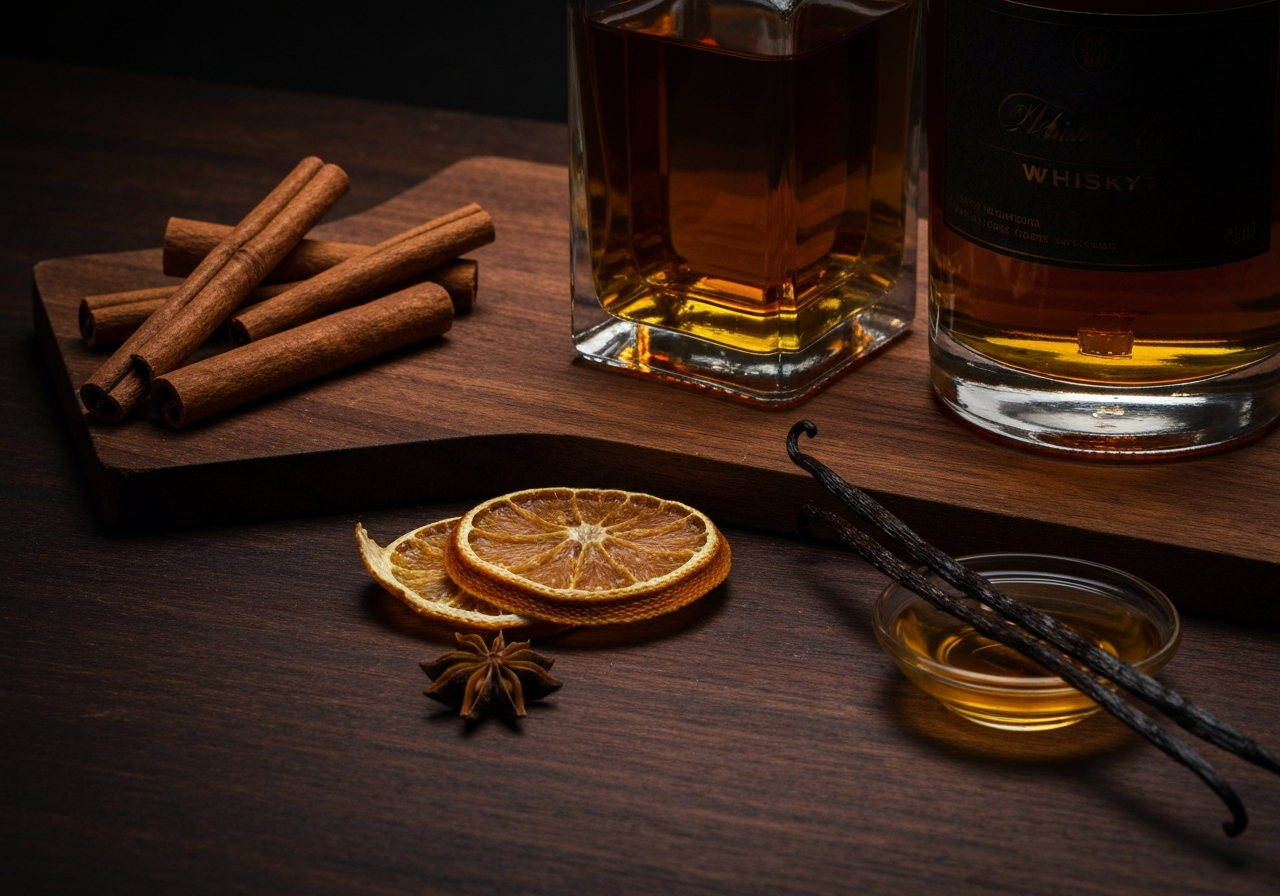
Most whisky is aged in American White Oak (Quercus alba), largely due to the requirements of the Bourbon industry. This wood is rich in "vanillins" (which provide that classic vanilla scent) and "oak lactones," which are responsible for the distinct aroma of toasted coconut. Because American oak is usually charred—literally burned on the inside—the heat caramelizes the wood sugars (hemicellulose), creating aromas of crème brûlée, marshmallow, and brown sugar. The char also acts as a layer of charcoal, filtering the spirit and further smoothing out any remaining harshness from the still.
In contrast, European Oak (Quercus robur), often used for Sherry casks, offers a completely different olfactory palette. It is much higher in tannins and provides "spicier" notes like clove, nutmeg, and dried ginger. Because European oak is more porous and is typically "seasoned" with Sherry for years before being used for whisky, it imparts deep, dark whisky tasting notes of raisins, dates, figs, and old leather. The difference between an American Oak-aged malt and a European Oak-aged malt is like the difference between a vanilla sponge cake and a rich, spiced fruitcake.
We must also consider the "seasoning" effect. The liquid that previously occupied the cask—whether it was Bourbon, Oloroso Sherry, Port, or even peaty whisky—soaks into the staves. Over the years, the maturing spirit breathes in and out of the wood, picking up the aromatic residue of its predecessor. This is why a "Sherry Bomb" smells like a winery, and a "Port Pipe" finish might smell like sun-drenched blackberries. The wood is a living, breathing vessel that slowly weaves its own story into the spirit's nose.
Embracing the Elements: Peat, Smoke, and Phenolics
For many, the world of whisky aromas begins and ends with smoke. But "smokiness" is a broad term that covers a vast spectrum of chemical compounds known as phenols. These phenols are measured in Parts Per Million (PPM), but don't let the numbers fool you; the type of peat used to dry the malted barley matters just as much as the quantity. Peat is essentially decomposed organic matter, and its chemical makeup depends entirely on what plants grew in that spot thousands of years ago.
On the island of Islay, the peat is composed of ancient seaweed, moss, and lichen, all saturated with salt spray. This results in the famous "medicinal" nose—think iodine, TCP, salt brine, and old bandages. When you nose a Laphroaig, you are smelling the literal essence of the Atlantic coast. Move inland to the Highlands, and the peat is made of wood, heather, and forest floor. This produces a "dryer" smoke, reminiscent of a wood-burning fireplace, autumn leaves, or charred heather. It’s a softer, more "bonfire" style of smoke compared to the "industrial" smoke of the islands.
It is important to distinguish between "smoky" and "peaty." Smoke is a flavor profile created by the burning of peat. However, "peatiness" can also manifest as an earthy, damp, or mossy scent that comes from the water source itself as it flows over peat bogs. A whisky can be earthy without being smoky, but it’s hard for a whisky to be smoky without some level of phenolic earthiness. Think of Ardbeg’s "sooty" smoke versus Bowmore’s "barbecue" sweetness; both are peated, but they occupy different corners of the olfactory map.
If you find yourself overwhelmed by the smoke, here is a pro tip: the "Empty Glass" technique. Once you’ve finished your dram, leave the glass on the table for an hour. As the heavy smoke molecules settle, the "ghosts" of the distillery—the fruit, the honey, and the malt—will emerge from behind the peat wall. Nosing the dry glass often reveals more about the whisky’s true soul than the first sniff of a fresh pour. It’s a testament to the layering of whisky aromas; the smoke is just the herald, the fruit is the king hidden inside.
The Professional’s Toolkit: Glassware and Environment
You wouldn't try to appreciate a fine painting in a dark room, and you shouldn't try to nose a fine whisky in a standard tumbler. The "rocks glass" or tumbler is the enemy of the nose. Its wide, open mouth allows the whisky aromas to dissipate far too quickly, and it does nothing to shield your nostrils from the concentrated sting of ethanol. To truly unlock the olfactory senses whisky needs to be concentrated.
The gold standard for nosing is the Glencairn glass or the tulip-shaped Copita. These glasses are designed with a wide bowl to allow for aeration and a tapered rim that focuses and funnels the aromatic vapors directly toward your nose. This "chimney effect" ensures that the more delicate notes aren't lost to the room. If you’re serious about building your whisky tasting notes, the right glassware is the single most important investment you can make.
Environment is the second pillar of professional nosing. Your nose is incredibly sensitive to "pollution." If you are in a room with a scented candle, a bubbling pot of garlic pasta, or someone wearing heavy perfume, your brain will struggle to isolate the subtle notes of the whisky. Find a neutral space. Even the "Hand-Warming" technique requires environmental awareness; use your body heat to gently encourage the release of molecules, but don't overdo it. If the glass feels hot, the ethanol will "boil" and singe your nasal membranes.
Another trick used by professional blenders is the "Cover and Rest" method. Place a watch glass, a coaster, or even a clean Pringles lid over the top of your Glencairn for five minutes. This allows the "headspace" above the liquid to become saturated with VOCs. When you finally remove the cover, you are met with a concentrated "burst" of the whisky’s entire aromatic profile. It’s like opening a window into the distillery's warehouse.
The Ritual of the Nose: Step-by-Step Techniques
When it comes time to actually smell the spirit, don't just jam your nose into the glass and take a deep breath. That’s a one-way ticket to "olfactory fatigue," where your nose shuts down to protect itself from the alcohol. Instead, follow a ritual. Start with the "Drive-By." Hold the glass a few inches away and move it slowly past your nose from left to right. This gives you a gentle first impression of the "top notes"—the most volatile molecules that travel the furthest.
Next, use the "Distance Strategy." Start with the glass at chest height, then your chin, and finally your nose. Note which aromas you pick up at each level. Generally, the fruity and floral notes are the lightest and travel the furthest, while the heavy oaks, peats, and oils stay closer to the liquid. This helps you map out the "structure" of the whisky.
The "Mouth-Ajar" secret is perhaps the most important technical tip for beginners. When you go in for a deep sniff, keep your mouth slightly open. This creates a circular airflow that allows the alcohol vapors to pass through without overwhelming your nasal receptors. It effectively "dilutes" the intensity of the ethanol, allowing you to find the hidden whisky aromas like honey, lavender, or old books that might otherwise be masked by the "sting."
Don't forget to alternate nostrils. Most people have one nostril that is more "open" or sensitive than the other at any given time (a physiological phenomenon called the nasal cycle). By switching back and forth, you might find that your left nostril picks up the bright citrus notes while the right nostril finds the deeper, chocolatey base notes. Finally, practice patience. A whisky is a living thing in the glass. It needs 10 to 20 minutes to "open up." As the most volatile esters evaporate, the more stubborn, complex aromas will begin to emerge. Never judge a whisky by its first thirty seconds.
Building Your Olfactory Library: Training Exercises
If you want to get better at identifying whisky tasting notes, you need to build what professionals call an "olfactory library." This isn't something you do with a glass in your hand; it’s something you do throughout your day. Practice "Active Nosing." When you walk through a grocery store, smell the peaches, the pineapples, and the fresh ginger. When you’re outside after a rainstorm, take a deep breath and memorize the scent of damp earth and wet stone. The more "labels" you have in your mental database, the easier it will be to pull them out when you encounter them in a dram.
A great exercise for beginners is the "Cross-Category" comparison. Pour a classic Bourbon (like Buffalo Trace), a Highland Scotch (like Glenmorangie), and a heavily peated Islay (like Ardbeg) side-by-side. Nosing them in sequence highlights the extreme differences in their "aromatic skeletons." The contrast makes the individual notes—corn sweetness vs. floral malt vs. medicinal smoke—stand out much more clearly than if you were nosing them in isolation.
You can also utilize tools like "Le Nez du Whisky," which is a kit of standardized aromatic vials designed to train your nose. However, you can achieve the same results with a DIY approach. Go to your spice rack and smell cinnamon, cloves, and black pepper. Compare the scent of a fresh orange peel to a dried one. This hands-on training is the fastest way to bridge the gap between "I smell something familiar" and "I smell toasted almonds."
For those looking for a challenge, try "Blind Nosing." Have a friend pour a dram without telling you what it is, or better yet, use a black Glencairn glass that hides the color of the liquid. Our brains are incredibly susceptible to visual bias; if we see a dark, amber liquid, we expect to smell Sherry and caramel. By removing the visual cues, you force your olfactory senses whisky relies on to work in isolation. You might be surprised to find that the "dark" whisky you thought was a Sherry bomb is actually a heavily charred Bourbon.
Finally, keep a "Nosing Journal" or use an app like DramNote. The act of writing down your impressions—even if they seem silly—is vital. If a whisky reminds you of "grandpa’s old leather jacket" or "the inside of a cedar chest," write it down. These personal descriptors are more valuable than generic "wood" or "leather" notes because they are anchored to your own experience. Over time, you’ll see your vocabulary expand and your ability to articulate the "secrets of the nose" grow more confident.
Conclusion: The Lifelong Journey of the Dram
In the end, nosing whisky is a deeply subjective art. While the distillation science and the chemistry of VOCs provide a factual foundation, your personal interpretation is what matters most. There are no "wrong" answers in your own sensory experience. If you smell toasted marshmallows in a glass where someone else smells campfire smoke, you are both right; you are simply accessing different drawers in your olfactory libraries.
The goal of mastering whisky aromas isn't to become a walking encyclopedia of chemical compounds. It is to deepen your enjoyment and your connection to the incredible craftsmanship that goes into every bottle. When you can identify the "copper kiss" of a tall still or the "vanillin" of a first-fill Bourbon cask, you aren't just drinking; you are listening to the story the distiller and the cooper are trying to tell you across time and distance.
We encourage you to share your findings. Whisky is a social spirit, and verbalizing what you smell often helps others "unlock" those same notes in their own glass. It’s a wonderful moment when a friend says, "I'm getting grilled pineapple," and suddenly, the whole room can smell it too. And remember to appreciate the "soul" of the empty glass; those lingering scents are the final whisper of the wood’s long influence.
So, why wait? Pour yourself a dram right now. Don't worry about the taste just yet. Set a timer for ten minutes, keep your mouth ajar, and let the whisky aromas take you on a journey. Use one new technique you learned today—perhaps the "Drive-By" or the "Distance Strategy"—and see what secrets your nose can decode. Your next favorite memory might be waiting just at the rim of the glass.