Whiskey Glossary: Decode Lingo Before You Pour
Demystify common whisky terms and impress your friends with your newfound knowledge.
Introduction: Why the 'E' Matters and Where It All Began
Have you ever stood in the spirits aisle, staring at a wall of amber bottles, and wondered why some labels proudly proclaim "Whisky" while others insist on "Whiskey"? It seems like a minor typo, but in the world of fine spirits, that single vowel is a passport. It tells you exactly where that liquid was born. As a general rule of thumb to help you navigate this whisky vs whiskey difference, look at the name of the country of origin. If the country has an "e" in its name—like the United States or Ireland—they generally include the "e" in "whiskey." If the country doesn't have an "e"—think Scotland, Japan, or Canada—they stick to the "whisky" spelling. It’s a simple linguistic quirk, but it’s the first step in decoding the rich history sitting on your shelf.
But before we had marketing departments and international trade laws, we had Uisge Beatha. This Gaelic phrase, pronounced "ish-ka ba-ha," literally translates to the "Water of Life." In the 15th century, spirits weren't exactly enjoyed in a Glencairn glass by a fireplace; they were medicinal. Monks and early distillers used these potent liquids to treat everything from smallpox to a general "heaviness of the heart." The first written record we have of this aqua vitae (the Latin equivalent) appears in the 1494 Exchequer Rolls of Scotland. It notes that a certain Friar John Cor was granted eight bolls of malt to make "the water of life" by order of the King. From that humble religious commission, an entire global industry was born.
I know that diving into a whiskey glossary can feel like learning a second language, but I promise this isn't about snobbery. Understanding these whiskey terms for beginners is about empowerment. It’s about being able to walk into a bar, look at a list of fifty pours, and know exactly which one is going to hit the flavor notes you love. Whether you prefer a spice-forward kick or a smooth, honeyed finish, the clues are all there on the label. And here is the most beautiful part: despite the complex lingo and the centuries of tradition, every single bottle of whisky in the world starts with just three simple ingredients: water, grain, and yeast. Everything else—the smoke, the caramel, the fruit, and the spice—is a result of the process we are about to explore.

The Foundation: Mash Bills and Raw Ingredients
Every great whisky begins with a recipe, and in the industry, we call this the mash bill definition. Simply put, the mash bill is the specific ratio of grains used to create the spirit. Think of it like a baker’s recipe for bread; if you change the flour, the loaf changes. In the world of whiskey, the grains chosen dictate the "bones" of the flavor profile before the liquid ever touches a barrel.
The most important grain in the history of the spirit is barley, specifically malted barley. You’ll hear the term "malting" thrown around a lot. This is the process of soaking the grain in water to trick it into thinking it’s time to grow. As the grain germinates, it releases enzymes that are crucial for converting starches into fermentable sugars later on. Once the grain has sprouted just enough, the process is halted by drying it in a large oven called a kiln. If you’ve ever wondered why some whiskies are described as "malty," it’s this toasted, cereal-like sweetness from the barley you’re tasting.
Beyond barley, we have the "Big Three" of the grain world:
- Corn: The powerhouse of American whiskey. Corn provides a high sugar content, leading to a spirit that is sweet, oily, and full-bodied. If you love notes of vanilla and buttered popcorn, you’re a fan of a high-corn mash bill.
- Rye: The rebel of the group. Rye is notoriously difficult to distill because it gets "sticky," but the flavor it provides is unmatched. It’s responsible for those big hits of black pepper, baking spice, and a certain herbaceous "green" quality.
- Wheat: This is the "smoother" grain. Often used as a secondary grain in "wheated bourbons," it offers a soft, honeyed, and bread-like texture that lacks the aggressive spice of rye.
We can’t talk about ingredients without mentioning peat. Peat is essentially decomposed organic matter—ancient moss, grass, and roots—compressed over thousands of years into a fuel source. In certain parts of Scotland, particularly Islay, peat is burned to dry the malted barley. This imparts those legendary smoky, medicinal, or briny notes. It’s the smell of a campfire by the sea, and for many, it’s the ultimate expression of whisky’s earthy origins.
Finally, there is the unsung hero: yeast. While it doesn't get much glory on the label, distiller's yeast can contribute up to 30% of the final flavor. As the yeast eats the sugars, it produces "esters"—chemical compounds that smell like green apples, bananas, or even tropical fruits. Many distilleries guard their proprietary yeast strains like state secrets, and for good reason—they are the invisible architects of the spirit's aroma.
From Wort to Wash: The Fermentation Vocabulary
Once the grains are selected and milled into a coarse flour called "grist," the real chemistry begins. This starts with "mashing." The grist is mixed with hot water in a massive, circular vat called a Mash Tun. The goal here is to extract as much sugar as possible from the grain. The resulting sugary, opaque liquid is known as "Wort." If you were to taste it, it would be intensely sweet and reminiscent of a heavy grain porridge.
The wort is then transferred into large tanks called "Washbacks" for fermentation. Once the yeast is added, it goes to work, devouring the sugars and converting them into alcohol and carbon dioxide. After 48 to 96 hours, you no longer have wort; you have "Wash." The wash is essentially a primitive, unhopped beer, usually sitting at about 7% to 10% alcohol by volume (ABV). If you visited a distillery and took a sip of the wash, you’d recognize the DNA of the final product, though it would be much rougher around the edges.
The amount of time the wash spends in the washback is a huge variable for flavor. Distillers who opt for a short fermentation (around 48 hours) usually end up with a wash that has nutty, cereal-forward characteristics. However, if they let it sit for a long fermentation (over 70 hours), the yeast begins to produce those complex, citrusy, and floral esters I mentioned earlier. This is where a whisky gets its "elegance."
In the American whiskey tradition, there is a specific technique you’ll see on almost every bourbon label: "Sour Mash." Despite the name, it doesn’t make the whiskey taste sour. Instead, it refers to the process of taking a portion of the "backset" (the spent, acidic mash from a previous distillation) and adding it to the new batch. Think of it like a sourdough starter. It ensures that the pH level of every batch remains consistent and creates an environment where "bad" bacteria can't grow. It’s a mark of consistency that has been a staple of American distilling for nearly two centuries.
The final step of this stage is the first distillation, which results in what we call "Low Wines." This is the first time the liquid is concentrated into a spirit, usually reaching about 25-30% ABV. It’s not quite whiskey yet, but the "Water of Life" is starting to find its pulse.
The Copper Alchemist: Distillation Hardware
To turn that low-alcohol wash into a high-proof spirit, we need the magic of copper. Distillation relies on the fact that alcohol boils at a lower temperature than water (about 173°F vs 212°F). By heating the wash, the alcohol turns into vapor, rises up the still, and is then condensed back into a liquid. But the hardware used to do this changes everything.
Traditional "Pot Stills" are the bulbous, onion-shaped copper kettles you see in photos of Scottish highlands. They operate on a "batch" basis—you fill them, distill, clean them out, and start over. Because they are less efficient than modern stills, they allow more of the heavy oils and flavorful compounds from the grain to carry over into the spirit. This results in a whiskey that is viscous, complex, and full-bodied. This is why pot stills are the gold standard for single malt vs blended scotch production.
On the other side of the aisle, we have "Column Stills" (also known as Coffey stills). These are tall, industrial-looking towers that can run continuously. They produce a spirit that is much higher in proof and lighter in character. Most "grain whiskies" and many large-scale bourbons are produced this way. While some purists argue pot stills are superior, column stills are what allow for the consistency and approachability found in your favorite everyday blends.
During distillation, the person running the still (the Stillman) has a critical job: making "The Cuts." As the spirit flows, it’s divided into three parts:
- The Heads: These are the first vapors to come off. They contain volatile alcohols like methanol and smell like nail polish remover. These are tossed aside or redistilled.
- The Tails: These are the final vapors. They are heavy with "fusel oils" and can smell like wet cardboard or sulfur. Also tossed aside.
- The Heart: This is the sweet spot. It’s the clean, flavorful, high-quality spirit that is destined for the barrel.
And why copper? It’s not just because it looks pretty. Copper acts as a chemical catalyst. As the vapors rise, the copper surfaces "strip" away unwanted sulfur compounds. If you distilled whiskey in a stainless steel still without any copper contact, the final product would likely smell like boiled eggs or struck matches. Copper ensures the spirit is clean, fruity, and sweet.
The final result of this process is "New Make Spirit," often called "White Dog" in the United States. It is a crystal-clear, high-proof liquid that packs a massive punch. At this stage, it has all the grain and fermentation character, but it lacks the soul that only time and wood can provide.
The Wood's Influence: Casks and Cooperage
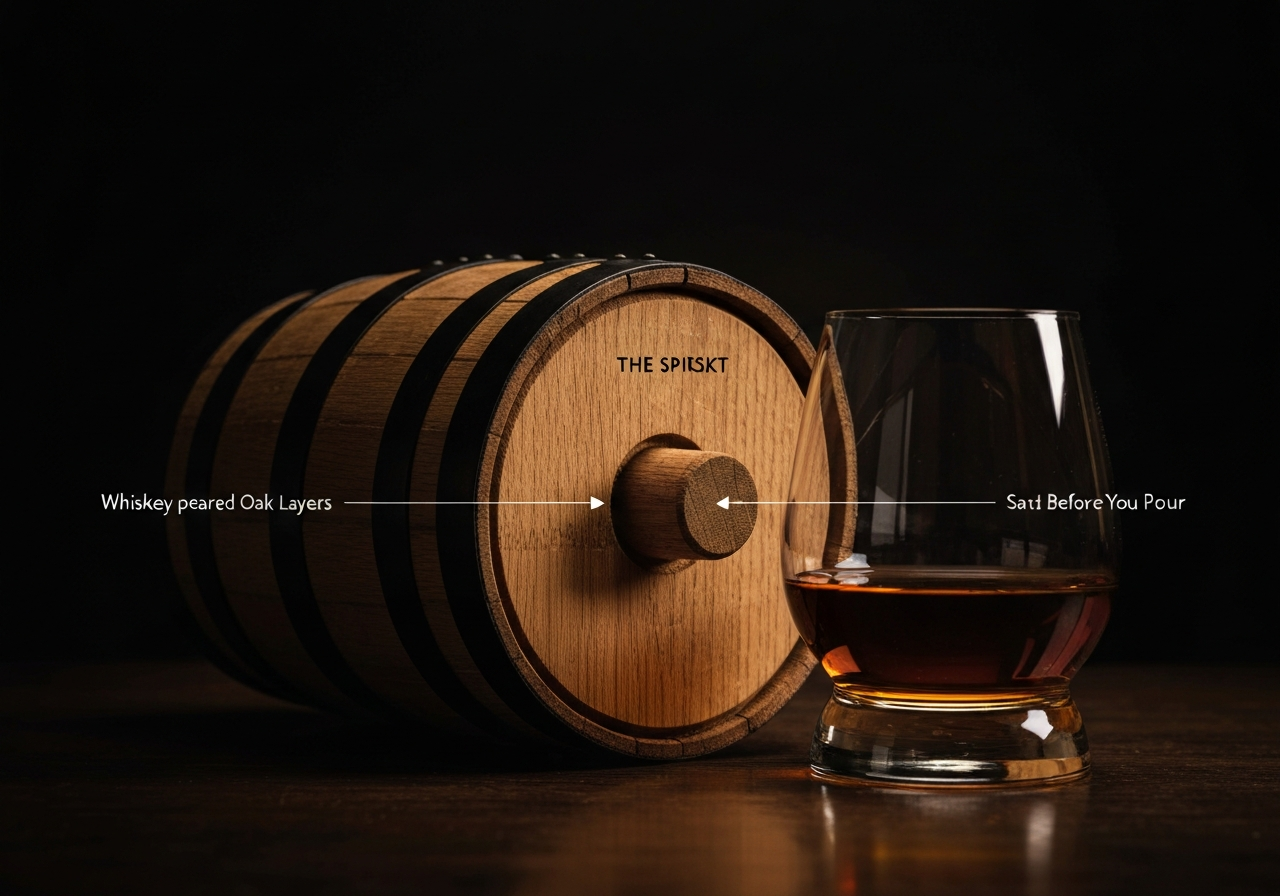
There is a famous saying in the industry: "The wood provides 70% of the flavor and 100% of the color." While the still creates the spirit’s identity, the barrel creates its personality. In most jurisdictions, whisky isn't legally "whisky" until it has spent a certain amount of time resting in an oak container.
The type of barrel matters immensely. In the world of Bourbon, the law requires the use of "Virgin" oak—brand new barrels that have never held liquid before. This results in a massive "oak bomb" of flavor: intense vanilla, caramel, and charred wood. Scotch distillers, however, often prefer "First-Fill" or "Refill" barrels. Since the initial intensity of the wood has been sucked out by a previous inhabitant (usually Bourbon or Sherry), the wood acts more subtly, allowing the delicate distillery character to shine through.
We also have to consider the species of oak. Quercus Alba (American White Oak) is the most common. It’s dense and full of "tyloses" that make the barrels leak-proof. Flavor-wise, it’s all about those classic bourbon notes: coconut, vanilla, and sweet cream. Quercus Robur (European Oak), often used for Sherry casks, is much more porous and rich in tannins. It imparts darker flavors like dried fruits, leather, Christmas spices, and a dry, grippy finish.
Before the spirit goes in, the barrel is treated with heat. "Toasting" the wood gently browns it, breaking down hemicellulose into wood sugars (vanillin). "Charring" goes a step further, literally setting the inside of the barrel on fire for several seconds. This creates a layer of charcoal that acts as a natural carbon filter, removing impurities from the spirit while creating a caramelized "red layer" just beneath the surface that provides the deep amber color.
Finally, we have the "Cask Finish." This is a secondary maturation where a whisky is moved from its primary barrel into a different one (like a Port pipe, a Rum cask, or a Cabernet Sauvignon barrel) for the final 6 to 12 months. It’s like adding a gourmet sauce to a perfectly cooked steak; it doesn't change the meat, but it adds a layer of complexity that can turn a great whisky into a legendary one.
The Invisible Toll: Angel's Share and Maturation
While the whisky sits in the warehouse, something mystical happens. It breathes. Because wood is porous, the spirit interacts with the outside air, expanding into the wood during the heat of the day and contracting back out when it cools. Over time, some of that liquid simply disappears into the atmosphere. This is what is angel's share—the roughly 2% of the barrel’s volume that evaporates every year. Legend has it the angels are taking their cut in exchange for watching over the spirit.
But the angels aren't the only ones taking a piece. There is also the "Devil’s Cut." This refers to the portion of the whiskey that is absorbed into the wood fibers of the barrel itself. It’s "lost" to the distiller unless they use mechanical means to sweat it back out. Between the angels and the devils, a barrel that starts full might lose a significant portion of its volume after a decade of aging. This is one of the primary reasons why older whiskies are so expensive—you are paying for the liquid that vanished.
It’s important to distinguish between "Age" and "Maturation." Age is just a number—how many times the Earth has circled the sun since the spirit hit the wood. Maturation is the chemical reality of how the spirit has evolved. A 5-year-old whiskey aged in the sweltering heat of Kentucky might be more "mature" than a 12-year-old whisky aged in a damp, cold Scottish warehouse. Heat accelerates the interaction between wood and spirit, making the extraction process happen much faster.
Even the location within a warehouse (or "Rickhouse") matters. Heat rises, so barrels stored on the top floors of a seven-story rickhouse will experience much more "breathing" than those on the cool, dirt-floored bottom level. Top-floor barrels tend to lose more water than alcohol, causing their proof to actually go up over time, while bottom-floor barrels often mellow out and lose proof. A master blender’s job is to dance between these different profiles to create the perfect bottle.
Decoding the Label: Strength and Purity
When you finally look at a bottle, the label can feel like a legal document. Let's break down some of the most confusing terms you'll encounter. First up: Cask Strength vs Bottled in Bond. These are the heavy hitters of the whiskey world.
Cask Strength (or Barrel Proof) means the whiskey was taken straight from the barrel and put into the bottle without any water added to dilute it. Most standard whiskies are diluted down to 40% or 46% ABV for consistency. Cask strength whiskies are usually 55% to 65% ABV. They are intense, punchy, and offer the purest representation of what the distiller tasted in the warehouse.
Bottled-in-Bond is a specific American designation stemming from the 1897 Act of the same name. To wear this label, the whiskey must be the product of one distillation season, by one distiller, at one distillery. It must be aged in a federally bonded warehouse for at least four years and bottled at exactly 100 proof (50% ABV). It was originally created to prevent "rectifiers" from adding tobacco spit or iodine to cheap moonshine, and today it remains a gold standard for quality and transparency.
You might also see "Single Cask." Most whiskies are a blend of hundreds of barrels to ensure that every bottle tastes the same. A Single Cask bottling comes from one individual barrel. Because no two barrels are identical, these are unique, one-of-a-kind snapshots in time. Once the bottle is gone, that specific flavor profile can never be replicated.
Then there is the debate over "Chill Filtration." When you add ice or water to whiskey, it can sometimes turn cloudy. This is because fatty acids and esters clump together at low temperatures. Many large brands use chill filtration to remove these compounds so the whiskey stays crystal clear. However, purists often seek out "Non-Chill Filtered" whiskies. Why? Because those fatty acids carry flavor and "mouthfeel." They might make the whiskey look a little hazy, but they keep the soul of the spirit intact.
And a quick warning: "Small Batch." You’ll see this on countless bottles, but here is the industry secret—there is no legal definition for it. For a craft distillery, a small batch might be two barrels. For a massive global brand, a "small batch" might be 2,000 barrels. Take that specific term with a grain of salt and look for more concrete details like age statements or mash bills instead.
The Taster's Lexicon: Nosing and Palate
Now for the best part: actually drinking it. But before you take a sip, you have to "nose" the whisky. Pro tip: don’t stick your nose deep into the glass and take a huge whiff like you would with wine. At 40%+ alcohol, you’ll just singe your nostrils. Keep your mouth slightly open and take short, gentle sniffs. Scientists tell us that roughly 80% of what we perceive as "flavor" is actually through our sense of smell. If you can smell it, you’re halfway to tasting it.
When the liquid finally hits your tongue, we look for "Palate" and "Mouthfeel." The palate is the actual flavor—is it sweet, spicy, or bitter? The mouthfeel is the physical texture. Is it thin and watery? Or is it "chewy," viscous, and oily? A high-quality whisky should coat your mouth like velvet, rather than just disappearing like water.
After you swallow, pay attention to the "Finish." This is the lingering flavor that stays in your throat and on your breath. A "long finish" is usually a sign of a complex, well-made spirit. You might also experience the "Kentucky Hug"—that warm, glowing sensation that starts in your chest and radiates outward. It’s one of the most comforting feelings in the world of spirits.
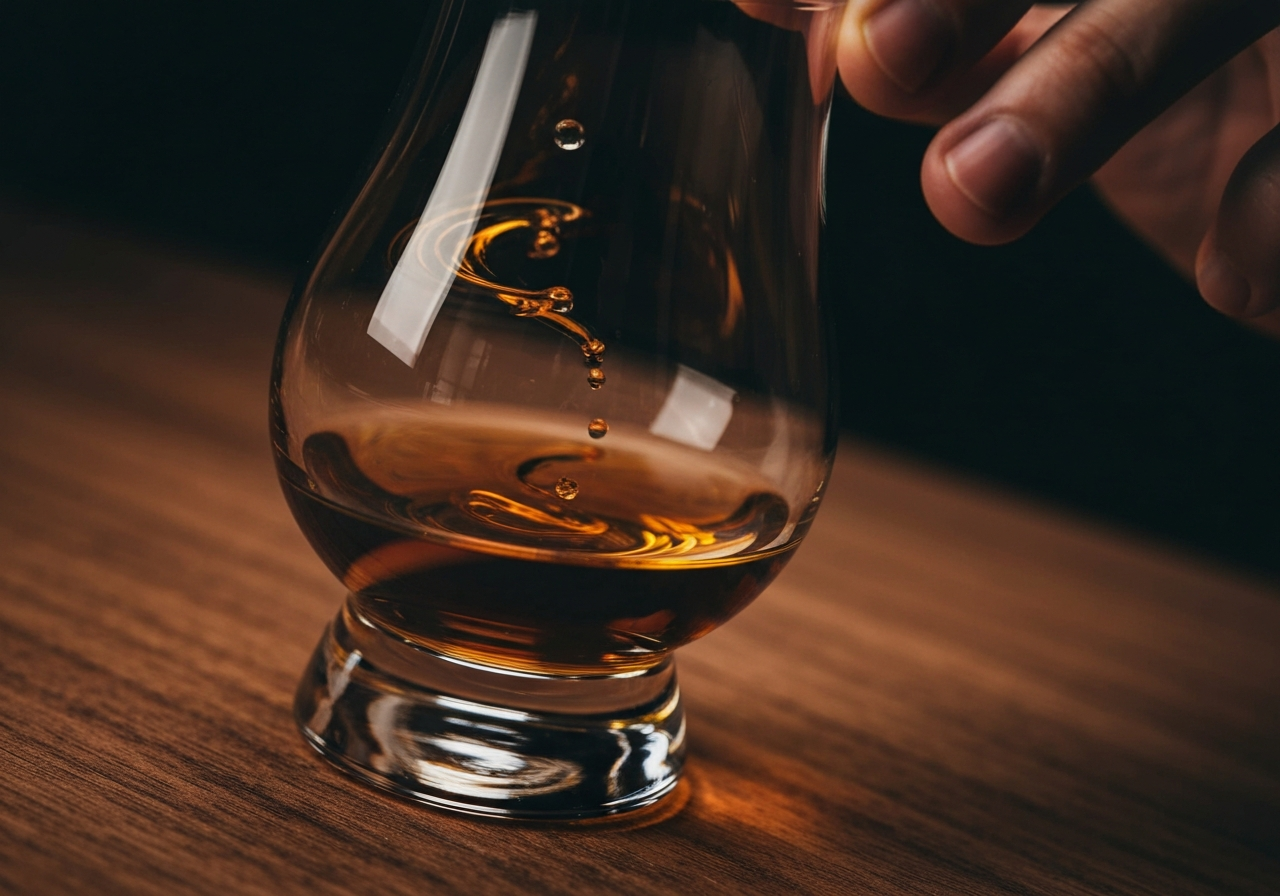
You’ll often see people swirling their glass and looking at the "Legs" (or tears) running down the side. There’s a common myth that slow-moving legs mean a better whisky. In reality, legs are just a measure of alcohol content and sugar viscosity (the Marangoni effect). They can tell you if a whisky is high proof or particularly sugary, but they aren't a direct indicator of quality. Don’t judge a book by its cover, and don’t judge a whisky solely by its legs!
Finally, don’t be afraid to add a drop of water. This isn't "watering it down"—it’s science. Adding a few drops of room-temperature water breaks the surface tension of the liquid and triggers a hydrophobic reaction. This "opens up" the whisky, releasing volatile aromatic molecules that were previously trapped by the alcohol. Especially with higher-proof whiskies, a little water can transform a "hot" alcohol burn into a symphony of hidden fruit and spice.
Regional Varieties: A Global Snapshot
As we wrap up our whiskey glossary, let’s look at the major categories you’ll find in the wild.
- Single Malt Scotch: To earn this title, the whisky must be made from 100% malted barley, distilled in pot stills at a single distillery in Scotland, and aged for at least three years in oak. It is the pinnacle of regional expression, ranging from the honeyed glens of Speyside to the peat-smoke bombs of Islay.
- Bourbon: America’s native spirit. It must be made in the USA, contain at least 51% corn, and be aged in new, charred oak containers. It cannot have any added colors or flavorings. It’s known for its sweetness and deep wood character.
- Rye Whiskey: Following similar rules to bourbon but requiring at least 51% rye grain. This leads to a spicier, drier, and more robust profile that is the backbone of classic cocktails like the Manhattan or Sazerac.
- Japanese Whisky: Long modeled after Scotch, Japanese whisky is known for its incredible balance and precision. Recent regulations have tightened the definition, requiring the spirit to be fermented, distilled, and aged in Japan to wear the label, ending the practice of blending imported spirits under a Japanese name.
- Blended Whisky: Often misunderstood, a single malt vs blended comparison isn't about better or worse; it's about intent. Blends like Johnnie Walker combine several single malts with grain whiskies to create a consistent, approachable, and smooth profile that stays the same bottle after bottle.
Conclusion: Pouring with Confidence
We’ve covered a lot of ground, from the 15th-century cells of Friar John Cor to the modern science of hydrophobic reactions. If there is one thing I want you to take away from this guide, it’s the Golden Rule of the dram: The best whiskey in the world is the one you enjoy drinking, the way you enjoy drinking it. Whether that’s a $200 single malt neat or a $20 bourbon in a paper cup with ginger ale, if you like it, you’re doing it right.
Terminology isn't here to build walls; it’s here to help you build a bridge to your next favorite bottle. Now, when a bartender mentions a "high-rye mash bill" or a "sherry cask finish," you aren't just nodding along—you’re visualizing the spice, the fruit, and the craftsmanship behind the bar. You are an informed enthusiast, ready to explore the vast and wonderful world of the Water of Life.
So, what’s your next move? I recommend hosting a "tasting flight" at home. Grab three different styles—maybe a bourbon, a peated scotch, and a rye—and use your new vocabulary to describe them to a friend. You’ll be surprised at how much more you notice when you have the words to describe it. This spirit is a lifelong journey, and even the Master Distillers are still learning something new every time they pull a bung from a barrel.
Thank you for joining me on this deep dive. I hope this helps you pour your next glass with a little more confidence and a lot more curiosity. Until next time, I’ll leave you with the traditional Scottish toast: Slàinte Mhath! (Pronounced "Slan-ge-vah," meaning "To your health!")
What was your favorite new term from today’s guide? Drop a comment below or tag us on DramNote with your latest tasting notes!