Whiskey 'Lagging': Unlocking Delayed Flavor Evolution
Discover the fascinating phenomenon of how whiskies can evolve and reveal new layers of flavor long after the initial pour.
The Patience Paradox: Defining the 'Lagging' Phenomenon
We’ve all been there. You finally track down that bottle you’ve been hunting for months. You get home, carefully slice the foil, hear that satisfying pop of the cork, and pour a healthy dram into your favorite glass. You take a sniff, eager for the complexity promised by the label, but all you get is a sharp, prickly burn of ethanol and a muted, woody flatness. It’s disappointing, right? You might even think you’ve been sold a dud. But before you write off that expensive purchase, you need to understand the patience paradox of whiskey lagging.
At its core, "lagging" is the temporal gap between the moment you pour a whiskey and the moment it actually reaches its peak sensory profile. It is the realization that a spirit, having been trapped in a vacuum-sealed bottle for years or even decades, is essentially "asleep." When it hits the glass, it undergoes a frantic, microscopic transition. Our brains, however, are often poorly equipped for this first encounter. Because our olfactory systems are highly sensitive to irritants, we often mistake the "ethanol punch" of a freshly poured dram for its true character. We perceive the strength of the alcohol as the primary flavor, while the delicate esters and oils remain hidden behind a chemical curtain.
This isn't just modern "whiskey snobbery." The concept of opening up whiskey traces back to traditional Scottish tasting rooms. Master blenders have known for centuries that a sample pulled straight from a cask or a fresh bottle won't reveal its secrets immediately. In the old dunnage warehouses, blenders would often pour "nosing samples" and leave them for hours—sometimes even overnight—covered with a small glass disc. They knew that the "lag" was necessary for the spirit to find its balance.
It’s important to differentiate whiskey lagging from "bottle aeration." While leaving a half-empty bottle on your shelf will slowly change the liquid over months, the surface-area-to-volume ratio in a tasting glass is exponentially higher. In a glass, the chemical changes that might take weeks in a bottle happen in minutes. I remember early in my journey pouring a 25-year-old Speyside malt that tasted like nothing but bitter, dusty wood. I was heartbroken. I left the glass on the table, went to make dinner, and came back 45 minutes later. The room smelled like a tropical fruit basket—pineapple, mango, and honeyed malt had completely replaced the oak. That was the moment I realized that time is just as important an ingredient as barley or water.
The Chemistry of Oxygen: How Aeration Unlocks the Cask
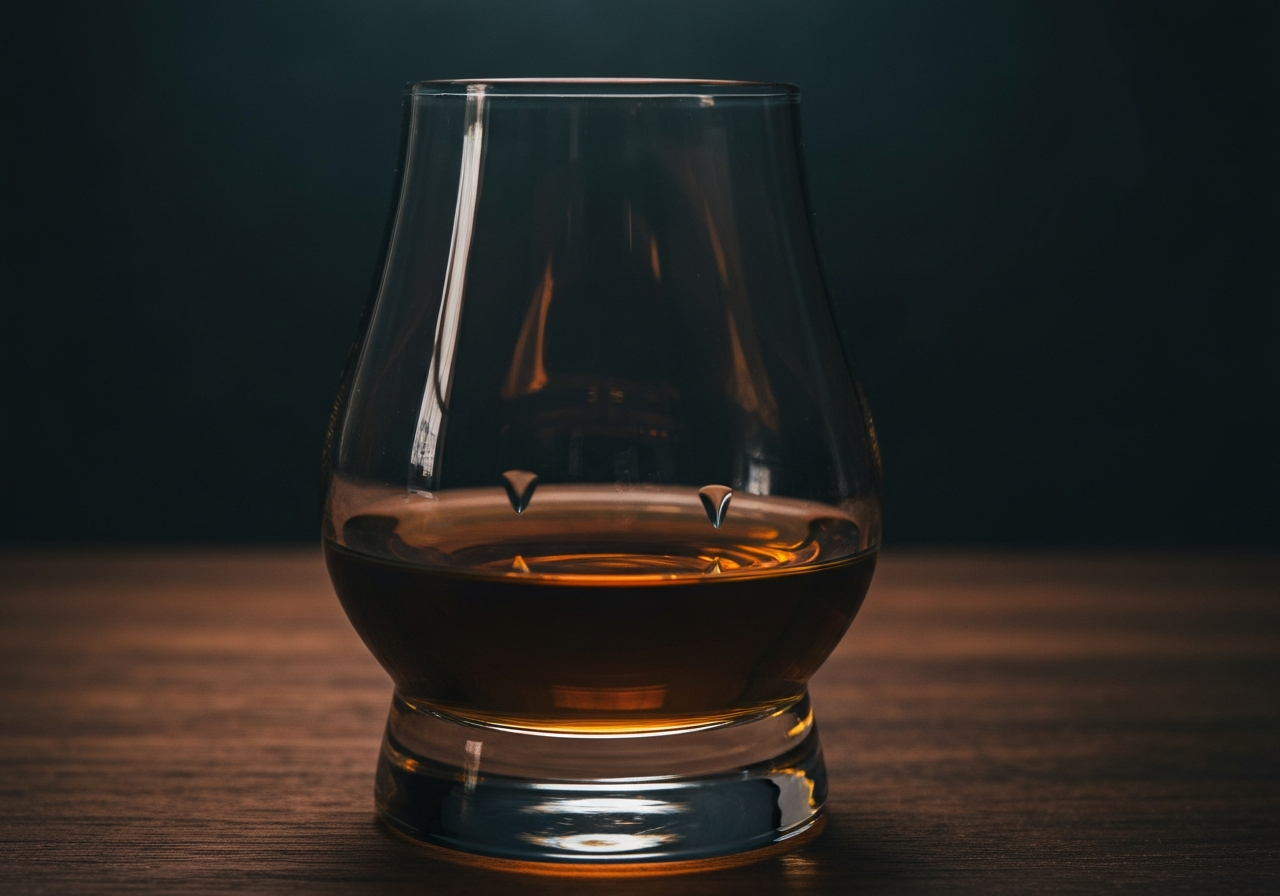
To truly master how to taste scotch and other fine spirits, we have to look at the science happening inside that crystal vessel. When whiskey meets air, a process called oxidation begins. Whiskey is a complex soup of chemical compounds, including long-chain esters. These esters are the "flavor heroes" responsible for those beautiful fruity and floral notes. However, in a newly opened bottle, these lighter molecules are often "trapped" or weighed down by heavier, more stable molecules. Oxygen acts as a catalyst, breaking down these bonds and allowing the lighter aromatics to break free and float toward your nose.
Then there’s the matter of ethanol. Alcohol is highly volatile, meaning it evaporates much faster than water or oil. When you first pour a dram, there is a concentrated cloud of alcohol vapor sitting right at the rim of the glass. This is what causes that "burn" in your nostrils. As the whiskey sits, a process of evaporative cooling and dissipation occurs. As that aggressive alcohol vapor thins out, it stops "masking" the more delicate congeners (flavor compounds). Think of it like a loud rock band where the drummer is playing too loudly; once the drummer settles into the groove, you can finally hear the subtle notes of the keyboard and the bass.
We also have to consider sulfur. Especially in younger whiskies or those from distilleries that use worm tub condensers, you might find heavy, rubbery, or "struck match" notes. These sulfur compounds are highly reactive to oxygen. Exposure to air helps these harsh notes mitigate or transform over time, often revealing a cleaner, sweeter profile underneath. This is a huge part of whiskey flavor evolution.
The glencairn glass science also involves the "Marangoni Effect." When you swirl your whiskey and see the "legs" or "tears" crawling down the side of the glass, you’re seeing the result of surface tension gradients caused by the evaporation of alcohol. As the whiskey "lags" and breathes, the viscosity and the way these legs form actually change. Furthermore, some molecules are "hydrophobic" (water-fearing). They want to escape the liquid and become volatile. By allowing the whiskey to sit, you are giving these hydrophobic molecules the opportunity to move to the surface and join the bouquet of aromas waiting for your olfactory bulb.
The Myth of the 'Neck Pour' vs. True Glass Evolution
In the whiskey community, you’ll often hear people talk about the "neck pour." The theory is that the very first dram out of a new bottle is somehow inferior to the rest. But is the "neck pour" a real chemical phenomenon, or is it just a myth? The truth is a bit of both. While there is a tiny amount of whiskey oxidation in glass and bottle headspace that occurs after the first pour, the "bad neck pour" is usually more about the taster than the liquid. When you try a new bottle for the first time, your palate is experiencing a "shock" as it adjusts to a specific ABV (alcohol by volume) and a new flavor profile. By the second or third dram a few days later, your brain has built a "map" for that whiskey, making it seem smoother.
However, we can’t ignore the physics of headspace. Headspace is the volume of air between the liquid and the cork. In a fresh bottle, there is almost no headspace, meaning the liquid is tightly "locked." As you drink the bottle, the headspace increases, providing more oxygen to interact with the remaining whiskey. This is why a bottle often tastes "at its best" when it is about two-thirds full. But don't confuse this slow bottle aging with the rapid evolution that happens once the liquid is in your glass. The glass is where the real magic of whiskey aeration happens at a controlled speed.
Interestingly, the masters of this are often found in Japan. There is an anecdote about the "Suntory Method," where blenders at Yamazaki and Hakushu will test whiskies at various stages of forced oxidation. They want to ensure that if a customer leaves a glass on a bar for twenty minutes, it still tastes like their intended product. They actually engineer whiskies to have a "long life" in the glass.
Generally, you’ll find that high-proof, non-chill-filtered whiskies exhibit the most dramatic lagging. Because they haven't been "stripped" of their natural oils and fats through chill-filtration, they have more complex structures that need time to unravel. Conversely, a 40% ABV, chill-filtered "supermarket" scotch might not evolve much at all because there simply isn't much left to "unlock." Finally, remember that ambient temperature plays a huge role. A warm room will accelerate the "lagging" process, making the alcohol more volatile, while a cold room "locks" the flavor in, requiring much more time (or the warmth of your hands) to get things moving.
The 'Minute per Year' Rule: A Guideline for the Patient Taster
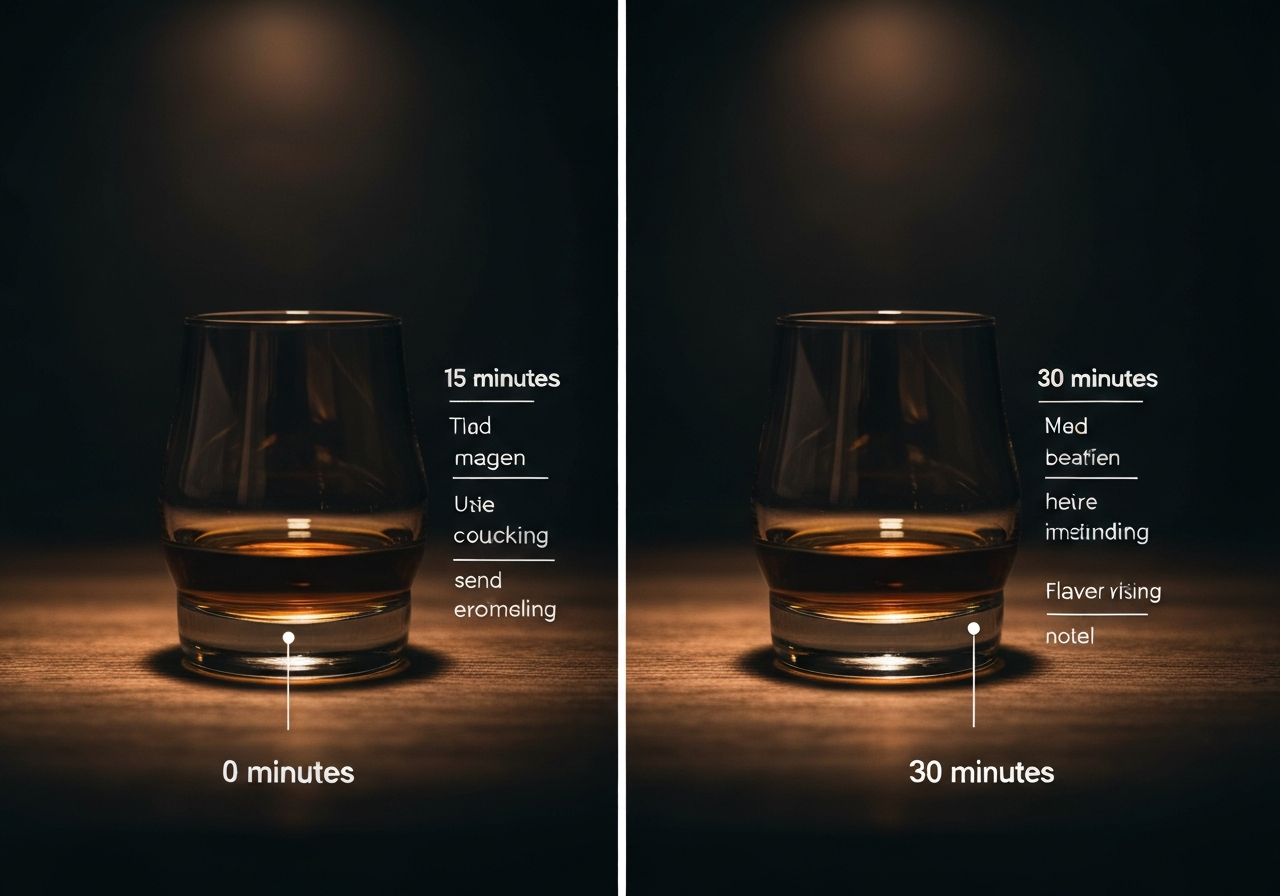
If you're looking for practical whiskey tasting tips, there is one industry rule of thumb that has stood the test of time: "A minute for every year." The idea is simple: for every year the whiskey spent maturing in a wooden cask, you should give it at least one minute to rest in the glass before your first sip. If you’re drinking a 12-year-old malt, give it 12 minutes. If it’s a 25-year-old rarity, wait nearly half an hour.
Why does this work? Older whiskies have spent decades absorbing tannins and lignins from the oak. These compounds can be quite restrictive and tightly wound. After 20+ years in a dark warehouse, the spirit is effectively in a deep slumber. It takes time for those heavy wood influences to step aside and let the fruit and grain notes "awaken." If you rush an old whiskey, you’re often just tasting the "outer shell" of the cask influence rather than the heart of the spirit.
Of course, there are always exceptions. Some young, vibrant, peat-heavy whiskies (think Octomore, Ardbeg Wee Beastie, or young Laphroaig) are prized for their aggressive, "punchy" nature. If you let a young, high-peat dram lag for 45 minutes, you might find it loses its "spark" or "edge," becoming a bit too mellow or flabby. For these, the "minute per year" rule might be too long. You want to catch them while they’re still shouting.
To really master this, I recommend using a watch or a timer. Pour your dram and take a quick "introductory" sniff at minute one. Then, set a timer for 10, 20, and 30 minutes. You’ll be amazed at how the profile shifts. To make the eventual reveal even more intense, use the "covered glass" technique. Place a watch glass or even a clean coaster over your Glencairn. This traps the evolving aromatic molecules while allowing the chemistry to happen underneath. When you finally lift the lid after 15 minutes, the concentrated "aroma bomb" that hits you is a completely different experience than if the glass had been left open to the entire room.
Vessel Dynamics: How Glassware Influences the Lag Rate
Not all glasses are created equal when it comes to whiskey lagging. The geometry of your vessel dictates the rate of ethanol evaporation and the concentration of aromas. The glencairn glass science is based on a specific "chimney" design. The wide bowl allows for a decent surface area for aeration, while the tapered neck concentrates the escaping aromas, making them easier for your nose to detect. This makes it an excellent "all-rounder" for watching a whiskey evolve.
However, if you compare a Glencairn to a traditional Copita (the tulip-shaped glass often used by blenders), you’ll notice the Copita often has a narrower opening. This slows down the "lagging" process slightly but provides an even more focused beam of aroma. On the other end of the spectrum is the Norlan glass, which uses a double-walled design and a specially engineered interior to agitate the whiskey and speed up aeration. Then there’s the wide-bottomed tumbler or "rocks glass." Because these have a massive surface area and no tapered neck, the whiskey "fades" very quickly. It's great for drinking, but terrible for opening up whiskey for a deep tasting session.
The thermal mass of the glass also matters. A heavy, thick crystal glass will hold its temperature longer. If the glass is cold, it will dissipate the energy that aromatic molecules need to escape the liquid. This is why many tasters prefer "hand-warming" their glass. By cupping the bowl in your palm, you are manually increasing the temperature, providing the kinetic energy needed to speed up the lagging process for a stubborn or "tightly-wound" dram. You are essentially acting as a human catalyst for the whiskey's evolution.
One final tip on glassware: beware of "glass fatigue." If you’ve been nosing the same glass for an hour, the crystal itself can sometimes develop a residual scent of the initial "ethanol hit" or heavy oils. Occasionally, it’s worth pouring your "lagged" whiskey into a fresh, clean glass to see if the profile clarifies even further. It sounds obsessive, but when you’re dealing with a world-class spirit, these small details make the difference between a good drink and a religious experience.
Style Specifics: Peat, Sherry, and Bourbon Evolutions
The way a whiskey "lags" is heavily dependent on how it was aged. Sherry Cask Lagging is perhaps the most rewarding. These whiskies are often loaded with heavy, dark notes: raisins, dates, balsamic vinegar, and dark chocolate. When first poured, they can often smell a bit "sulfuric" or overly "oaky." However, after 15 to 20 minutes, those heavier compounds settle, and the bright, dried-fruit notes begin to emerge. It’s like a curtain being pulled back on a stage; the initial "bite" recedes to reveal a lush, velvet-like sweetness.
Then there is the "Peat Paradox." Heavily peated whiskies undergo a fascinating transformation. Initially, a fresh pour of an Islay malt might smell like an acrid, "wet campfire" or a burning rubber tire. But give it air, and the smoke often transforms. It becomes "medicinal," with notes of TCP and iodine, or it might turn "sweet," revealing a creamy vanilla or briny seaweed character. This is why many peat-heads actually prefer their bottles when they are half-empty; the "lagging" has already begun in the bottle, softening the blow of the smoke and allowing the distillery character to shine through.
Bourbon and Virgin Oak whiskies present a different challenge. Because American whiskey is aged in new charred oak, it is incredibly high in tannins. These tannins can create a "sawdust" or "dry paper" sensation on the palate if the whiskey is drunk too quickly. Whiskey lagging helps to soften these tannic edges. As the spirit breathes, the "sawdust" notes often evolve into rich caramel, butterscotch, and toasted marshmallow. If you’ve ever found a bourbon to be too "spicy" or "hot," give it ten minutes in the glass. You’ll be shocked at how much it rounds out.
Cask strength whiskies (anything above 55% ABV) are the true "lagging" champions. These "monsters" almost always require patience. Without the addition of water, the high alcohol content acts as a physical barrier to flavor. If you're tasting a cask-strength Springbank, for example—known for its industrial "funk" and oily texture—you might find that a freshly opened bottle smells like a damp garage. But let that glass sit, or perhaps add a single drop of water to break the surface tension, and that "funk" transforms into an incredibly complex mix of tropical fruit, salt, and earth. Patience is the only way to get past the initial burn of a high-ABV dram.
The Sensory Journey: Conducting a Time-Lapse Tasting
To truly understand how to taste scotch and appreciate its evolution, I encourage you to try a "Time-Lapse" tasting. Instead of drinking your pour in five minutes, turn it into a 45-minute journey. Start with a 2-ounce pour in a Glencairn glass. This is the perfect volume to allow for significant air contact without the liquid disappearing too fast.
The "First Impression" (0-2 minutes) is all about the structure. Don’t look for hidden notes yet. Just identify the primary pillars: How strong is the alcohol? Is the wood prominent? Is it grainy or fruity? This is the "raw" state of the whiskey. It’s the "before" picture. At this stage, your palate is just getting calibrated. Take tiny sips—just enough to coat your tongue.
The "Heart of the Dram" (10-15 minutes) is when things get interesting. By now, the aggressive ethanol vapors have dissipated. You should start to see secondary notes emerge. If it’s a Highland malt, you might suddenly smell heather or honey. If it’s a Speyside, the apples and pears will start to ripen. This is the stage where the whiskey is most balanced. I like to use a "flavor wheel" during this stage. Map the movement of the notes—are they moving from the "center" (basic wood/alcohol) toward the "edges" (complex spices/tertiary fruits)?
The "Deep Dive" (30+ minutes) is where you uncover the "rancio" or the complex earthiness. This is especially true for older whiskies. After half an hour, the heaviest oils have finally become volatile. You might find notes of old leather, tobacco, forest floor, or dried mushrooms. These are the "soul" of the whiskey, the notes that only appear with significant whiskey lagging. Finally, try the "Empty Glass" test. Ten minutes after you’ve finished the liquid, smell the glass again. The water and alcohol are gone, leaving only the concentrated oils stuck to the crystal. Often, the best smell of the entire night is the scent of a glass that has been empty for fifteen minutes.
Mastering the Environment: External Factors in Flavor Evolution
While we focus a lot on what’s inside the glass, the world outside the glass matters just as much for whiskey flavor evolution. Humidity is a huge factor. In very dry air, alcohol and water evaporate much faster. This can lead to a more "aggressive" lagging experience, where the whiskey can actually "tire out" or become flat more quickly than usual. If you’re in a humid environment, the process is slower and more controlled.
Then there’s the "High Altitude" factor. If you’ve ever noticed that whiskey tastes "tighter" or more "closed-off" on an airplane, you’re not imagining it. Barometric pressure affects how aromatic molecules move. In high-altitude cities like Denver, or in a pressurized airplane cabin, the lower pressure means that the "lagging" happens differently. The whiskey doesn't "bloom" as easily as it does at sea level. This is why "airplane bottles" often taste like nothing but fire and wood; the environment is actively working against the spirit's ability to open up.
We also have to account for "palate fatigue." Sometimes, it’s not the whiskey that’s lagging—it’s your senses. If you’ve been smelling the same glass for twenty minutes, your nose will naturally stop "detecting" certain molecules. This is a survival mechanism called olfactory adaptation. To combat this, use the "Reset" technique. Smell something neutral, like a jar of coffee beans, or even the scent of your own clean skin (the back of your hand). This "recalibrates" your nose, allowing you to experience the next stage of the whiskey’s evolution with fresh eyes (or a fresh nose).
Finally, be mindful of background aromas. If you have a scented candle burning, or if someone is cooking a spicy curry in the next room, those volatile molecules will compete with your whiskey. They can artificially mask the delicate changes happening in your glass. When you’re doing a serious tasting to observe whiskey lagging, try to find a "sensory neutral" space. The more you control the environment, the more clearly you’ll see the whiskey’s true face.
Conclusion: The Art of Slow Drinking
In a world that is increasingly obsessed with speed and instant gratification, whiskey offers us a rare opportunity to slow down. Embracing whiskey lagging isn't just about getting "better" flavor out of a bottle; it’s about a philosophical shift. When you allow a dram to sit and evolve, you move from simply "consuming" a drink to "conversing" with a spirit. You are giving the liquid the respect it deserves, considering it took years—sometimes decades—to reach your glass.
By understanding the science of aeration and the importance of patience, you also get better value for your money. If you drink a $150 bottle of scotch in five-minute increments, you’re only experiencing about 40% of what that bottle has to offer. By letting it "lag," you unlock the full spectrum of its potential. You find the "hidden" notes that make a premium bottle worth the price tag.
So, here is my final recommendation for your next dram: Pour it. Swirl it once. Then, walk away. Set a timer for 15 minutes and go do something else—read a chapter of a book, listen to a record, or just watch the world go by. When you return to that glass, you won't just be drinking a whiskey; you’ll be meeting the spirit as it was truly intended to be seen. Remember, the best things in the whiskey world—from the slow growth of the oak tree to the long slumber in the warehouse—cannot be rushed. Why should the final moments in your glass be any different? Happy (slow) tasting!