Whiskey 'Proof' vs. ABV: Decoding Alcohol Content
Understand the difference between proof and ABV and what it means for your dram.
The Label Language: Why Alcohol Metrics Matter
If you have ever stood in the whiskey aisle of your local liquor store, staring at a wall of amber-hued glass, you know that whiskey labels are more than just pretty designs. They are dense with data. Amidst the romantic tales of limestone water and family legacies, there are two numbers that stand out above all others: Alcohol By Volume (ABV) and Proof. When we sit down for a session with the DramNote app, these are often the first metrics we record, and for good reason. They dictate the very essence of the sensory experience you are about to have.
The relationship between whiskey proof vs abv is the primary technical specification for any consumer. It isn't just about how quickly a spirit might get you buzzed; it’s about the "burn" versus the "flavor." Ethanol is a powerful substance. It is the engine that carries the aromatic compounds of the grain and the wood to your olfactory system. When you uncork a bottle, the concentration of that ethanol determines the texture, the weight on your palate, and the intensity of the aromatics. Understanding these numbers is essential for gauging the value of your purchase. If you buy a bottle at 50% ABV, you are essentially getting significantly more spirit—and less added water—than a bottle sitting at the industry minimum of 40% ABV. In a very literal sense, higher alcohol content means you are buying a more concentrated product.
Alcohol By Volume is the global gold standard. It represents the percentage of the total liquid volume that is pure ethanol, measured at a standardized temperature of 20°C (68°F). However, particularly in the United States, "Proof" remains a beloved secondary metric. It feels more traditional, more "whiskey," and often serves a marketing role that speaks to a brand’s heritage. Whether you are looking for a gentle sipper or a high-octane powerhouse, these figures are your roadmap. They tell you how much dilution the whiskey can handle before it falls apart and how much "heat" you should expect on that first sip. In this guide, we’re going to decode these numbers so you can approach your next dram with total confidence.
The Explosive Origins: The 'Gunpowder' History of Proof
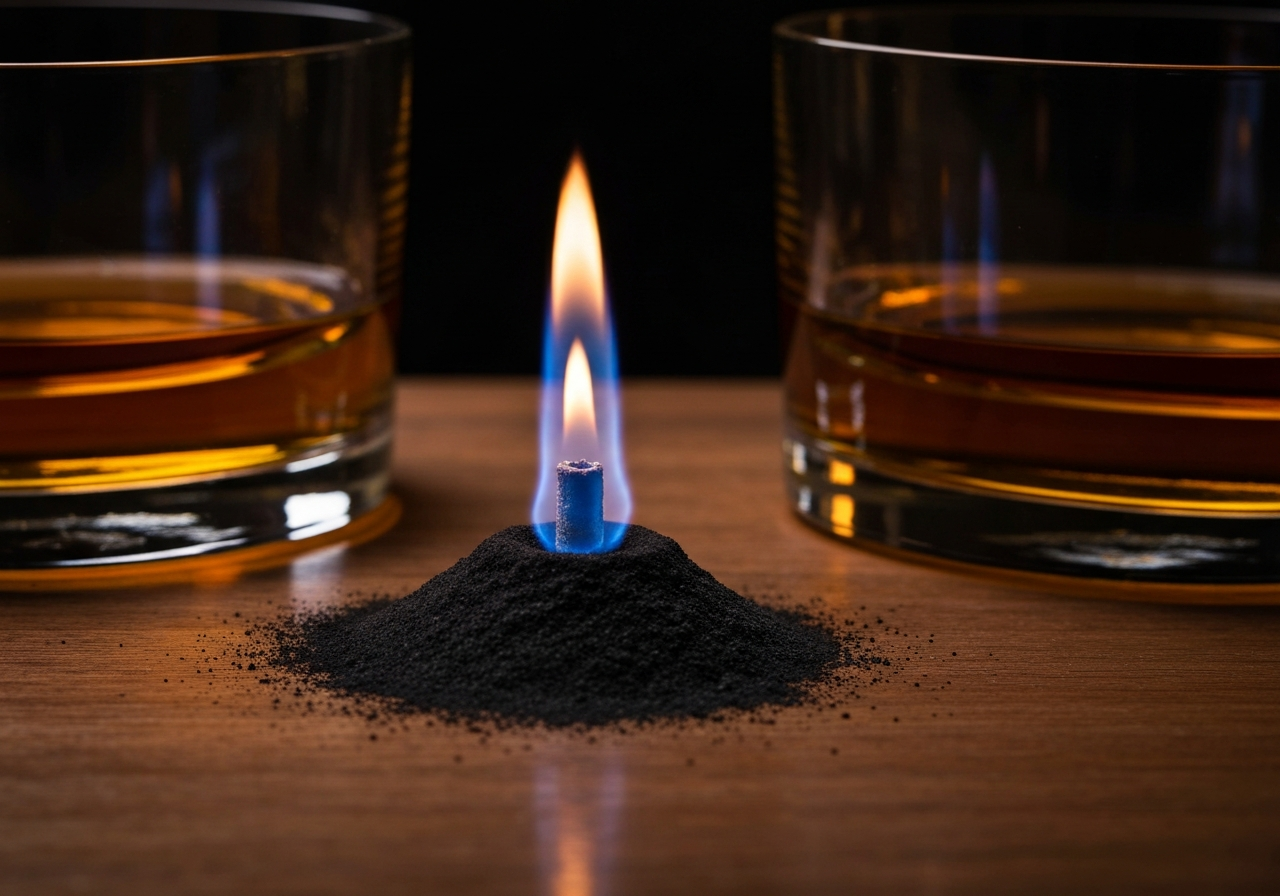
To understand why we use the word "proof" today, we have to travel back to 16th-century England. Long before the invention of precision digital density meters, the government needed a way to tax spirits based on their potency. The problem was that they didn't have a reliable way to measure it. Tax collectors and sailors relied on a method that was as dangerous as it was creative: the gunpowder test.
A "proof" test involved taking a small pellet of gunpowder and soaking it in the spirit being tested. A flame was then applied to the wet powder. If the gunpowder failed to ignite, the spirit was considered "under-proof"—it contained too much water, which dampened the powder and prevented combustion. However, if the gunpowder still ignited despite being soaked, it was "proven" that the spirit contained a significant amount of alcohol. If the powder exploded or flared up violently, the spirit was "over-proof."
The specific threshold for this ignition was eventually determined to be roughly 57.15% ABV. This became the British definition of "100 degrees proof."
This crude method created a system that lasted for centuries. It was a practical, "boots-on-the-ground" way for a sailor to know if his rum ration had been watered down or for a merchant to know if he was being cheated. In 1816, the British government replaced the gunpowder test with the Sikes Hydrometer, a much more scientific tool that measured the specific gravity of the liquid. Even though the science changed, the terminology stuck. Drinkers were used to the idea of "proof," and the government didn't want to confuse the public by switching to a pure percentage system immediately. It’s a classic example of how history and tradition continue to shape the modern whiskey world. While we no longer need to risk an explosion to check our bottle’s potency, the legacy of those gunpowder-soaked pellets lives on every time we see the word "proof" on a label.
The Science of ABV: The International Standard
While proof has the history, alcohol by volume has the precision. ABV is the legal requirement for spirit labeling in almost every country on Earth. It is overseen by the International Organization of Legal Metrology (OIML), ensuring that a 40% ABV whiskey in Tokyo is the exact same strength as a 40% ABV whiskey in Tennessee. But measuring alcohol is more complicated than just looking at a beaker, because alcohol is a bit of a shapeshifter.
The measurement of ABV is highly sensitive to temperature. Alcohol expands and contracts at a different rate than water. If you measure the volume of a spirit when it is hot and again when it is cold, you will get different results. This is why all official ABV measurements are standardized at a specific temperature—usually 20°C (68°F) or 60°F (15.56°C) depending on the local jurisdiction. Modern distilleries use high-precision digital density meters that can determine the ethanol content to several decimal places by measuring the oscillation of a glass tube containing the liquid. It’s a far cry from the gunpowder days.
You might notice that a vast majority of "standard" whiskeys sit at exactly 40% ABV. This isn't a coincidence. In many jurisdictions, including under the Tax and Trade Bureau (TTB) in the U.S. and the Scotch Whisky Association (SWA) in Scotland, 40% is the legal "bottling floor." Anything lower than that cannot legally be called "whiskey." From a chemical perspective, ethanol acts as a solvent for flavor compounds known as congeners. These are the oils, esters, and phenols that give whiskey its flavor. A higher ABV liquid can physically carry more of these aromatic oils than a lower ABV one. This is why many enthusiasts prefer whiskeys at 46% ABV or higher; it’s the point where the spirit can remain un-chill-filtered and retain a richer, more oily mouthfeel.
American Proof vs. British Proof: A Tale of Two Systems
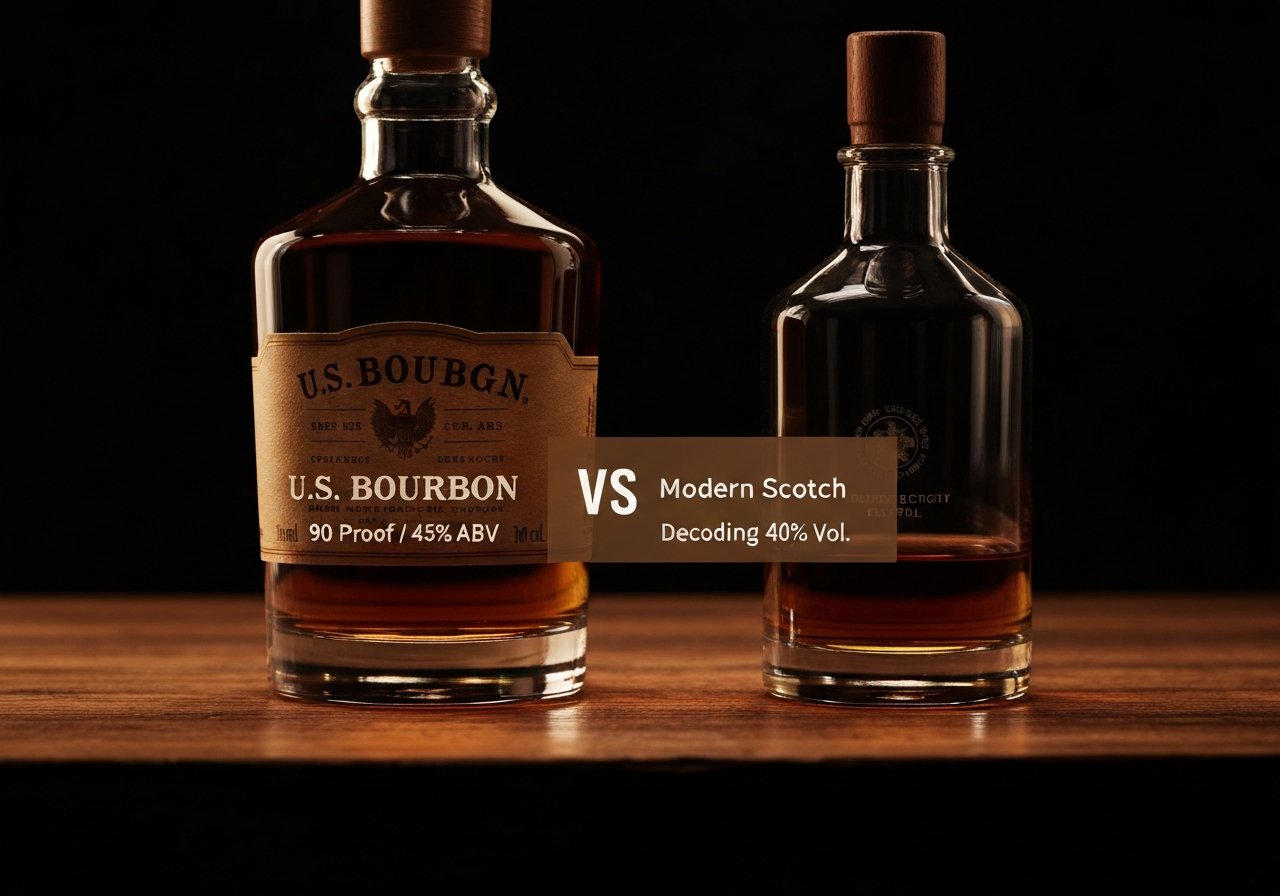
One of the most confusing aspects of whiskey collecting, especially for those who hunt for vintage bottles, is that "proof" hasn't always meant the same thing in different parts of the world. In the United States, the system is wonderfully simple, thanks to the TTB. To calculate whiskey proof in America, you simply double the ABV. A whiskey that is 50% ABV is 100 proof. A whiskey that is 60% ABV is 120 proof. It’s a clean, linear scale that is easy for any consumer to understand.
However, the British "Imperial" proof system was much more complex. Based on that original gunpowder threshold, British proof was calculated where 100 proof equaled approximately 57.06% ABV. This was based on the specific gravity of the spirit compared to distilled water. Because of this, the conversion wasn't a simple doubling. To convert British proof to ABV, you had to multiply the proof by 0.5706. This leads to some very confusing scenarios for collectors of "dusty" bottles.
- A vintage British bottle labeled "70° Proof" is actually only 40% ABV.
- A modern American bottle labeled "70 Proof" would be a mere 35% ABV (which isn't legally whiskey).
- A British bottle at "100° Proof" is significantly stronger (57% ABV) than an American bottle at "100 Proof" (50% ABV).
The United Kingdom officially abandoned this confusing system in 1980 to align with European Union standards, moving entirely to the ABV percentage. However, you will still see the term "proof" used in marketing or on "proof strength" gin and whiskey in the UK, which often harks back to that 57% mark. If you are ever at an auction and see an old bottle of Scotch from the 1960s labeled "75° Proof," don't assume it’s a high-octane monster—it’s likely a standard 43% ABV bottling.
The 'Bottled-in-Bond' Legacy and 100 Proof
In the world of American whiskey, there is one specific number that carries more weight than any other: 100. The bottled in bond definition is rooted in one of the most important pieces of consumer protection legislation in U.S. history—the Bottled-in-Bond Act of 1897. Before this law, the whiskey market was like the Wild West. Rectifiers would take neutral grain spirit, color it with tobacco spit or iodine, add wood chips for "aging," and sell it as premium bourbon. It was often dangerous and almost always a scam.
To provide a guarantee of quality, the government created the "Bonded" designation. To be labeled Bottled-in-Bond, a whiskey must be the product of one distillation season, by one distiller, at one distillery. It must be aged in a federally bonded warehouse for at least four years and, crucially, it must be bottled at exactly 100 proof bourbon (50% ABV). This 100-proof requirement was a hallmark of quality. It was strong enough to prove it hadn't been overly diluted, but approachable enough to drink neat.
Even today, Bonded whiskeys are a favorite among enthusiasts. Because they are bottled at 50% ABV, they usually skip the process of chill-filtration. Chill-filtration is a cosmetic process where the whiskey is cooled and passed through a fine filter to remove fatty acids and esters that might cause the spirit to turn cloudy if it gets cold. However, those fats and esters provide the mouthfeel and flavor. At 50% ABV, the alcohol acts as a natural stabilizer, keeping those oils in suspension without the need for heavy filtering. For many, 100 proof remains the "goldilocks zone"—the perfect balance of strength, texture, and historical integrity.
Cask Strength and the 'Hazmat' Whiskey Trend
If 40% is the floor and 50% is the classic standard, then cask strength is the ceiling. The cask strength meaning is simple: it is whiskey bottled exactly as it came out of the barrel, with no water added. Depending on the age of the whiskey and the climate where it was stored, these bottles typically range from 52% to 68% ABV. In the modern whiskey community, there is a growing obsession with these high-proof powerhouses.
There is even a sub-category known as "Hazmat" whiskey. This refers to any spirit that is over 140 proof (70% ABV). The name comes from the fact that the FAA and most commercial airlines prohibit these bottles from being carried on planes because they are considered a flammability hazard. While drinking something that the airline considers a hazardous material might sound intimidating, enthusiasts argue that these bottles offer the "purest" expression of a distillery's character. When you buy a cask strength bottle, you are the one in control. You can choose to drink it neat (if your palate can handle the heat) or use a whiskey dilution guide to bring it down to your preferred strength.
One fascinating aspect of high-proof whiskey is how the climate affects the proof during aging. This is the battle of the "Angel’s Share." In a humid environment like Scotland, water evaporates more slowly than alcohol, meaning the ABV of a scotch will actually drop over time as it sits in the barrel. In the hot, dry climate of Kentucky or Texas, water evaporates much faster than alcohol. This causes the concentration of ethanol to rise, leading to those massive 130+ proof bourbons that have become so popular. Economically, cask strength also makes sense. If you buy a 60% ABV bottle, you are getting roughly 50% more actual spirit than a 40% ABV bottle of the same size. It often justifies the higher price tag because that one bottle can go much further once you start adding water at home.
How Alcohol Content Affects Flavor Perception
Understanding the science of flavor is where the whiskey proof vs abv debate gets really interesting. Ethanol itself has a flavor—it’s generally sweet but carries a sharp heat. However, its primary job is to be a vehicle. It carries aromatic molecules to your nose and tongue. But there is a tipping point. If the alcohol content is too high, it can actually act as an anesthetic, numbing your taste buds and preventing you from tasting anything but the "burn."
Many blenders and connoisseurs talk about the "Sweet Spot," which many believe is 46% ABV. This is the point where the whiskey is strong enough to avoid chill-filtration and carry a robust array of flavors, but not so strong that the ethanol dominates the experience. When you get into the 55%+ range, the intensity can be overwhelming for a neat pour. This is where the "Hydrophobic Effect" comes into play. Ethanol molecules have a "water-hating" (hydrophobic) end and a "water-loving" (hydrophilic) end. Flavor molecules like esters tend to hang out near the ethanol.
When you add a drop of water to a high-proof whiskey, it creates a minor chemical chain reaction. The water forces the ethanol and its attached flavor compounds to the surface of the liquid. The surface tension breaks, and those aromatic molecules are released into the air—a process we call "opening up" the dram. This is why a cask strength whiskey can taste completely different with just three drops of water. At 40% ABV, the whiskey is already "pre-opened" by the distillery, meaning those delicate top notes might have already been released and dissipated before you even pop the cork. High-proof whiskey allows you to experience that release for yourself.
The Economics of Alcohol: Taxes and Dilution
Behind every bottle of whiskey is a team of accountants and tax lawyers. Distilleries are not taxed based on the total amount of liquid they produce, but rather on the amount of pure alcohol they produce. In the United States, this is calculated using a metric called "Proof Gallons." A proof gallon is one liquid gallon of spirits that is 50% alcohol (100 proof). If a distillery produces a gallon of 150-proof spirit, they are taxed for 1.5 proof gallons.
This creates a massive financial incentive for the "standard" 80-proof (40% ABV) bottling. By diluting their aged spirit from the barrel strength down to 40% ABV, a distillery is essentially "stretching" their taxable spirit with water. This maximizes the number of bottles they can yield from a single barrel while minimizing the tax burden per bottle. This is why 80-proof whiskey is the most affordable on the shelf; it represents the most efficient way to get a product to market.
On the flip side, luxury brands often use higher ABV as a "premiumization" tactic. By bottling at 48% or 52%, they are signaling to the consumer that they haven't "stretched" the product as much. They are willing to pay a higher tax per bottle and yield fewer bottles per barrel to provide a more "authentic" and "undiluted" experience. As a savvy consumer, you can use this knowledge to calculate the "price per unit of alcohol." While a $60 bottle of cask strength whiskey seems more expensive than a $40 bottle of 80-proof whiskey, the cask strength bottle might actually be a better value once you account for the extra 20% of actual spirit you are receiving.
Practical Tips: Navigating Proof When You Drink
So, how do you apply all this knowledge the next time you pour a glass? First, don't be afraid to calculate whiskey proof adjustments yourself. If you have a 60% ABV (120 proof) whiskey and you want to bring it down to a more manageable 46% ABV (92 proof), you can use a simple formula: (Current Volume x Current ABV) / Target ABV = New Total Volume. If you have a 2oz pour of 60% whiskey, adding about 0.6oz of water will bring it down to 46%. It’s a great way to explore the different "layers" of a single bottle.
However, keep in mind that "proofing down" at home is a little different than what they do at the distillery. Distilleries use demineralized, deionized water to ensure no off-flavors are introduced, and they often allow the spirit to "marry" for several weeks after dilution to let the molecules stabilize. When you add water at home, the reaction is instant and can be a bit more turbulent on the palate. Also, consider the impact of ice. A single large ice sphere will dilute a 100-proof whiskey to roughly 60-proof over the course of 15 minutes. If you start with an 80-proof whiskey and add ice, you’ll quickly end up with a watery, flavorless mess.
Finally, use your eyes. Have you ever noticed the "legs" or "tears" that crawl down the side of your glass after you swirl it? That is the Marangoni effect, caused by the difference in surface tension between alcohol and water. Higher ABV whiskeys will have slower, thicker, and more persistent legs. It’s a visual indicator of the oil and alcohol concentration you’re about to enjoy. And always remember: proof is a measure of intensity, not just quality. A 60% ABV pour is essentially 1.5 times the alcohol of a standard pour. If you’re used to two glasses of standard bourbon, a single glass of "Hazmat" whiskey will put you in the same spot. Sip slowly, enjoy the complexity, and let the numbers on the label guide your journey through the world of fine spirits.