Whiskey 'Proof' vs. ABV: Decoding Alcohol Content Simply
Understand what 'proof' and ABV really mean when choosing your first dram.
The Initial Sip: Why Alcohol Content is More Than Just a Number
We’ve all been there. You sit down at a dimly lit bar, feeling a bit adventurous, and order a neat whiskey. The glass arrives, you take a healthy sip, and—whoosh—your throat feels like it’s been introduced to a blowtorch. This "whiskey burn" is the primary reason many newcomers walk away from the spirit, convinced that higher alcohol content simply equals lower quality or a "harsh" drink. At DramNote, we hear this all the time from whiskey for beginners enthusiasts: "It just tastes like fire."
But here’s the secret the pros know: ethanol isn’t just there to give you a buzz. In the world of fine spirits, alcohol is a vital flavor carrier. Think of it as a solvent. Those beautiful notes of ripe green apple, toasted cinnamon, and rich vanilla don’t just happen; they are held in suspension by the alcohol. Specifically, ethanol holds the essential oils—the esters and aldehydes—that the whiskey pulled from the grain and the oak barrel during its long sleep. Without that whiskey alcohol content, your favorite dram would be little more than flavored water with the texture of cold tea.
The intimidation factor is real, though. When you pick up a bottle and see technical terms like "Alcohol by Volume" or a high "Proof" number, it can feel like you’re reading a chemistry textbook instead of a menu for relaxation. This psychological barrier often stops people from trying premium expressions that might actually be smoother than the cheap stuff, despite having more alcohol. Our goal today is to help you transition from drinking whiskey for the effect to tasting whiskey for the craft. By understanding the intensity of the liquid in your glass, you can move past the "heat" and start finding the actual flavor. In this guide, we’ll break down the history of these measurements, how to do the math in your head, and why that "burn" might actually be your best friend once you know how to manage it.
Decoding ABV: The Global Standard for Spirits
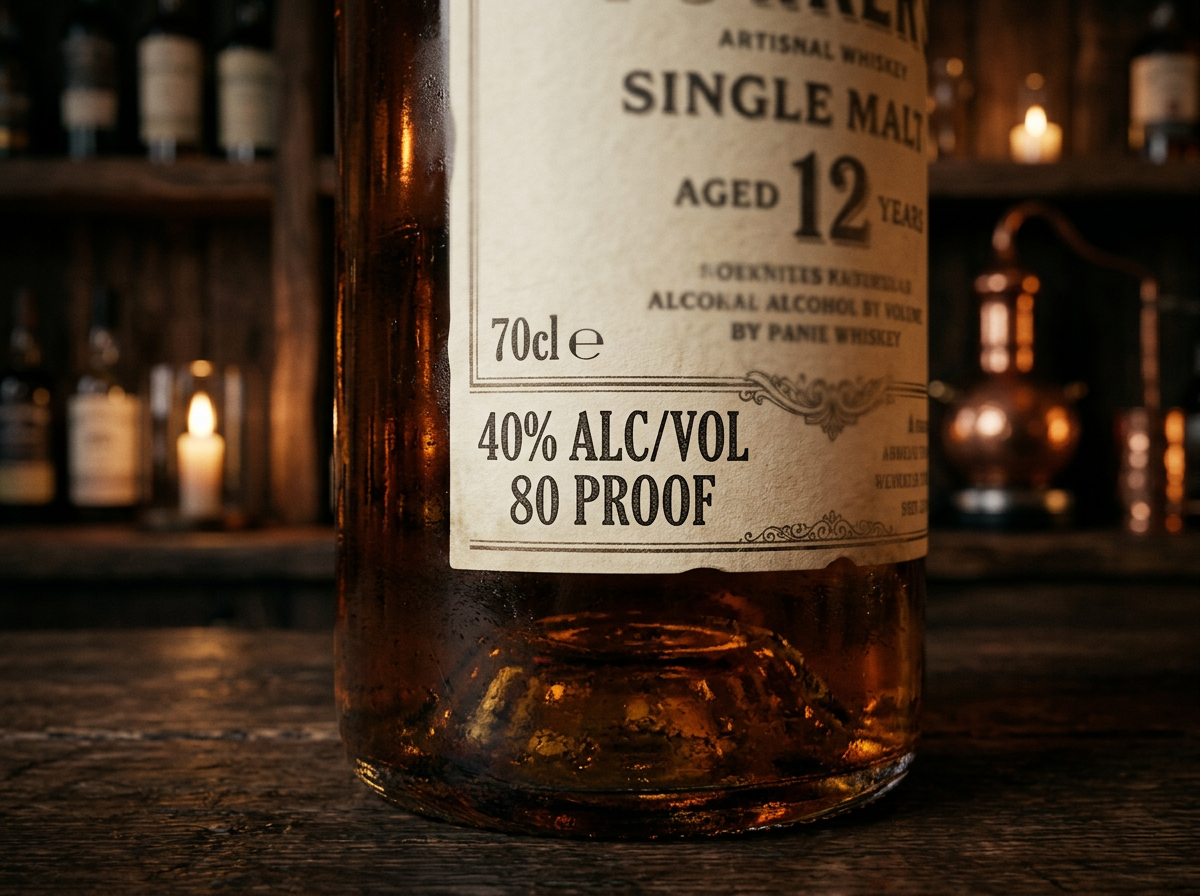
When you look at a whiskey label today, the most prominent number you’ll see is the ABV. But what is alcohol by volume explained in plain English? Simply put, ABV is the percentage of the total volume of liquid that is pure ethanol. This measurement is taken at a standard temperature—usually 60°F (15.5°C)—because alcohol expands and contracts with heat. If you’re drinking a bottle that says 40% ABV, it means that in that 750ml bottle, exactly 300ml is pure alcohol, and the rest is mostly water, with a tiny fraction of flavor-providing congeners.
There is a legal line in the sand for whiskey. In almost every major whiskey-producing region, including Scotland, Ireland, and the United States, a spirit must be bottled at a minimum of 40% ABV to legally be called "whiskey." Anything less, and it falls into the category of "spirit drink" or liqueur. This 40% threshold isn't arbitrary; it’s the point where the spirit retains enough structural integrity to hold onto its flavor profile while remaining palatable for the average consumer.
To ensure this precision, distillers don't just guess. They use high-precision tools called hydrometers and follow the "Gay-Lussac" scale, named after the French chemist Joseph Louis Gay-Lussac. This scientific rigor is essential for two reasons: tax and quality. Governments tax spirits based on their alcohol content, so being off by even half a percent can result in massive fines or lost revenue. For the consumer, ABV provides a modern, universal standard. Whether you are buying a bottle in Tokyo, London, or Kentucky, "40% ABV" means the exact same thing.
Think of the ABV as your "water-to-spirit" ratio. When you see a standard 40% bottle, visualize it as 40 parts concentrated flavor and 60 parts "dilution." As we move higher up the scale to 46% or 50%, that ratio shifts, giving you more "oomph" and a denser concentration of the oils that provide that creamy mouthfeel we all crave in a good dram.
The Gunpowder Test: The Fascinating History of 'Proof'
While ABV is the scientific standard, the word "Proof" carries a lot more romantic, and slightly dangerous, history. The term dates back to 16th-century England and was born out of a very practical need: ensuring sailors weren't being ripped off. In the British Royal Navy, sailors were given a daily ration of rum. However, unscrupulous purveyors would often water down the rum to save money. To "prove" the strength of their spirit, sailors would mix a bit of the rum with a pinch of gunpowder and attempt to light it with a flame.
If the gunpowder flared or exploded, the spirit was "proof"—it contained enough alcohol to support combustion. If it didn’t light, it was "under proof," meaning it had too much water. If it exploded too violently, it was "over proof." Eventually, it was determined that the point at which gunpowder would consistently ignite was exactly 57.1% ABV. In the original British system, 57.1% ABV became the "100 proof" benchmark. If that sounds confusing to you, don't worry—it was confusing for everyone back then, too.
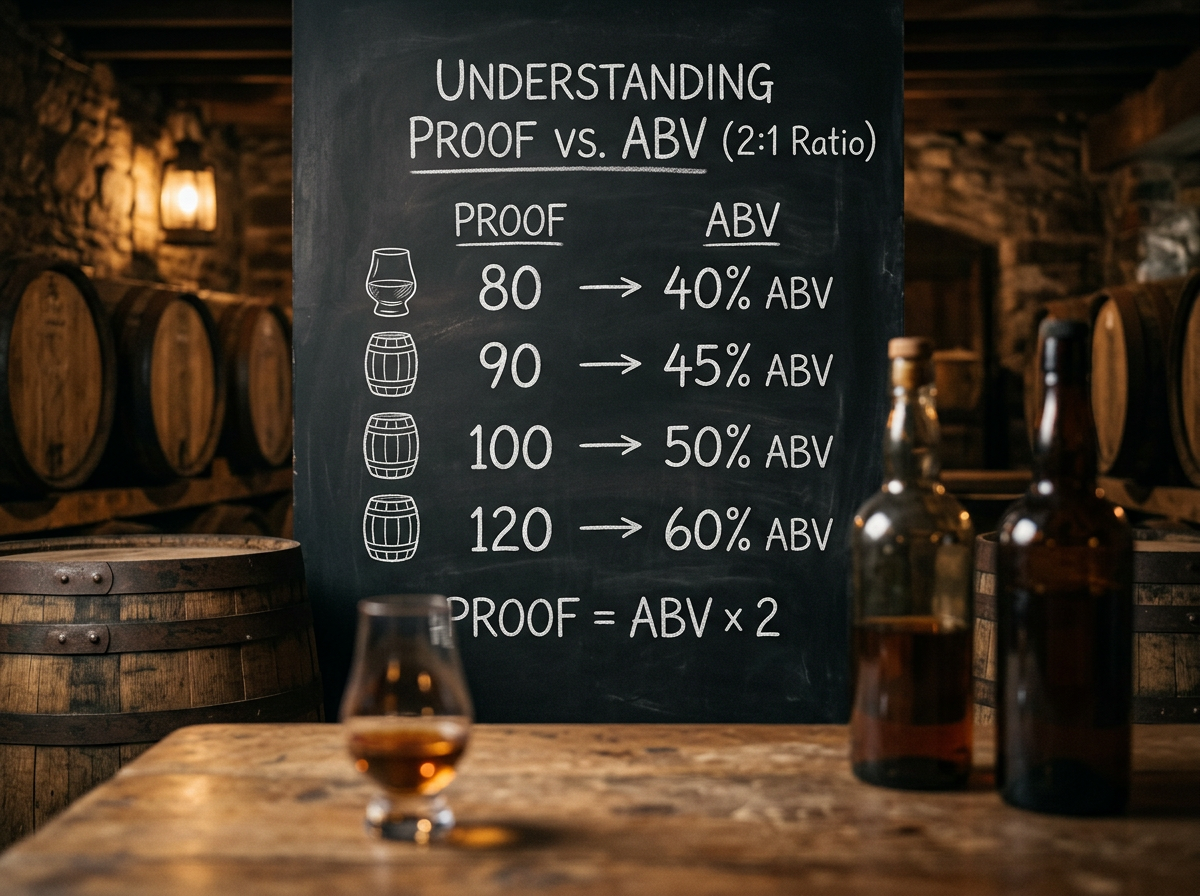
As the whiskey industry moved into the 18th and 19th centuries, the American system decided to simplify things. Instead of the awkward 57.1% calculation, the United States adopted a 2:1 ratio. In the mid-1800s, the U.S. government established that "100 proof" would be exactly 50% alcohol by volume. This made the math much easier for distillers, tax collectors, and consumers alike. If a whiskey was 40% alcohol, it was 80 proof. If it was 50%, it was 100 proof.
For a long time, both systems co-existed, leading to massive confusion in international trade. A "100 proof" bottle from Scotland was much stronger than a "100 proof" bottle from America. Finally, in 1980, the United Kingdom officially transitioned to the ABV system to align with European Union regulations, largely leaving the "proof" terminology to the Americans. Today, when we talk about whiskey proof vs abv, we are almost always referring to the American 2:1 standard, a lingering legacy of a time when whiskey had to be flammable to be trusted.
Doing the Math: Converting Proof to ABV in Your Head
The good news for modern whiskey drinkers is that you don’t need a calculator to navigate the liquor store shelves. If you’re looking at an American whiskey, the "Divide by Two" rule is your best friend. Because the U.S. system is a direct 2:1 ratio, converting is effortless. If you see a bottle of Wild Turkey 101, you simply divide 101 by two to realize you’re drinking a 50.5% ABV spirit. If your favorite bourbon is 90 proof, it’s 45% ABV.
You might wonder: why do brands still use proof if ABV is the legal standard? A lot of it comes down to marketing psychology. "101 Proof" sounds much more powerful and evocative than "50.5%." The number 100 carries a connotation of perfection and strength. For a brand, being able to put a triple-digit number on the label suggests value—you’re getting more "spirit" for your dollar. It’s a way of signaling to the consumer that this bottle has some backbone.
For those new to the hobby, it helps to categorize whiskeys by these benchmarks:
- The Standard (80 Proof / 40% ABV): This is the baseline. It’s light, easy to drink, and usually the most affordable.
- The Step-Up (90-94 Proof / 45-47% ABV): This is where many enthusiasts spend their time. It’s strong enough to hold flavor but hasn't reached the "aggressive" stage yet.
- The Bold (100 Proof / 50% ABV): This is the "Goldilocks" zone for many. It has a significant presence and stands up well to ice or mixers.
Precision matters, especially if you’re making cocktails at home. If you replace an 80-proof bourbon with a 110-proof bourbon in an Old Fashioned, you aren't just making it "stronger"; you are fundamentally changing the balance of the drink. The higher alcohol will cut through the sugar and bitters much more sharply, requiring you to perhaps add a touch more water or syrup to keep the flavors in harmony. Understanding this whiskey proof vs abv relationship allows you to be the master of your own glass.
The Flavor Spectrum: How High Proof Changes What You Taste
One of the most fascinating aspects of whiskey is the relationship between "heat" and sweetness. When you increase the alcohol content, you aren't just increasing the burn; you are also concentrating the wood sugars. Higher ABV whiskeys often have much more intense notes of caramel, toffee, and vanilla. This is because the alcohol acts as a magnifying glass for the characteristics the whiskey picked up from the barrel. However, there is a catch: the "Ethanol Shield."
When you nose a high-proof whiskey (anything over 50% ABV), your first reaction might be a stinging sensation in your nostrils. This is the ethanol vapor, and if you aren't careful, it can temporarily "blind" your sense of smell. To get past it, keep your mouth slightly open while sniffing. This allows the vapors to circulate rather than hitting your olfactory sensors like a freight train. Once you move past that shield, you’ll find that high-proof whiskeys have a much richer mouthfeel—often described as "chewy" or oily. This is because higher ABV whiskeys are often filtered less aggressively, retaining the fatty acid esters that provide texture.
Physiologically, your mouth reacts to high alcohol via the trigeminal nerve. This is the same nerve that reacts to the "heat" in a spicy chili pepper. There is a difference between "good heat" and "bad burn." Good heat feels like a warm hug in your chest (the "Kentucky Hug") and is followed by a burst of flavor. Bad burn is purely astringent, leaving your mouth feeling dry and bitter. Usually, high-quality, well-aged whiskey will provide the former, even at high proofs.
Don’t let this make you think that lower proof is "weak," though. Some of the most complex Scotch whiskies are bottled at 43% ABV. In this lower range, the "heat" is stripped away, allowing subtle floral, grassy, and delicate fruit notes to shine. These are flavors that might be completely overwhelmed by the intensity of a 120-proof bourbon. It’s all about what you’re in the mood for: the subtle nuances of a 40% dram or the high-octane flavor bomb of a 60% powerhouse.
Cask Strength and Barrel Proof: Whiskey in Its Purest Form
As you fall deeper down the whiskey rabbit hole, you’ll start seeing the terms "Cask Strength" or "Barrel Proof." This is the holy grail for many enthusiasts. By definition, what is cask strength whiskey? It is whiskey that has been bottled exactly as it came out of the barrel, with zero water added to dilute it. While standard whiskeys are "cut" with water to reach a consistent 40% or 45% ABV, cask strength bottles represent the raw, unadulterated state of the spirit.
The ABV of cask strength whiskey can vary wildly, typically falling between 52% and 66%, though some can go even higher. This number is influenced by the "Angel’s Share"—the portion of whiskey that evaporates through the porous oak staves during aging. In humid climates like Scotland, alcohol tends to evaporate faster than water, causing the ABV to drop over time. In hot, dry climates like Kentucky, water evaporates faster than alcohol, which can actually cause the ABV inside the barrel to increase as it ages. Tasting a barrel-proof bourbon is essentially tasting the climate and the history of that specific warehouse.
Why do people crave it? It’s the closest you can get to standing in a rickhouse with a Master Distiller and drinking straight from the wood. It puts the control entirely in your hands. When you buy a cask strength bottle, you are getting more actual whiskey and less "bottling water." This often justifies the higher price tag. You are buying the concentrate. From there, you can choose how to dilute whiskey yourself to find your personal "sweet spot."
Buying cask strength is also a lesson in value. If you buy a 60% ABV bottle and dilute it down to 40% in your glass, you are effectively getting 1.5 bottles worth of drinking whiskey for the price of one. It is the most honest expression of a distillery’s character, showing you exactly what the wood did to the grain without any interference from the bottling line.
The Gold Standard: Understanding Bottled-in-Bond (100 Proof)
If you see a green tax stamp or the words "Bottled-in-Bond" on a label, you are looking at a specific piece of American history. The Bottled-in-Bond Act of 1897 was actually the first consumer protection law in the United States, predating even the Pure Food and Drug Act. In the late 1800s, whiskey was a "wild west" industry. Rectifiers would take neutral grain spirit and add tobacco spit, iodine, or acid to make it look and taste like aged whiskey. It was dangerous and often deadly.
To combat this, the government created a set of strict requirements that a whiskey must meet to earn the "Bonded" label. The most important for our discussion today is the bottled in bond meaning regarding proof: it must be bottled at exactly 100 proof (50% ABV). Not 99, not 101. This ensured a consistent "punch" and quality for the consumer. Additionally, the whiskey must be the product of one distillation season, by one distiller, at one distillery, and aged in a federally bonded warehouse for at least four years.
For many experts, 100 proof is considered the "Gold Standard" for tasting a distillery’s true character. At 50% ABV, there is enough alcohol to carry a massive amount of flavor and provide a rich texture, but it isn't so high that it becomes difficult for the average palate to navigate. It is the perfect balance of strength and approachability.
Today, Bottled-in-Bond whiskeys are undergoing a massive revival. Bottles like Evan Williams White Label, Old Grand-Dad Bonded, and Rittenhouse Rye are beloved not just for their history, but because they offer high-quality, high-proof experiences at very affordable prices. They are the "benchmark" whiskeys that every beginner should try to understand what a well-structured, 100-proof spirit should feel like.
The Science of Dilution: Why a Drop of Water Opens the Door
There is a common misconception that adding water to whiskey is "cheating" or "disrespectful" to the distiller. In reality, science says the opposite. In 2017, a group of Swedish researchers published a study in the journal Scientific Reports regarding a molecule called guaiacol. Guaiacol is responsible for the smoky, peaty flavors in many whiskeys. The study found that at high alcohol concentrations, guaiacol stays "trapped" in the bulk of the liquid. However, when you add water and drop the ABV, those flavor molecules are pushed to the surface of the glass.
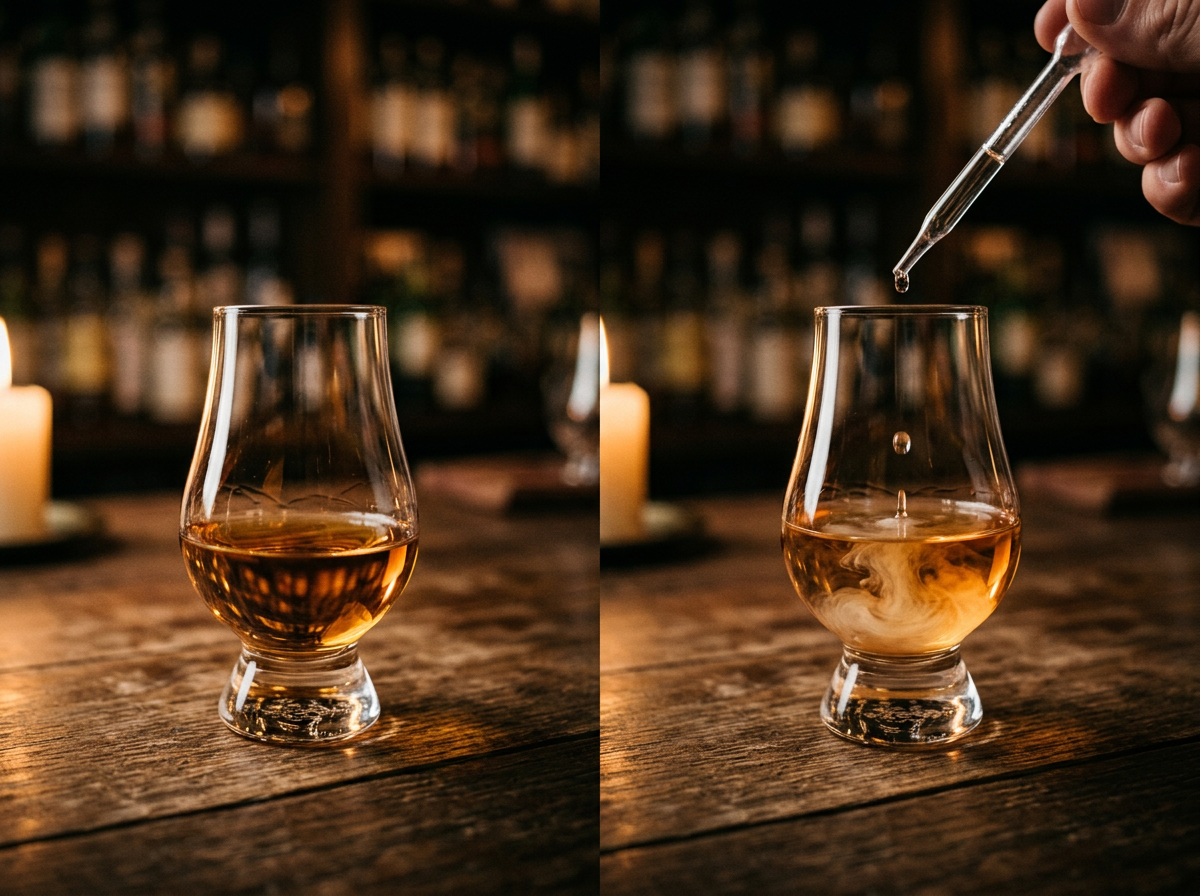
This is known as a "hydrophobic" reaction. When you add a few drops of water, it breaks the surface tension of the alcohol. This "opens up" the whiskey, releasing a bouquet of aromas that were previously suppressed by the ethanol. If you’ve ever added water to a whiskey and suddenly smelled flowers or fruit that weren't there before, you’ve witnessed this science in action. It’s like turning up the contrast on a photograph; the details become sharper.
The ritual of how to dilute whiskey is part of the fun. We always recommend tasting a whiskey neat first. Take a small sip, let your palate adjust to the ABV. Then, using a pipette or a small spoon, add exactly one or two drops of room-temperature water. Swirl the glass, wait a few seconds, and nose it again. You’ll be amazed at how the profile shifts. This is the best way to find your "proof of choice"—the specific ABV where a whiskey tastes best to you.
Another pro tip is the "Kentucky Chew." When tasting high-proof whiskey, take a small sip and move it around your mouth as if you are chewing it. This aerates the liquid and mixes it with your saliva, naturally diluting the spirit and mitigating the burn before you swallow. Just be careful not to "drown" the whiskey. If you add too much water, you’ll lose the structural integrity of the flavor, and the whiskey will taste thin and "flat." It’s much easier to add more water than it is to take it out!
Beginner’s Buying Guide: Choosing Your Proof by Palate
Walking into a liquor store can be overwhelming, so let’s simplify your next purchase based on your current palate. If you are brand new to spirits, look for the Entry Level (80-86 Proof). These bottles are designed to be smooth. Brands like Basil Hayden or standard Irish whiskeys like Jameson fall here. They are perfect for sipping neat while your tongue gets used to the sensation of alcohol.
If you want to start making cocktails, you need the Cocktail King (90-101 Proof) range. If you use an 80-proof whiskey in a drink with lemon juice and sugar, the whiskey will disappear. You need that extra ABV to ensure the "whiskey-ness" of the drink still stands up. This is where bottles like Buffalo Trace or Elijah Craig Small Batch shine. They have enough "oomph" to remind you that you’re drinking a whiskey cocktail.
For those ready to level up, look for the Flavor Explorer (107-115 Proof). This range is common for "wheated" bourbons (like Old Weller Antique) or high-rye expressions. These provide a massive intensity of flavor—think deep oak, heavy spice, and thick caramel—without being quite as intimidating as the truly high-test stuff. Finally, there is the "Hazmat" Category (140+ Proof). These are rare, ultra-high proof whiskeys that are technically flammable. They should be approached with extreme caution and almost always require dilution.
One final tip for the label-watchers: look for the term "Non-Chill Filtered." You will often see this on bottles with higher ABV (usually 46% and above). Chill filtration is a process that removes those fatty oils we mentioned earlier to prevent the whiskey from getting cloudy when cold. Whiskeys bottled at higher proofs don't need this process, meaning they retain more of their natural texture and "soul." If you see a high-proof, non-chill filtered bottle, you’re likely looking at a very high-quality product.
Conclusion: Your Journey Beyond the Label
At the end of the day, the numbers on the bottle are just tools to help you navigate your journey. Whiskey proof vs abv isn't a competition of strength; it’s a map of flavor intensity. Proof is a nod to our history—a legacy of gunpowder, sailors, and the fight for pure spirits. ABV is the scientific reality—a measurement of the "engine" that carries the flavors we love from the barrel to our glass.
There is no "right" way to enjoy whiskey, and there is certainly no "correct" proof. Some days you might want the gentle, floral embrace of an 80-proof Scotch, and other days you might want the roaring, spice-filled heat of a 125-proof barrel-strength bourbon. The beauty of this hobby is experimentation. Your palate will change over time; what feels like "fire" today might feel like "richness" six months from now.
To set yourself up for success, consider your glassware. A Glencairn glass, with its tulip shape, is specifically designed to help manage those alcohol fumes, funneling the aromas to your nose while letting the "heat" dissipate. It’s a game-changer for high-proof spirits. So, the next time you’re browsing the shelves or logging a dram on DramNote, take a second to look at that percentage. Challenge yourself to try it neat, then add that single drop of water, and watch the whiskey transform. Whiskey is a journey of discovery, and now that you’ve decoded the label, you’re ready to lead the way. Cheers!