Whiskey's Accidental Alchemy: Spirits Born from Error
Discover the surprising tales of whiskies that owe their existence to mistakes, miscalculations, and happy accidents.
The Myth of the Master: When Chaos Outshines Craft
In the world of fine spirits, we are often sold a very specific, polished image. We picture the Master Distiller as a sort of liquid alchemist, dressed in a pristine tweed waistcoat, standing in a quiet warehouse while golden light filters through a single window. In this romanticized vision, every drop of whiskey is the result of a meticulously calculated formula, a perfect marriage of science and intent where nothing is left to chance. We want to believe that the bottle on our shelf is the culmination of a decade of rigid planning. But if you’ve spent enough time around a working distillery, you know that the reality is often much messier, much louder, and significantly more unpredictable.
The truth is that whiskey history is paved with blunders. Some of the most legendary spirits to ever grace a glencairn were born not from a laboratory experiment, but from a moment of sheer, unadulterated chaos. This is the concept of 'Serendipitous Distillation'—the idea that environmental factors, human fatigue, or a simple lapse in communication can sometimes produce a result far superior to anything a human could intentionally design. In the early days of production, whiskey wasn't a luxury; it was a survivalist endeavor. Distillers were often looking for shortcuts to save time, fuel, or money. Many of the techniques we now consider "premium"—like long-term aging or secondary finishes—were originally viewed as logistical failures or necessary evils.
We call this the 'Happy Accident' philosophy. It is the realization that some of the industry’s most expensive and sought-after bottles were originally considered ruined stock by the people who made them. Imagine the horror of a distillery manager realizing a worker has pumped the wrong spirit into the wrong tank, potentially ruining millions of dollars of inventory. In most industries, that’s a firing offense. In the whiskey world, it’s often the beginning of a cult classic. As we dive into the tales of vatting errors, forgotten barrels, and geographical mishaps, we’ll see how the very best whiskey often comes from the moments when the 'Master' loses control and allows the spirit to take its own path.
The Ardbeg Serendipity: A Vatting Blunder Worth Millions
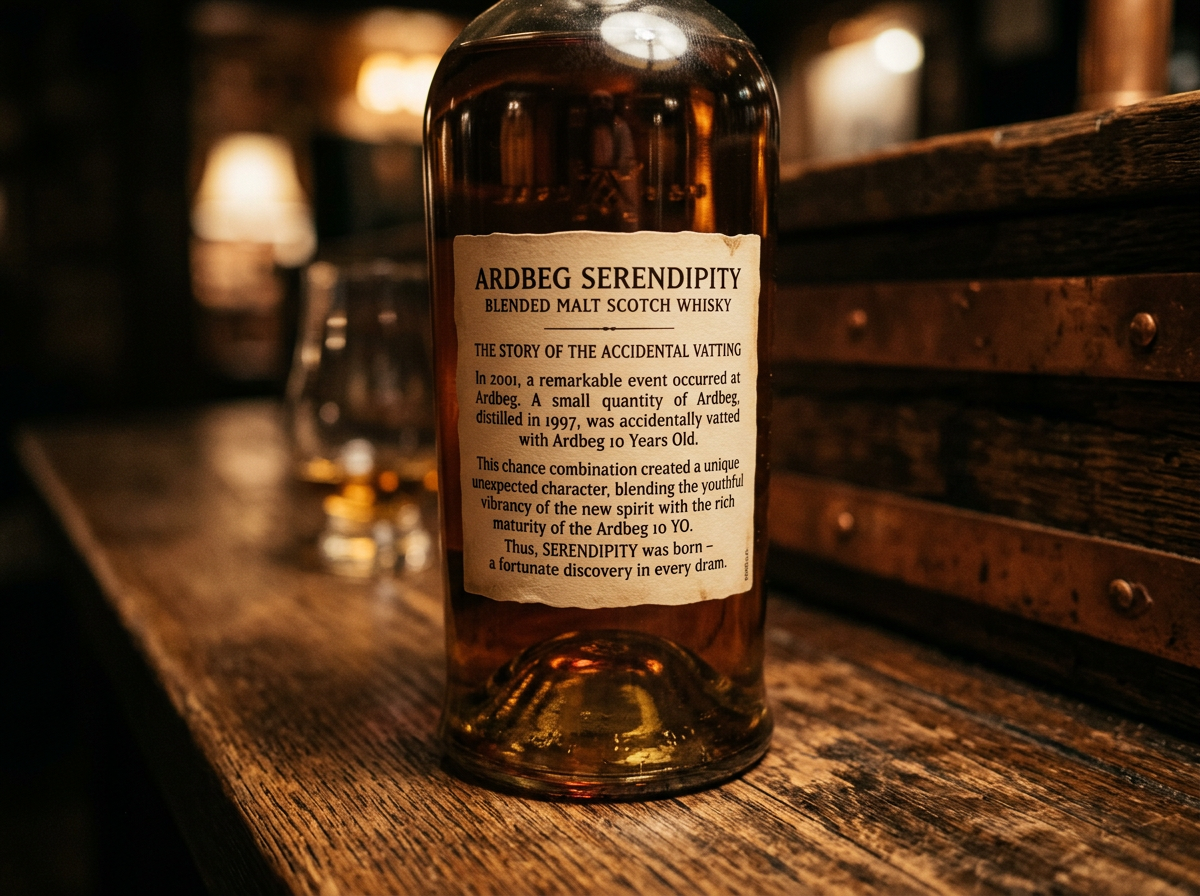
If you want to talk about accidental whiskey, you have to start with the legendary 2005 incident at the Ardbeg distillery on the island of Islay. Ardbeg is world-renowned for its heavy peat and medicinal punch, but it is also known for its precision. However, in 2005, the production line saw a mistake of epic proportions. A distillery worker, likely running on a mix of long hours and routine, accidentally pumped a large quantity of precious 17-year-old Ardbeg malt into a vat that already contained a much younger, lighter malt from the Glen Moray distillery in Speyside.
When the error was discovered, the initial reaction from the production team wasn't excitement—it was pure, cold horror. They had effectively 'polluted' one of their most valuable, well-aged Islay stocks with a youthful Speyside spirit that had a completely different character. At the time, Ardbeg 17-year-old was becoming a rare commodity, and to see it blended away into a non-age-statement mistake felt like a catastrophe. They had created a 'bastard malt' that legally couldn't even be called Ardbeg, as it was now a blended malt (or vatted malt, as it was known then).
However, the marketing team saw something the distillers didn't. Instead of dumping the stock or selling it off to a generic blender, they tasted it. They found that the medicinal, heavy smoke of the Ardbeg was surprisingly complimented by the sweet, buttery, and grainy notes of the Glen Moray. The younger spirit acted as a vibrant bridge, lifting the heavy phenols of the aged Islay malt. They decided to lean into the mistake, naming the release 'Serendipity.' They were transparent about the error, and the bottle featured a quirky label that told the story of the blunder.
The flavor profile became an instant hit. The 'Serendipity' offered a unique balance: the citrus and vanilla of the Speyside spirit softened the blow of the peat, making it accessible yet complex. Today, the legacy of Serendipity stands as a masterclass in luxury branding. By 'owning the mistake,' Ardbeg turned a potential PR nightmare into a piece of distillery lore. If you're lucky enough to find a bottle today, be prepared to pay a premium. Originally a moderately priced release, it is now a highly sought-after collector's item, often fetching ten times its original retail price at international auctions. It serves as a constant reminder that sometimes, the worker who makes the biggest mistake is actually the one who creates the most value.
Wild Turkey 'Forgiven': The Bourbon-Rye Collision
Across the Atlantic in Lawrenceburg, Kentucky, another legendary "oops" moment occurred in 2010. The Wild Turkey distillery is a bastion of tradition, overseen by the legendary father-son duo, Jimmy and Eddie Russell. The Russells are known for their unwavering commitment to the "Wild Turkey way," which makes the story of 'Forgiven' even more compelling. It began when a distillery crew member mistakenly pumped high-proof, mature rye whiskey into a tank that was already holding 6-year-old bourbon.
In the rigid world of American whiskey, bourbon and rye are distinct categories with very different mash bills and flavor profiles. Mixing them outside of a very specific, pre-planned blending process is practically unheard of at a major distillery. When Eddie Russell first heard about the error, his reaction was one of genuine frustration. They had lost a significant amount of inventory that was slated for specific bottlings. However, after the initial anger subsided, Eddie did what any great distiller would do: he pulled a sample from the tank and tasted it.
The chemistry was fascinating. The spicy, peppery, and floral notes of the mature rye began to dance with the sweet caramel, vanilla, and charred oak notes of the bourbon. Because the rye was high-proof and well-aged, it had the structure to stand up to the sweeter bourbon base. Eddie realized that the liquid was not only salvageable but actually quite delicious. It had a unique 'pop' that neither the standalone bourbon nor the rye possessed.
The naming of the product was a stroke of genius. By calling it 'Forgiven,' Wild Turkey gave a public nod to the employee who made the error, essentially saying that the resulting whiskey was so good that the mistake was wiped from the record. This human-interest angle resonated deeply with bourbon enthusiasts. The limited release sold out almost instantly. While Wild Turkey eventually released a second batch of 'Forgiven' due to popular demand, enthusiasts and collectors still hunt for the first batch—the true 'accidental' blend—as it represents a singular moment in whiskey history where the rules were broken by accident and the result was magic.
The Shackleton Discovery: Nature's Frozen Time Capsule
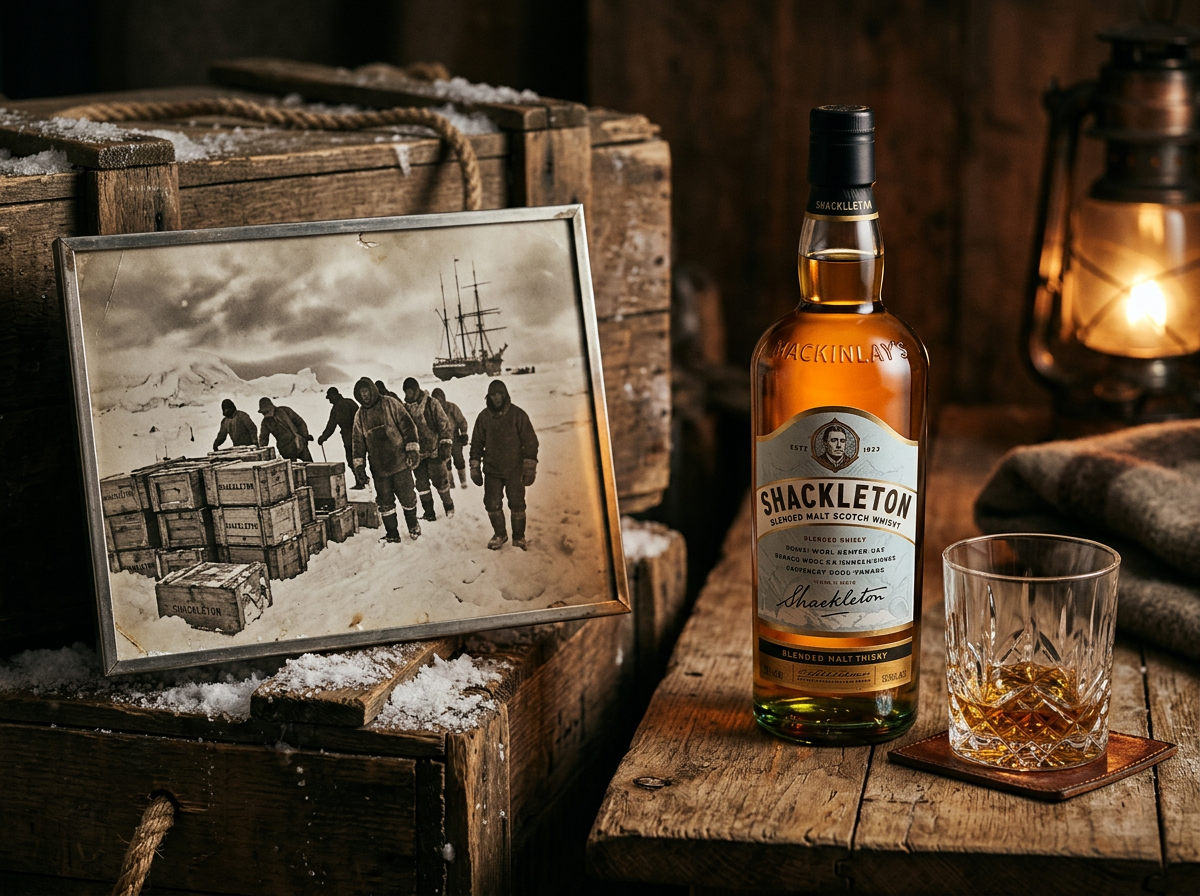
Some mistakes aren't about vatting; they are about leaving things behind. In 2007, a team of explorers in the Antarctic made a shackleton whiskey discovery that would change our understanding of historical spirit maturation. They found three crates of Mackinlay’s Rare Old Highland Malt whiskey buried deep under the ice beneath Ernest Shackleton’s 1907 base camp at Cape Royds. Shackleton had never intended to leave his whiskey behind; it was abandoned during a desperate, hurried retreat for survival as the expedition faced the brutal Antarctic winter.
The scientific miracle here was two-fold. First, despite being buried for a century at temperatures reaching -30°C, the whiskey remained liquid. The high alcohol content prevented it from freezing, which saved the glass bottles from shattering. Second, the extreme cold acted as a cryogenic stabilizer. While whiskey usually matures through the expansion and contraction of wood in varying temperatures, these bottles had undergone a unique, slow-motion maturation process in a near-static environment for a hundred years.
When the crates were recovered, they were treated with the reverence of holy relics. They had to be thawed under strict laboratory conditions over several weeks to prevent the bottles from cracking due to thermal shock. Master Blender Richard Paterson, often called 'The Nose,' was tasked with analyzing the liquid. He used what he called 'DNA analysis'—sophisticated chemical profiling—to understand the exact components of this century-old spirit. What they found was a style of whiskey that had largely vanished: a Highland malt with a very specific, subtle peat profile that had been preserved perfectly by the ice.
This "mistake" of leaving the crates behind taught modern distillers a great deal about the impact of extreme cold on peat smoke phenols. It showed that long-term stabilization could refine a spirit in ways that heat-driven maturation could not. Paterson eventually used his findings to launch the 'Shackleton Blended Malt,' a recreation of that historical profile. The Shackleton discovery proved that sometimes, the best thing you can do for a whiskey is to lose it in the freezer of the world for a hundred years.
Sherry Casks: The Transport Solution That Changed Everything
One of the most profound whiskey aging mistakes in history is actually the foundation of the modern Scotch industry: the use of sherry casks. Today, brands like The Macallan or GlenDronach spend millions of dollars sourcing the finest Oloroso and Pedro Ximénez casks from Spain. We talk about 'sherry finishes' as a high-art form. But in the 18th and 19th centuries, the use of these casks was never an intentional flavor choice; it was a desperate economic shortcut.
During this era, Britain was importing massive amounts of Sherry from Spain. The wine arrived in large oak casks at various British ports. Once the Sherry was bottled or consumed, the empty casks were piled up on the docks. They were essentially industrial waste. For cash-strapped Scottish distillers, these discarded wine barrels were a godsend. They were significantly cheaper than buying virgin oak or commissioning new barrels. The distillers used them simply because they were the most available shipping containers.
The 'epiphany' happened during transit. Distillers noticed that whiskey left in these sherry-soaked barrels for the duration of a long journey—or forgotten in a warehouse for a few years—was transformed. The harsh, fiery 'moonshine' edge of the raw spirit was rounded off. In its place were notes of dried fruits, cloves, chocolate, and walnut. This is the sherry cask history that many forget: it was a cost-saving measure that accidentally defined the classic 'Christmas cake' flavor profile we now associate with the Highlands and Speyside.
This transition from a logistical "make-do" to a premium standard changed the industry forever. It led to the realization that the container was just as important as the still. What started as an accident of global trade routes became the gold standard of maturation. Today, we don't just use whatever barrels are lying around; we 'season' them specifically for whiskey, but we are still just trying to replicate the magic that happened when a 19th-century distiller decided to save a few pennies by buying a used wine tub.
Jefferson’s Ocean: Turning a Shipping Nightmare into a Brand
In the modern era, Trey Zoeller of Jefferson’s Bourbon decided to intentionally lean into the 'accident' of history. The inspiration for 'Jefferson’s Ocean' came from a moment of observation rather than a mistake, but the process itself relied on what was traditionally considered a shipping nightmare. Zoeller was on a boat when he noticed a bottle of bourbon sloshing around. He wondered: what would happen if we aged a whole barrel like this? Historically, whiskey shipped across oceans was often considered 'damaged' or altered by the rough conditions, but Zoeller suspected there was more to the story.
The first voyage of Jefferson’s Ocean was an experiment that many expected to fail. The barrels were subjected to extreme weather, massive temperature fluctuations, and constant motion. In traditional rickhouse aging, these are things you try to avoid. You want stability. But the 'mistake' of the voyage actually accelerated the maturation in a way that couldn't be replicated on land. This is what scientists call the 'bellows effect.' The constant agitation of the waves forces the whiskey in and out of the wood grain at a much higher frequency than atmospheric pressure changes alone.
The most surprising 'accident' of the process, however, was the influence of the salt air. Distilleries usually want a controlled, clean environment. But the barrels on the ship were breathing in the saline, humid air of the open sea. This created a unique briny finish—a savory, salted caramel note—that was previously unseen in Kentucky bourbon. What could have been a ruined, over-oaked, or 'tainted' batch became a revelation.
Jefferson’s Ocean has now turned this 'shipping error' into a science. Each voyage is tracked by GPS, and consumers can look up the specific weather patterns their whiskey experienced. Was there a hurricane? Did it cross the equator twice? The 'weather of the mistake' is now a selling point. It’s a perfect example of how modern brands are taking the variables that used to ruin a batch and turning them into a signature flavor profile.
Tax Evasion and the Birth of Long-Term Aging
If there is one thing that has shaped whiskey history more than anything else, it’s the human desire to avoid paying taxes. In the 18th and early 19th centuries, the British government imposed heavy taxes on spirit production, leading to the rise of 'illicit distillers' throughout Scotland. To avoid the 'gaugers' (the tax men), distillers had to get creative with where they hid their product. They would stash barrels in damp caves, bury them in peat bogs, or hide them in the back of deep, dark warehouses for years at a time.
This was essentially a game of 'hide and seek' where the goal was to forget the whiskey existed until the coast was clear. The accidental benefit of this tax evasion was the discovery of long-term aging. Before this, most whiskey was drunk 'white' or very young. But when distillers finally retrieved their hidden barrels years later, they found a spirit that was amber-hued, mellow, and incredibly complex. The fear of government seizure inadvertently led to the industry standard of 10, 12, and 18-year age statements.
Even the 'Angels' Share'—the 2% of whiskey that evaporates from the barrel each year—was originally viewed as a storage error or a loss of profit. Distillers hated it. It wasn't until they realized that this evaporation was concentrating the flavors and allowing the whiskey to 'breathe' that they began to value the loss. The Glenlivet is a prime example of this evolution. George Smith, the first legal distiller in the Glenlivet valley, had to refine the rough edges of his previously hidden stocks to meet the demands of King George IV, who had developed a taste for the 'smooth' illicit stuff. The legality was the accident; the quality was the result of hiding in the dark.
Conclusion: Celebrating the Beautiful Blunder
As we’ve seen, the history of whiskey is not a straight line of progress; it’s a jagged path filled with trips, falls, and wrong turns. From the vatting errors of Ardbeg to the frozen crates of Shackleton, the industry’s greatest hits often come from deviations from the 'standard operating procedure.' These stories remind us that whiskey is a living, breathing entity where human error is simply another ingredient in the alchemy. The mistakes of the past have become the traditions of the present.
The lesson for modern drinkers is simple: don't be afraid of the 'weird' bottles. In an era where consistency is often prioritized above all else, a lack of consistency can sometimes be a sign of character. Modern distilleries are now trying to 'manufacture' these accidents through 'Experimental Series' and unusual wood finishes, but there is still something special about a bottle that exists because someone, somewhere, made a mistake. It adds a layer of humanity to the spirit that a computer-controlled distillery can never replicate.
So, the next time you’re browsing the shelves of your local shop, look for the oddities. Look for the 'limited editions' that come with a strange backstory. They might just be the result of a beautiful blunder. After all, if the history of whiskey has taught us anything, it’s that perfection is overrated, but a well-timed accident can be delicious. Here’s to the errors, the omissions, and the mistakes—may they continue to fill our glasses with the unexpected. Cheers!