Whiskey's 'Chewing' Technique: Unlock Deeper Flavors
Discover a simple yet revolutionary whisky tasting method that reveals hidden complexities in every sip.
The Art of the 'Chew': An Introduction to Mindful Tasting
Imagine you’re sitting in a dimly lit, wood-paneled study, the scent of old books and leather lingering in the air. In your hand is a Glencairn glass, its amber contents catching the soft glow of a nearby lamp. For many, the next step is a simple sip and a quick swallow—a fleeting moment of warmth followed by a sharp burn. But what if I told you that you’re missing out on nearly 80% of the experience? To truly unlock whisky flavors, you have to do something that might feel a bit silly at first: you have to chew it.
The whisky chewing technique is not about literal mastication; you aren’t trying to break down solids. Instead, it is a deliberate, physical movement of the jaw and tongue designed to maximize the contact between the liquid and the sensitive surfaces of your mouth. By "chewing" the whisky, you ensure that every taste bud and olfactory receptor is invited to the party. This technique transforms a simple drink into a mindful meditation.
One of the most vocal proponents of this method is the legendary Charles MacLean. A leading authority on Scotch and a man whose nose is insured for more than most of our houses, MacLean popularized the "rule of thumb" for Charles MacLean whisky tasting: keep the spirit in your mouth for one second for every year it spent in the cask. If you’re enjoying an 18-year-old single malt, that’s 18 seconds of exploration before you even think about swallowing. It sounds like a long time, but it’s the difference between "shot" culture and "tasting" culture.
When we take a shot, we bypass the tongue’s most sensitive zones and send the alcohol straight to the throat, where the "burn" dominates. In contrast, the chew slows everything down. This psychological shift is vital; by slowing the physical act of drinking, you prime your brain to identify subtle sensory inputs that would otherwise be lost. We are moving beyond the initial alcoholic heat to find the "bloom"—that moment when the spirit’s profile opens up like a flower in the sun.

The Biology of Flavor: Why Your Tongue Isn't Enough
To understand why chewing works, we have to look at the fascinating biology behind how we perceive what’s in our glass. Most people use the words "taste" and "flavor" interchangeably, but in the world of professional spirits judging, they are distinct. Taste is what happens on your tongue: the detection of sweet, sour, salty, bitter, and umami. Flavor, however, is a much more complex multisensory construct. It is the combination of those five tastes plus retro-nasal olfaction whisky enthusiasts often rave about.
When you perform the whisky chew, you aren't just moving liquid; you are moving air. This motion forces aromatic vapors up through the back of your throat and into your nasal cavity. This is retro-nasal olfaction—the process by which your brain interprets smells that originate from inside the mouth. Since our noses are capable of detecting thousands of distinct aromas compared to the tongue's five basic tastes, this "backwards smelling" is where the real magic happens. It’s how a Highland malt suddenly reveals notes of heather honey, dried apricots, or distant peat smoke.
Saliva also plays a heroic role here. Your saliva isn't just water; it’s a complex fluid containing enzymes like amylase. When you chew your whisky, your saliva begins to break down the esters and chemical bonds within the spirit. It also naturally dilutes the liquid, lowering the ABV (alcohol by volume) impact on your tongue. This reduction in "heat" allows your taste buds to recover from the initial shock and start detecting the nuance of the grain and the wood.
We’ve all seen those old "tongue maps" in school textbooks—the ones that say you taste sweet on the tip and bitter at the back. As it turns out, that’s a myth. All taste buds are capable of detecting all tastes, but different zones do have varying thresholds for intensity. By using the chewing motion to circulate the whisky into the sublingual area (under the tongue) and across the soft palate, you ensure that even the most subtle textures and flavors are picked up by the receptors best suited to find them.
The Physics of Aeration: Releasing the Spirit's Soul
If you’ve ever watched a sommelier swirl wine in a decanter, you’ve witnessed aerating whisky’s older cousin. The goal is the same: introducing oxygen to the liquid to encourage it to "open up." Whisky, however, is a much more concentrated spirit. The "soul" of the whisky is locked within Volatile Organic Compounds (VOCs). These molecules are what give whisky its character, but they are often trapped by the high alcohol content.
Mechanical agitation—the act of chewing—acts like a tiny, high-energy decanter inside your mouth. By creating a turbulent environment, you encourage these VOCs to transition from a liquid state into a gas. As they become volatile, they fill the "headspace" of your mouth and throat, making them available for your olfactory bulb to process. Without this movement, many of the heavier, more complex molecules remain "shut," hidden behind a wall of ethanol.
There is also a bit of fascinating chemistry at play known as the "Exothermic Reaction." When high-proof alcohol meets the water in your saliva, a minute amount of heat is released. While you might not feel a temperature spike like a hot cup of tea, this microscopic energy boost further assists in volatilizing the aromas. It’s a self-sustaining cycle of flavor release: the more you move the liquid, the more it interacts with your biology, and the more the spirit reveals.
Professional blenders, the masters of the craft, can often identify over 1,000 distinct aromatic compounds in a single malt. They don't achieve this through magic; they achieve it through movement and dilution. By chewing the whisky, you are mimicking the effect of a blender’s swirling glass. You are creating a "storm" in your mouth that breaks apart the tight clusters of molecules, allowing the "soul" of the cask—the vanillas, the tannins, and the spice—to finally escape.
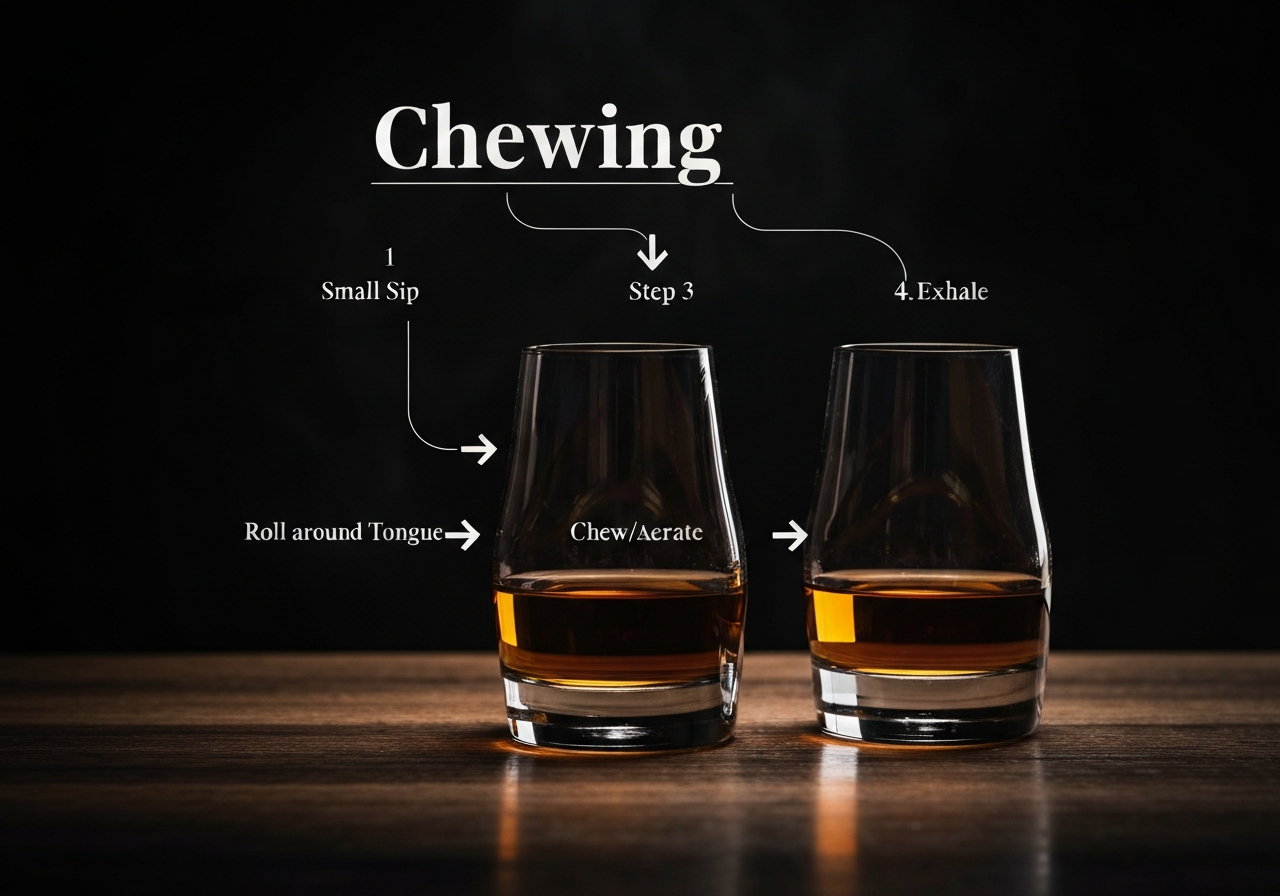
Step-by-Step: Mastering the Kentucky Chew
If you're ready to move beyond the simple sip, let’s walk through the actual process of the how to taste whisky like a pro. This whisky tasting guide will help you master the movement that will change your relationship with your collection forever.
- The Initial Sip: Start small. You aren't looking for a mouthful of liquid. Take an "educational sip"—about 5 to 10ml. This is just enough to coat the tongue without overwhelming the palate. If you take too much, you’ll find it difficult to move your jaw without making a mess.
- The Movement: This is the literal "chew." Move your jaw up and down as if you are chewing a piece of soft bread. While doing this, use your tongue to circulate the liquid. Roll it over the top, push it under the tongue, and let it wash against the insides of your cheeks.
- The Duration: Remember the MacLean rule (one second per year). If you're drinking a non-age-statement (NAS) whisky, aim for a minimum of 10-15 seconds. This gives your palate time to acclimate to the alcohol and allows the "bloom" to occur. You’ll notice the initial sharp sting of the alcohol begins to fade, replaced by a creamy sweetness or a spicy complexity.
- The Side-Breath: This is an advanced move. While the whisky is still in your mouth and you are chewing, gently inhale a tiny bit of air through your nose or the corners of your mouth. This adds even more oxygen to the mix and supercharges the retro-nasal experience. You’ll suddenly "smell" the flavor with incredible intensity.
- The Swallow: Don't just gulp it down. Perform a "controlled swallow," letting the liquid slide down the back of your throat slowly.
- The "Hah" Exhale: Immediately after swallowing, open your mouth slightly and exhale a soft "Hah" breath. This clears the remaining vapors through your nasal passage, often revealing a final, hidden note of fruit or smoke that wasn't present during the chew.
Practicing this technique might feel strange at first—you might even feel a bit self-conscious if you’re at a bar. But the moment you taste that hidden layer of salted caramel or blackened oak, you’ll realize it’s worth a bit of lip-smacking.
The Booker Noe Legacy: Origins of the 'Kentucky Chew'
While the Scotch world has Charles MacLean, the American Bourbon world has the legendary Booker Noe. Booker was the 6th-generation Master Distiller of Jim Beam and the creator of Booker’s Bourbon. He was a larger-than-life figure who didn't believe in the "preciousness" of spirits. To him, bourbon was something to be experienced with gusto, leading to the birth of the booker noe chew, more commonly known as the Kentucky Chew.
Booker used to demonstrate this technique to journalists and enthusiasts by taking a healthy sip of barrel-strength bourbon and quite literally smacking his lips together. He famously said that you shouldn't just drink bourbon; you should "eat" it. Because bourbon is often bottled at a higher proof and features a dense, corn-heavy grain profile, it has a physical presence that demands respect. The Kentucky Chew was Booker’s way of ensuring that the high-proof heat didn't overshadow the rich notes of vanilla, corn, and toasted nuts.
The "smack" of the lips is a key part of the American variation. By smacking the lips, you are aerating the liquid specifically at the front of the mouth, where the sweetness of the corn is most apparent. It also creates a visual and auditory experience that reinforces the idea of whisky as a "food" for the senses. Booker’s philosophy was simple: if you’ve waited six to eight years for the spirit to age in a charred oak barrel, the least you can do is give it fifteen seconds of your time.
What started as a regional tradition in the rickhouses of Kentucky has now become a global standard for professional spirits judging. Whether you’re tasting a delicate Lowland Scotch or a "hazmat" proof Kentucky bourbon, the principles Booker Noe championed remain the gold standard for getting the most out of every drop.
Decoding Texture: Beyond the Flavor Notes
When we talk about unlock whisky flavors, we often focus on things we can name—apple, cinnamon, smoke. But there is another dimension to whisky that the chewing technique reveals: whisky mouthfeel. Texture is often the "X-factor" that separates a good whisky from a legendary one.
By chewing the whisky, you allow the lipids and fatty acids—which survive the distillation process—to coat the entire interior of your mouth. This is where you detect viscosity. Some whiskies feel "thin" or "watery," while others are "oily," "creamy," or even "waxy." Consider the famous waxy texture of Clynelish; you simply cannot fully appreciate that candle-wax sensation without the chewing motion. It’s a physical feeling that adds a sense of luxury and weight to the experience.
Chewing also helps you identify "astringency." This is the drying sensation caused by tannins from the oak barrels. If you’ve ever bitten into a grape skin or drank a very dry red wine, you know the feeling. In whisky, tannins are essential for structure, but they can be overwhelming. The chew allows you to feel that dryness on the sides of your tongue and inner cheeks, helping you gauge the balance between the wood and the spirit.
Then there is the "sparkle" or "zest." Higher-proof whiskies often create a physical tingling sensation, almost like static electricity on the tongue. By chewing through this "sparkle," you can navigate the alcohol heat to find the sweetness hiding beneath. To improve your tasting notes, try using a "Texture Lexicon." Instead of just writing "tastes like vanilla," try adding "velvety texture" or "syrupy mouthfeel." It adds a whole new layer of depth to your DramNote entries!
The Evolution of the Finish: What Happens After You Swallow
The journey doesn't end once the liquid leaves your mouth. In fact, for many enthusiasts, the "finish" is the most important part of the tasting. The finish is the lingering flavor and sensation that remains after you swallow. If you’ve used the whisky chewing technique, you’ll find that the finish is significantly extended and much more complex.
There is often a "second wave" of flavors that only appears after the swallow. Heavier molecules, like those associated with heavy peat smoke, medicinal phenols, or deep barrel char, are often too heavy to be fully appreciated during the initial chew. They "stick" to the back of the throat and the base of the tongue, revealing themselves only as the liquid passes. By chewing for 15-20 seconds, you’ve primed these areas to catch those heavy hitters.
In the industry, we talk about the "length" of a whisky. A "short" finish disappears almost instantly, while a "long" finish can last for minutes. A 30-second chew of a well-aged Islay malt can lead to a finish that stays with you for half an hour. You’ll also experience the "Kentucky Hug"—that gentle, radiating warmth that starts in your chest and moves back up to your throat. It’s a sign of a well-crafted, high-quality spirit.
Watch for how the notes evolve. A finish might start spicy and peppery, but as it fades over the course of a minute, it might turn into something completely different—perhaps dark chocolate, dried floral notes, or a lingering honeyed sweetness. This evolution is only possible when you’ve properly aerated and agitated the spirit through chewing, ensuring that every molecule has its chance to shine.
Common Pitfalls and How to Avoid Them
As with any skill, there are a few common mistakes that can hinder your progress. If you’re struggling to find those hidden notes, check to see if you’re falling into one of these traps:
- The Gulp: Taking too much liquid is the number one mistake. If your mouth is full, you can’t chew, you can’t circulate air, and you’re likely to just irritate your throat. Keep it to a small, manageable sip.
- Ignoring the Water: Sometimes, even with the best chewing technique, the ABV is just too high for your palate to handle. Don't be afraid to add a drop or two of room-temperature water. This can pre-dilute the spirit to a "sweet spot" (usually around 35-40% ABV), making the chewing process much more effective.
- The Cold Factor: Ice is the enemy of flavor discovery. Cold temperatures numb your taste buds and suppress the volatile compounds you are trying to release. If you must have it chilled, try the chewing technique with a neat pour first, then add your ice.
- Rushing the Process: Whisky is a slow spirit. If you try to "power-taste" through five different whiskies in ten minutes, you’ll suffer from palate fatigue. Take breaks, drink water between drams, and give each chew the time it deserves.
- Over-aeration: Be careful with very old whiskies (40+ years). These spirits are often delicate and fragile. Excessive chewing might cause the light, floral top notes that have survived for decades to dissipate too quickly. For these rarities, a gentler approach is often better.
Conclusion: Developing Your Personal Ritual
At the end of the day, the whisky chewing technique isn't just a gimmick or a party trick; it is a physiological tool that allows you to maximize the value of every bottle you buy. Whether it’s a $30 budget bourbon or a $500 rare single malt, the spirit inside that bottle represents years—sometimes decades—of work, weather, and wood. Respecting that time by taking fifteen seconds to "chew" your sip is the best way to honor the craft.
I encourage you to experiment with your own ritual. Try using different glassware, such as a traditional Glencairn versus a flared Copita glass, and see how the chewing technique feels in each. The shape of the glass can actually change how the air enters your mouth during the chew, further altering the profile.
If you’re still a skeptic, try a "Side-by-Side" test tonight. Pour a dram of your favorite "daily driver" whisky. Take the first sip normally—just a quick swallow. Note the flavors. Then, take a second sip and apply the Kentucky Chew. Keep it in your mouth for 15 seconds, move your jaw, take that side-breath, and exhale the "Hah." The difference in depth, sweetness, and complexity will likely shock you.
Whisky is a slow spirit that demands a slow technique. We’d love to hear about your experience! The next time you sit down with a dram, give it a good chew and see what hidden notes you discover. Did that spicy rye suddenly turn to mint? Did that peaty malt reveal a hidden strawberry note? Share your discoveries with the DramNote community—we’re all on this flavor journey together. Cheers!