Whiskey's Color: Decoding the Amber Hues
Understand how aging and ingredients create the beautiful spectrum of whisky colors.
The First Sip is with the Eyes: The Importance of Visuals
There is a specific, quiet magic that happens the moment you pour a dram of whisky into a clean glass. Before you even lift the glass to your nose, and certainly long before the liquid touches your tongue, your brain has already begun the tasting process. We often say that the first sip of any spirit is taken with the eyes. As you hold your glass up to the light, your mind is racing to categorize what it sees. Is it a pale, straw-colored liquid that promises citrus and sea salt? Or is it a deep, mahogany nectar that hints at heavy oak, dark chocolate, and decades of slumber?
The psychological impact of color on our flavor perception is profound. Numerous sensory studies have shown that drinkers often associate darker spirits with "richer," "older," or "more complex" profiles. It is a natural human bias; we see a deep amber hue and our palate begins to salivate for caramel and spice. In the world of whiskey tasting for beginners, this is often the first hurdle to overcome—learning that a dark color doesn't always equate to high quality, just as a light color doesn't mean a whisky is "thin" or "young."
Historically, the visual presentation of whisky wasn't always a priority. In the early days of illicit distilling and farm-based production, whisky was often stored and transported in opaque stone jars or ceramic "pigs." You couldn't see the liquid inside, and quite frankly, the producers didn't care if you could. It was only with the advent of clear, industrial-grade glass bottles in the late 19th and early 20th centuries that the whisky aging process became a visual spectacle. Suddenly, distillers realized that "liquid gold" was a powerful marketing tool. Today, the clarity and hue of the spirit are carefully protected, showcased in bottles designed to catch the light on a retail shelf.
Understanding the difference between natural color whisky and "adjusted" color is the first real step in a connoisseur’s journey. The "First Impression" rule dictates that the viscosity and hue of a whisky prepare the palate for specific notes like vanilla, spice, or dried fruit. When you see a thick, oily-looking liquid with a dark amber tint, your brain prepares for a heavy mouthfeel. However, part of the joy of whisky is having those expectations subverted. Perhaps that pale liquid is a peat monster, or that dark spirit is surprisingly light and floral. While color is a beautiful prelude, remember: it is a clue, not a conclusion. Darker isn't always better; it’s just a different chapter of the story.

The Blank Canvas: New Make Spirit
To understand where those beautiful ambers and golds come from, we have to start at the very beginning: the "New Make" spirit. Often referred to in the United States as "White Dog," this is the liquid that emerges directly from the copper pot stills or column stills. If you were to look at a glass of new make, you’d be forgiven for thinking it was vodka or gin. It is crystal clear, transparent, and remarkably pure in appearance.
The chemistry of distillation is essentially a process of separation. When the fermented mash (the "wash") is heated, the alcohol and volatile aromatics turn into vapor, leaving behind the heavy solids, proteins, and—crucially—all the color from the original grain. As this vapor travels through the neck of the still and into the condenser, it turns back into a liquid. This process effectively resets the visual clock. No matter how dark the roasted barley or how yellow the corn was in the mash tun, the resulting spirit is a blank canvas.
This new make spirit is powerful stuff. Depending on the distillery, it usually comes off the still at an ABV (Alcohol by Volume) ranging from 60% to 70% or even higher. This high alcohol concentration is vital for the whisky aging process. At this strength, the spirit acts as a potent solvent. When it is eventually poured into a wooden cask, it doesn't just sit there; it aggressively attacks the wood fibers, dissolving the chemical compounds that will eventually provide 100% of its natural color and a vast majority of its flavor.
There is a bit of historical lore buried in this clarity. Back in the days of moonshining, "White Lightning" was the term for this unaged, clear spirit. Moonshiners marketed it as a pure, honest product, but the reality was often about speed and tax evasion. If you didn't have to wait years for the barrel to turn the spirit brown, you could get your product to the customer faster and avoid the prying eyes of the "revenuers." However, as consumers began to realize that the barrel-aged versions were smoother and more flavorful, the clear "White Dog" became the exception rather than the rule.
The copper stills themselves play a silent role in this visual foundation. Copper is essential for stripping away unwanted sulfur compounds that would otherwise make the spirit smell like boiled cabbage or struck matches. By cleaning the spirit chemically, the copper ensures that the foundation is clean and colorless, allowing the barrel to "paint" its influence onto a pristine surface. Without this initial clarity, the nuances of the oak barrel influence would be muddied and lost.
Oak as the Artist: The Chemistry of the Cask
If the new make spirit is the canvas, the oak barrel is the artist. Once the clear spirit is tucked away inside a cask, a slow, silent chemical symphony begins. While many factors influence the final dram, industry experts generally agree on the "60-80% Rule": up to 80% of a whisky’s flavor and 100% of its natural color come directly from the wood. Without the barrel, whisky would remain a clear, harsh spirit; with the barrel, it becomes a complex, multi-layered masterpiece.
The oak barrel influence is driven by the breakdown of three primary wood compounds:
- Lignin: This compound is the source of vanillin. As the spirit breaks down lignin, it releases those classic vanilla and creamy notes, often contributing a light, golden sweetness to the color.
- Hemicellulose: These are essentially wood sugars. When the wood is heated during the barrel-making process, these sugars caramelize, providing the spirit with deep amber tones and flavors of butterscotch and caramel.
- Tannins: Found in high concentrations in European oak, tannins provide the structure and "grip" of the whisky, while also contributing to darker, reddish hues.
The type of oak used is perhaps the biggest variable in the whiskey color chart. The two most common species are Quercus Alba (American White Oak) and Quercus Robur (European Oak). American White Oak is dense and packed with vanillin, typically yielding colors that lean toward bright gold, straw, and honey. European Oak, on the other hand, is much more porous and tannin-rich. It tends to "bleed" color more easily, resulting in deep ambers, burnished coppers, and even mahogany tints.
This is a process of "extractive" aging. As temperatures change, the spirit expands into the wood during the summer and retracts back into the belly of the cask during the winter. Each cycle acts like a pump, pulling more and more pigments and flavors from the wood fibers. A critical factor in this extraction is the "fill" of the barrel. A "first-fill" barrel (one that has never held whisky before, or has only held its original occupant like bourbon) is like a fresh tea bag; it provides an intense, rapid infusion of color. A "second-fill" or "refill" cask is like using that same tea bag a second or third time—the color it provides will be much paler and the process much slower.
The Impact of Previous Occupants: Sherry, Bourbon, and Beyond
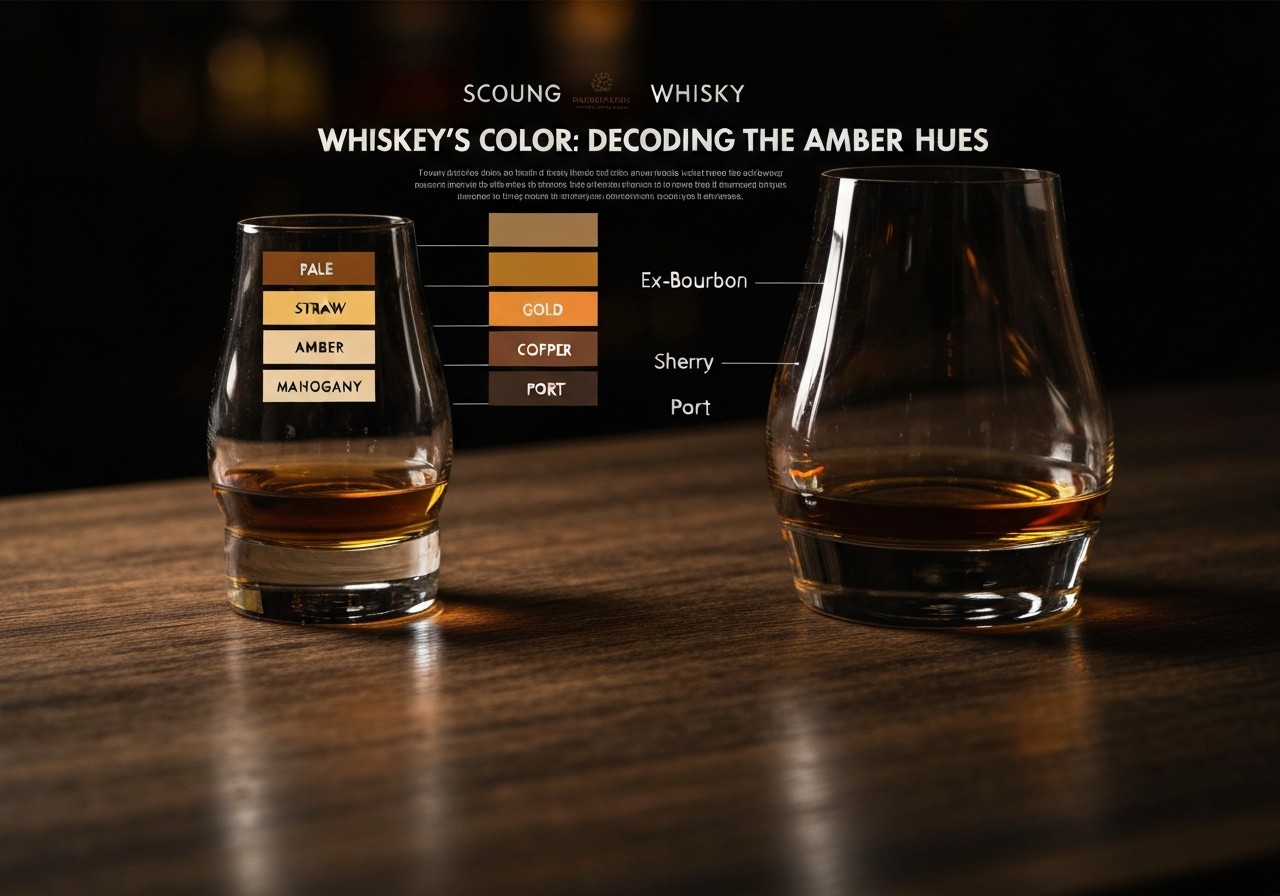
One of the most exciting aspects of bourbon vs scotch color comparisons is looking at what the barrel held before the whisky arrived. In the Scotch world, most distilleries use "seasoned" casks. The spirit doesn't just interact with the oak; it interacts with the remnants of the previous liquid trapped within the wood’s staves, known as the "indurated layer."
If you see a whisky that is remarkably dark with a reddish, mahogany, or "chestnut" tint, there is a very high probability it was aged in an ex-Sherry cask. Casks that previously held Oloroso or Pedro Ximénez sherry are famous for their deep, dark influence. They impart notes of dried fruits, figs, and dark chocolate, and the color is often an intense, dark brown that looks far older than the age statement on the label might suggest.
In contrast, ex-Bourbon barrels are the workhorses of the industry. Because American law requires bourbon to be aged in new, charred oak containers, there is a massive supply of once-used barrels sent to Scotland, Ireland, and beyond. These casks typically result in a "straw to gold" spectrum. They provide those vibrant yellows and bright ambers we associate with classic Highland or Speyside malts. When you compare a 12-year-old Scotch aged in ex-bourbon vs. a 12-year-old Scotch aged in ex-sherry side-by-side, the visual difference is staggering—one might look like pale white wine, while the other looks like dark maple syrup.
Then we have the exotic finishes. In recent years, distillers have become increasingly adventurous, "finishing" their whisky for the last few months or years of maturation in casks that held Port, Madeira, or even red wines like Cabernet Sauvignon or Pinot Noir. Port pipes often impart a distinct pinkish or "salmon" hue to the spirit, while red wine casks can give the whisky a ruby or garnet tint. These visual cues are a playground for the senses, telling you exactly what kind of "previous occupant" has left its mark on the liquid.
Fire and Wood: Toasting and Charring
Before a barrel can ever hold spirit, it must be treated with fire. This isn't just to make the staves easier to bend; it is a fundamental chemical transformation that dictates the whisky aging process. There are two main methods: toasting and charring. While they sound similar, they serve very different purposes in the color-creation process.
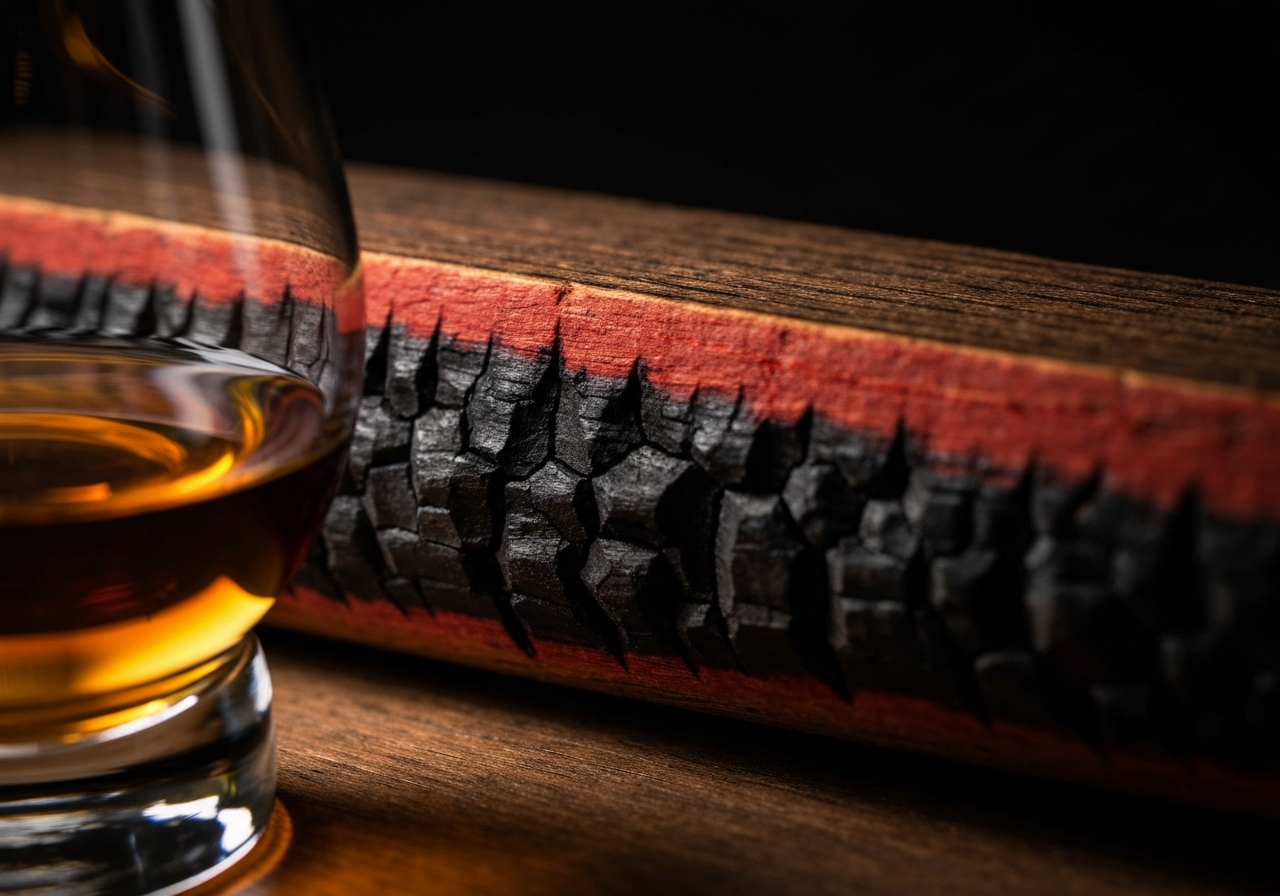
Toasting involves heating the inside of the barrel at a lower temperature for a longer period. This gently breaks down the hemicellulose into wood sugars without burning the surface. Toasting creates what is known as the "Red Layer" just beneath the surface of the wood. When the spirit hits this layer, it picks up those caramelized sugars, resulting in a deep, rich amber color and plenty of sweetness. Most wine barrels are toasted, which is why wine-cask finished whiskies often have that soft, glowing warmth.
Charring, however, is much more aggressive. The inside of the barrel is set on fire for a period ranging from a few seconds to several minutes. This creates a layer of black carbon (charcoal) on the inside. There are typically four levels of char, with "Char #4" often called the "Alligator Char" because the burnt wood resembles the scaly skin of an alligator.
- The Carbon Filter: The char layer acts as a natural carbon filter, removing harsh impurities and sulfur from the spirit as it moves through.
- Pigment Access: The charring process cracks the wood, creating more surface area and allowing the spirit to move deeper into the "Red Layer" mentioned above.
- Muting vs. Enhancing: Interestingly, a very heavy char can sometimes "mute" certain bright colors, but it generally enhances the smoky, dark, and "burnt orange" appearance of the whisky.
The charring process is essential for Bourbon, where the law mandates "new charred oak." This is why even a relatively young 4-year-old bourbon can often appear darker than a 10-year-old Scotch. The fresh, heavily charred wood is incredibly "active," pumping color into the spirit at a much faster rate than a used, uncharred, or lightly toasted barrel would.
Environment and Time: The Variables of the Warehouse
You can have the best spirit and the finest oak, but the environment where those barrels sit will ultimately decide the final hue. This is where the whisky aging process meets geography. The phenomenon of "thermal expansion" is the engine of color. In hot climates, such as Kentucky, Tennessee, or even Taiwan (think Kavalan whisky), the spirit expands and moves into the wood much more vigorously than it does in the cool, damp climates of Scotland or Ireland.
Consider this "case study": A 6-year-old bourbon from Texas, where temperatures routinely soar, might look significantly darker than an 18-year-old Scotch from the Highlands. The extreme temperature swings in Texas force the spirit in and out of the wood staves dozens of times a year, accelerating the extraction of pigments. In Scotland, the process is much more gradual, a slow-motion dance that takes decades to achieve the same level of color saturation.
Then there is the "Angel's Share"—the portion of whisky lost to evaporation during aging. As water and alcohol escape through the porous wood, the remaining liquid becomes more concentrated. This includes the concentration of the color pigments. Furthermore, the position of the barrel within the warehouse (or rickhouse) matters. Heat rises, so barrels stored on the top floors of a Kentucky rickhouse will age faster and become darker than those stored on the cooler bottom floors. Master blenders often mix barrels from different levels to achieve a balanced natural color whisky.
The most important takeaway for a whiskey tasting for beginners session is to debunk the "myth of age." Time is not a guarantee of color. If you put a spirit into a "tired," third-fill refill cask and leave it for 30 years in a cold warehouse, it may still be a very pale straw color. Conversely, a spirit in a fresh, first-fill sherry butt in a warm environment might turn deep mahogany in just five years. Always look at the color in the context of the cask type and the climate.
The E150a Controversy: Spirit Caramel
We cannot talk about whiskey color chart nuances without addressing the "elephant in the room": Spirit Caramel, or E150a. This is a highly concentrated, tasteless food coloring that is legally allowed in many whisky-producing regions, including Scotland. Its purpose isn't to add flavor (though some purists argue it adds a slight bitterness), but rather to ensure "batch consistency."
Imagine you are a global brand producing millions of bottles a year. Because every barrel is different, every batch of whisky will naturally come out a slightly different shade. Big brands worry that if a consumer sees two bottles of the same whisky on a shelf and one is slightly lighter than the other, they will think something is wrong with the product. To solve this, they use E150a to "color-match" every batch to a standard sample.
This has led to the "Natural Color" movement. Many independent bottlers and craft distillers proudly state "No Added Color" or "Natural Color" on their labels. For the connoisseur, natural color whisky is a mark of authenticity. It allows you to trust that the hue you see is an honest representation of the spirit's journey through the wood.
"When a whisky is naturally colored, the glass tells the truth about its life in the barrel. When caramel is added, the glass tells a story the marketing department wants you to hear."
How do you spot "fake" color? It takes practice, but E150a often leaves a specific "unnaturally orange" or "neon amber" tint, especially in very cheap or very young bottles that haven't had the time to develop that depth naturally. If a 3-year-old whisky looks like an 18-year-old sherry bomb but lacks the "legs" or viscosity of an old spirit, you might be looking at a heavy dose of caramel.
Regional laws vary interestingly on this. In Germany, labeling laws are quite strict; if a whisky has added caramel, the label must state "mit farbstoff" (with colorant). This is why many enthusiasts look at German-imported bottles to see if their favorite dram is actually natural or adjusted. In the US and UK, however, this declaration is often not required, leaving the consumer to rely on their own "eye" and the transparency of the distiller.
Reading the Glass: Legs, Tears, and Clarity
Once you’ve assessed the hue, it’s time to look at the "physics" of the liquid. When you swirl the whisky in your glass, you’ll notice streaks of liquid running back down the sides. These are called "legs" or "tears" (scientifically known as the Marangoni effect). While they don't tell you the quality, they tell you about the ABV and the whisky aging process.
- Thick, slow-moving legs: These often indicate a higher alcohol content or a higher concentration of oils and wood sugars, suggesting a richer mouthfeel.
- Thin, fast-moving legs: These usually suggest a lighter, perhaps younger or lower-ABV spirit.
To perform a proper "Chroma" check, hold your glass against a neutral white background—a sheet of paper or a white tablecloth works perfectly. This helps you identify the subtle nuances that might be masked by the lighting in a dark bar. You’ll start to see if the gold has a greenish tint (common in some refill casks) or if the amber has a copper or ruby "glow." Lighting is everything; natural sunlight will always give you a truer sense of the color than the yellow glow of incandescent bulbs.
Another thing to look for is clarity. If a whisky is "Non-Chill Filtered," it means the distiller hasn't filtered out the fatty acids and esters that can cause the whisky to turn cloudy when cold or when water is added. This cloudiness is called the "louche" effect. Many enthusiasts prefer non-chill-filtered whisky because those fatty acids contribute to a richer "glow" and a more textured mouthfeel. Chill filtration can sometimes strip away the natural "shimmer" of a whisky, making it look perfectly clear but perhaps a little "flat" visually.
Conclusion: Developing Your Eye for Whisky
The journey from a clear, fiery distillate to a complex, amber masterpiece is one of the most beautiful transformations in the culinary world. By learning to decode the hues in your glass, you aren't just looking at a drink—you're looking at a map of time, wood, and geography. You're seeing the scorched interior of a Kentucky oak tree, the salty air of a coastal Scottish warehouse, and the ghost of a Spanish sherry that lived in the wood years ago.
As you continue your journey, I encourage you to keep a "tasting journal." Make the visual description your very first entry for every new bottle. Don't just write "amber"—try to be specific. Use terms like "polished brass," "clover honey," "burnt orange," or "deep mahogany." Over time, you’ll start to see patterns. You’ll begin to recognize the signature "house style" of your favorite distilleries just by the way the light hits the liquid.
But remember the ultimate takeaway: Color is a clue, not a conclusion. It is the opening act of the show, designed to pique your interest and set the stage. Always let your palate have the final say. Some of the most incredible whiskies I’ve ever tasted were as pale as a summer morning, and some of the most disappointing were as dark as a winter night. Use your eyes to appreciate the art, but use your taste to find the truth. Now, go grab a glass, find a white sheet of paper, and see what stories your current favorite dram is trying to tell you.