Whiskey's 'Lagging' Flavors: Unlocking Delayed Dram
Discover how some whiskies reveal their true complexity over time, and how to savor those elusive late-stage notes.
The Ghost in the Glass: Defining the Lagging Flavor Phenomenon
Imagine, for a moment, that you are sitting in a dimly lit corner of a quiet whisky bar. You’ve just been poured a dram of a legendary spirit—perhaps a rare Port Ellen or an old, wax-laden Brora. You take a sip. The initial impact, what we in the industry call the "Attack," is immediate: a burst of sea salt, a prickle of alcohol, and perhaps a flash of lemon zest. You swallow. Your palate feels clear, and you might even think the experience is over. But then, as you lean back, something strange and wonderful happens. Thirty seconds pass. Then forty. Suddenly, a ghost appears.
A wave of smoked honey, damp earth, and dried apricot rises from the back of your throat, coating your tongue in a flavor that wasn't there during the initial sip. This is the "lagging flavor," and it is one of the most sought-after experiences in whiskey complexity. While a standard whiskey finish explained usually focuses on the immediate aftertaste, a lagging note is a second act—a "Temporal Complexity" that moves through time as much as it moves across your taste buds.
The emotional experience of this second wave is what separates a good whisky from a legendary one. In younger, more linear whiskies, what you see is what you get. The flavor hits fast and fades faster. But in premium, long-aged spirits, the spirit has a shifting profile. It’s like a conversation with an old friend who reveals their deepest secrets only after the second bottle of wine. These "Ghost" notes are the hallmark of long finish scotches, where the spirit has spent decades interacting with oak, slowly developing heavy molecular structures that refuse to be rushed. To appreciate these whiskies, you have to be a patient listener, waiting for the spirit to speak its final, most profound word long after the glass has left your lips.

The Chronology of a Sip: From Attack to Afterglow
To truly understand how to capture these elusive notes, we have to look at the anatomy of a sip. Professional whiskey tasting techniques often break the experience down into a three-act structure. First comes The Attack (0-2 seconds), the immediate sensory input where your brain registers "this is whiskey." Next is The Development (2-10 seconds), where the mid-palate notes of grain, fruit, or spice begin to dance. Finally, there is The Afterglow (10+ seconds), which encompasses the finish and the eventual lagging notes.
Why don't we taste everything at once? It’s a matter of biological prioritization. Your tongue’s receptors are hardwired to prioritize high-intensity stimuli. When 46% or 50% ABV hits your tongue, your nerves scream "alcohol!" This sharp acidity and heat can temporarily mask subtle esters and delicate floral notes. This is often referred to as 'Palate Fatigue' in its most micro-form; the initial sweetness or spice desensitizes the tongue to the deeper, earthier tones that require a more neutral environment to be perceived.
Then comes the "Washout Effect." As you swallow, your saliva acts as a natural solvent, cleansing the palate and stripping away the more aggressive, water-soluble compounds. This reveals the heavier, less soluble molecules that have literally stuck to your mucous membranes. This creates a "Flavor Curve" that can be surprisingly non-linear. Some whiskies are famous for having a "hollow mid-palate"—where the flavor seems to dip or disappear after the initial swallow—only to return with a massive, booming lagging finish that lasts for minutes. Understanding this chronology allows you to stay focused through the "hollow" moments, knowing that the best is yet to come.
The Chemistry of the Slow Burn: Volatility and Molecular Weight
If we dive into the world of molecular whiskey tasting, we find that the "lag" isn't magic—it’s physics. Every flavor you perceive is a chemical compound with a specific molecular weight and volatility. Light esters, which provide those bright, fruity, and floral notes like green apple or pear, are highly volatile. They evaporate almost instantly at room temperature, which is why you smell them the moment the glass nears your nose and taste them the second the liquid touches your tongue.
However, a dram is also packed with Congeners—the chemical byproducts of fermentation and distillation—and compounds leached from the wooden cask. Heavy phenols, like Guaiacol (which provides a campfire smoke aroma), and tannins from the oak have much higher molecular weights. They are less volatile and move slower. Furthermore, many of these lagging compounds are "hydrophobic," meaning they don't like water. They prefer to cling to the oily fats and proteins in your mouth and throat.
A fascinating part of this chemistry involves "Micelles." These are tiny clusters of fatty acids that can trap flavor molecules inside them. When the whisky is in the bottle, these molecules are locked away. But as you sip and the whisky is diluted by your saliva, these micelles begin to break apart, slowly releasing the trapped flavors over time. Research suggests that nearly 80% of what we perceive as "lagging flavor" is actually aromatics being released from the back of the throat rather than traditional "taste" on the tongue. As the mouth warms these heavy, oily compounds, they finally reach a temperature where they can volatilize and make their way to your sensory receptors.
Retro-nasal Olfaction: The Secret Path to the Brain
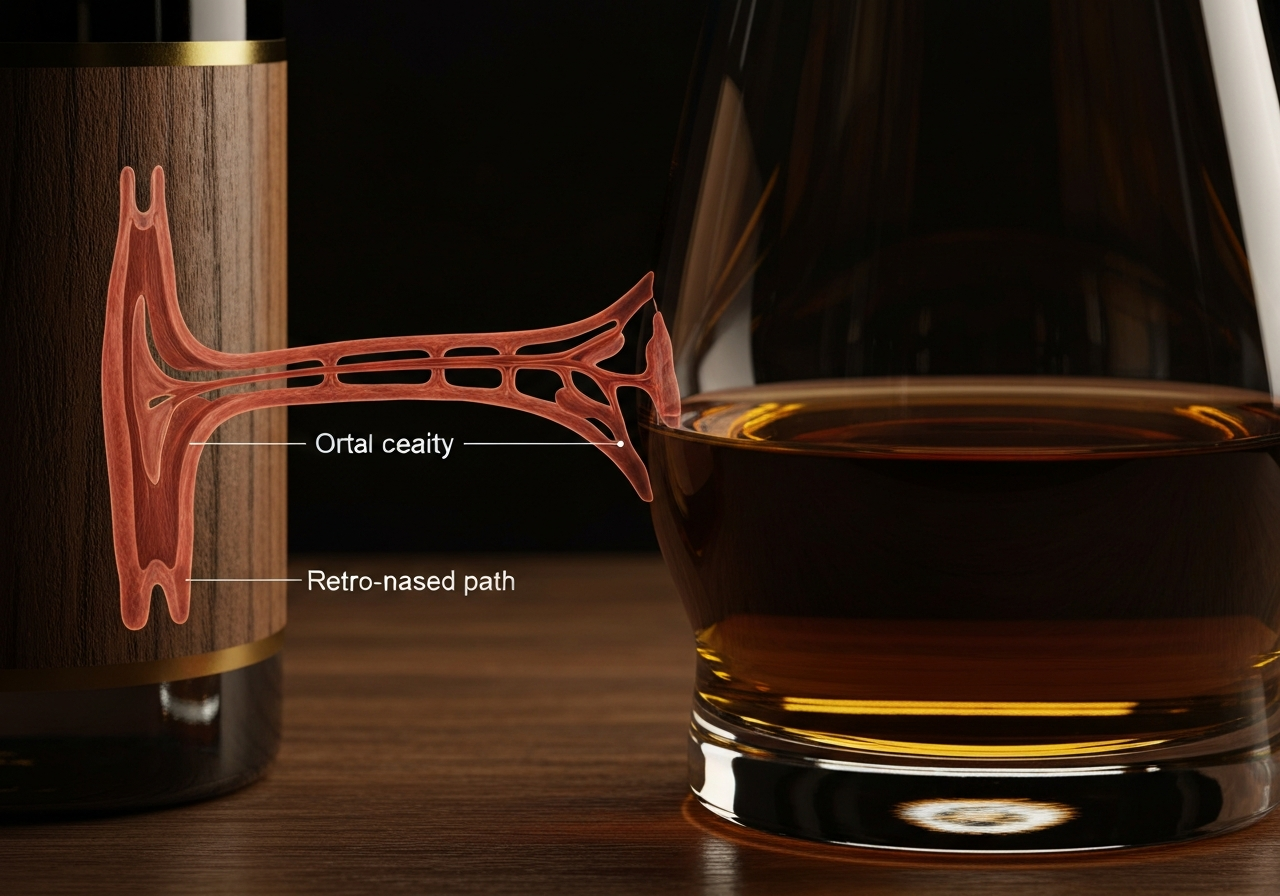
This brings us to the most important biological secret of high-end tasting: retro-nasal olfaction whisky perception. While "ortho-nasal" olfaction is the act of smelling through your nostrils, retro-nasal olfaction occurs when aromas travel from the back of your mouth, up through the pharynx, and into the nasal cavity while you are swallowing or exhaling.
The "Lag" you experience is, biologically speaking, more of a smell than a taste. You can prove this with the "Pinch Test." Take a sip of a complex whisky, swallow, and immediately pinch your nose shut. You’ll notice that the lingering notes of "old leather," "dried tobacco," or "tropical funk" almost entirely vanish. The moment you release your nose and exhale, the flavors rush back. This is because those heavy, slow-moving molecules require airflow to reach the olfactory bulb.
Your body temperature (98.6°F) acts as a powerful catalyst in this process. The whisky in your glass might be 65°F or 70°F, but once it enters your body, it warms up rapidly. This heat provides the energy necessary to volatilize those heavy, "stuck" compounds. To master the art of catching the tail-end of a dram, you must practice the "Exhale Technique." After you swallow, keep your mouth closed and exhale slowly and steadily through your nose. This creates a vacuum effect that pulls the warming vapors from the back of your throat directly onto your olfactory sensors, unlocking the full spectrum of the spirit's complexity.
Cask Influence and the Architecture of Delay
The barrel is the architect of the lagging finish. Not all wood is created equal when it comes to the "slow burn." European Oak (Quercus Robur), commonly used for Sherry casks, is significantly more porous and tannin-rich than American White Oak (Quercus Alba). These tannins act as the structural "bones" of the lagging finish, providing a dry, lingering grip that allows other flavors to hang around longer.
We often see what I call the "Sherry Cask Paradox." When you first sip a heavily sherried whisky, you are hit with massive oak spice and dried fruits. But because the Oloroso or Pedro Ximenez liquids are so dense and oily, they create a "delayed fruit" effect. The initial oak spice fades, and then, a minute later, a deep, jammy sweetness emerges that wasn't apparent at the start. It’s a secondary maturation that happens on your palate in real-time.
Char levels also play a role. The layer of carbonized wood inside a barrel acts as a filter, trapping certain harsh notes but also concentrating others. In ultra-aged whiskies (25+ years), we often find the "Rancio" effect—a term borrowed from Cognac. These are savory, mushroomy, or even cheesy lagging notes that only appear after decades of micro-oxidation. A special mention must go to Japanese Mizunara oak; it is famous for a uniquely long lagging note of sandalwood and temple incense that can stay with you for a quarter of an hour. It is the ultimate example of how wood chemistry dictates the "long game" of flavor.
The Peat Paradox: Why Smoke Lingers and Lags
Peated whiskies offer the most dramatic example of lagging flavors. However, there is a distinct difference between "Front-Palate Smoke" and "Lagging Smoke." When you sip a young, high-PPM (Phenol Parts Per Million) whisky, the smoke is often acrid, medicinal, and immediate—like a slap in the face with a wet bandage. This is the front-palate smoke, and while it's exciting, it often lacks depth.
In contrast, the "Lagging Smoke" of a well-aged Islay malt is more like a dying campfire or cold ash. This is due to how heavy phenolic compounds bind to the proteins in your saliva. They create a physical coating on the tongue and throat. Take the classic comparison between Lagavulin 16 and Laphroaig 10. While Laphroaig often hits with an immediate medicinal punch, Lagavulin is famous for its "sooty" finish—a lagging, bonfire-smoke quality that seems to grow in intensity after you’ve swallowed.
The paradox of peat is that it can often mask delicate fruit notes during the initial sip. I’ve had whiskies where the smoke was so dominant that I thought it was a "one-note pony." But if you wait two or three minutes, the smoke begins to retreat, and suddenly, a "ghost" of grilled pineapple or lime zest appears. The peat acts as a curtain; you have to wait for the curtain to pull back to see the true performance happening on the stage behind it.
Mastering the 'Kentucky Chew' and Other Tasting Rituals
If you want to prime your palate for these lagging notes, you need to borrow a move from the American whiskey legends. The Kentucky chew method, popularized by the late Booker Noe of Jim Beam, is more than just a quirky habit—it’s a functional tasting tool. By literally "chewing" the whiskey in your mouth, you are aerating the spirit and ensuring it coats every single square millimeter of your tongue and the insides of your cheeks.
Here is a step-by-step guide to the ritual:
- Take a medium-sized sip (don't swallow yet!).
- Move the liquid around your mouth as if you were chewing a piece of steak.
- Draw a tiny bit of air through your lips to oxygenate the spirit.
- Swallow slowly, then keep your mouth closed.
- Perform the "Closed-Mouth Swallow" to trap the initial vapors in your oral cavity.
Another great tip is the "Ten-Second Rule." A common piece of advice among master blenders is to hold the whisky in your mouth for one second for every year it spent in the cask. A 12-year-old scotch gets 12 seconds; a 25-year-old gets 25. This allows the liquid to reach body temperature before it even hits your throat, ensuring that those heavy molecular compounds are ready to volatilize the moment you swallow. Also, never underestimate the power of hydration. Drinking room-temperature water between sips is essential to reset the "lag" sensors and prevent the buildup of tannins from blocking the more delicate lagging notes.
Dilution as a Catalyst for Complexity
One of the most controversial topics in the whiskey world is adding water, but when it comes to lagging flavors, it is often a necessity. High-ABV, cask-strength whiskies can be so intense that they create an "alcohol wall." This wall prevents you from reaching the lagging notes because your palate is in a constant state of defense against the high proof.
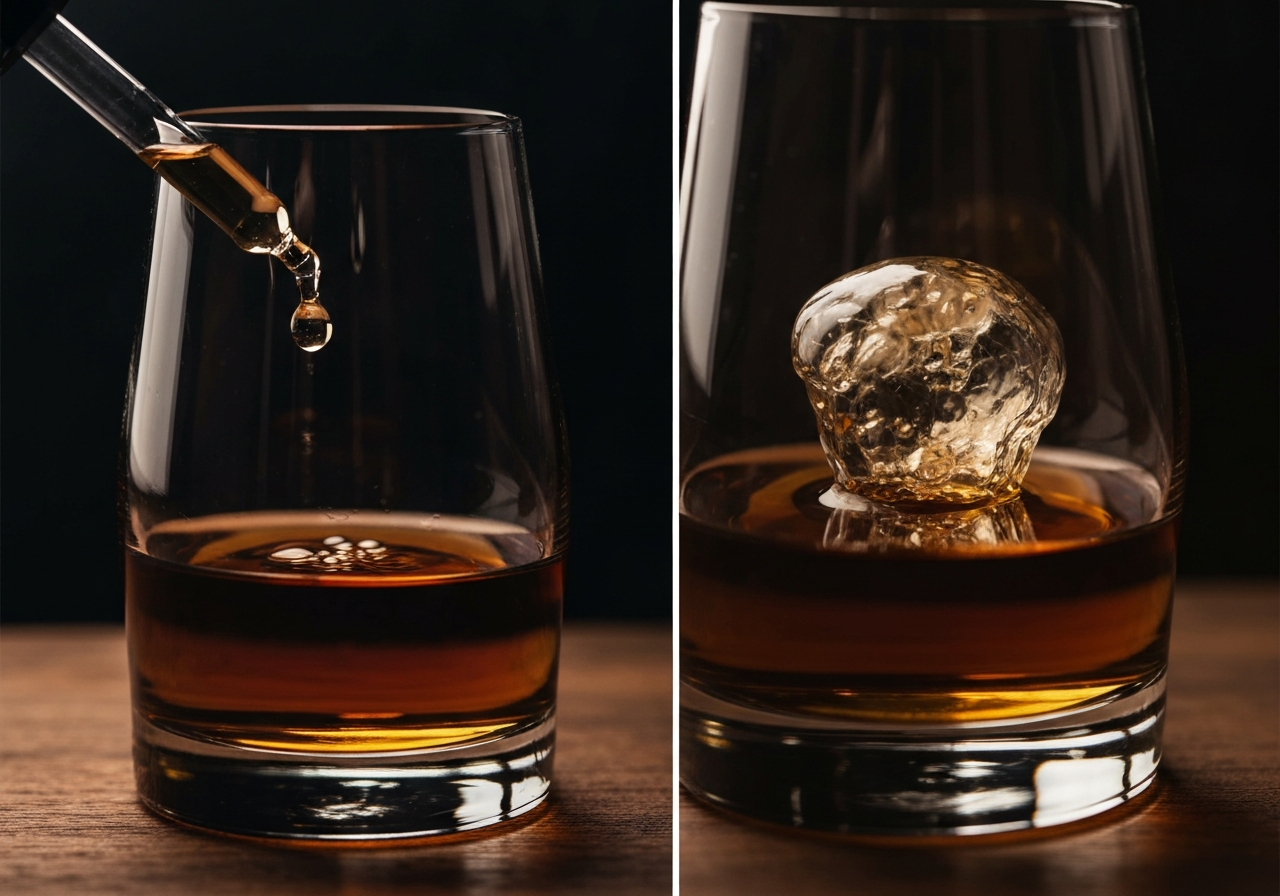
There is a scientific phenomenon sometimes called the "Guinness Effect" or "Molecular Surface Tension." A single drop of water can break the surface tension of the spirit, causing a microscopic "explosion" that releases trapped aromas. This is particularly true for Guaiacol. Dilution makes smoky molecules more volatile and easier to detect in the finish. By bringing a 58% ABV dram down to 46% or even 40%, you are effectively "opening the cage" and letting the lagging flavors escape.
A practical tip for the serious taster is "tiered dilution." Don't just add a splash of water and call it a day. Taste the dram neat first to see the "Attack." Then, add three drops and see how the "Development" changes. Finally, add a teaspoon of water and watch how the "Lag" transforms. Also, remember the "Wait Time" rule of thumb: let a dram sit in the glass for one minute for every year of its age. A 20-year-old whisky needs 20 minutes of air to properly "unfold" its lagging potential before the first sip is even taken.
Identifying the 'Long-Game' Flavors: A Guide to the Tail-End
As you begin to focus on the end of the sip, you’ll start to notice a specific catalog of flavors that almost always appear as "lagging" notes rather than leading ones. Earthy and "Animalic" notes—think old leather, musk, damp forest floor, or horse saddle—are rarely part of the initial attack. They are heavy, grounding notes that anchor the finish.
Common lagging notes include:
- Dark Chocolate & Espresso: These often emerge as a dry, roasted sensation 30 seconds after a Sherry-cask dram.
- Beeswax & Old Parchment: Classic markers of old Highland malts (like Clynelish), these provide a structural, textural lag.
- The 'Mango Lag': A legendary phenomenon in well-aged Irish whiskey or long-fermentation scotches where a dry, spicy start ends in a sudden flash of tropical fruit.
- Incense & Sandalwood: The signature of Mizunara oak or very old peat.
It’s also vital to distinguish between "Bitter" and "Dry." A bitter finish is often a flaw, usually from over-oaked young spirit. However, a lagging dryness (tannins) is a structural element. It "cleans" the palate and prepares you for the next wave of flavor. By building a mental "flavor library" specifically for the notes that appear after the 30-second mark, you will find that your appreciation for whiskey complexity grows exponentially. You’ll stop looking for just the "big" flavors and start hunting for the "ghosts."
Conclusion: The Reward of the Patient Pour
The "lag" is the ultimate test of a master blender’s skill. Anyone can make a whisky that tastes good for two seconds; it takes a true artist to craft a spirit that continues to evolve for two minutes. In our modern, fast-paced world, whisky remains one of the few "slow" beverages. It demands that we sit still, breathe, and pay attention.
The philosophical takeaway here is that the best parts of a dram—and perhaps the best parts of life—are often what remains after the initial rush has passed. The "Attack" is the excitement of the new, but the "Lag" is the depth of the lasting. I challenge you: the next time you pour a special bottle, don't just take a sip and reach for the glass again. Take a sip, set the glass down, and set a timer for five minutes. Document only the notes that appear after you’ve swallowed. You might be surprised to find that the most beautiful part of the whisky wasn't in the liquid itself, but in the ghost it left behind.
"The measure of a great spirit is not how it begins, but how long it stays to tell you its story." — Anonymous Master Distiller
Happy tasting, and may your finishes be long and your lagging notes be legendary.