Whiskey's Warmth: Understanding Proof & ABV Simply
Demystify alcohol content and discover how it shapes your drinking experience.
The First Sip: Why These Numbers Matter to You
We’ve all been there. You’re standing in the whiskey aisle, surrounded by beautiful amber bottles and rustic labels, feeling like you’ve finally mastered the difference between a Bourbon and a Scotch. But then, your eyes land on the fine print. One bottle says 40% ABV. Another says 80 Proof. A third boasts a staggering 114.2 Proof, while a dusty "Bottled-in-Bond" selection sits firmly at 100. If you’re a beginner, this "label shock" can be intimidating. Why are there so many different ways to measure the same thing? And more importantly, how do these numbers actually change what happens when the liquid hits your tongue?
When most people talk about whiskey, they mention "the burn." That sharp, prickly sensation in the back of your throat can be the very thing that keeps newcomers from exploring the category further. However, as you dive deeper into the world of drams, you’ll start to hear seasoned enthusiasts talk about "the warmth" or the "Kentucky Hug" instead. Understanding whiskey proof vs abv is the secret to moving from "the burn" to "the warmth." It’s the difference between feeling attacked by your glass and feeling embraced by it.
Think of the alcohol content in your whiskey like the volume knob on a high-end stereo system. If the volume is too low, the music is pleasant but you miss the subtle nuances—the soft vibration of a bass string or the breath of the singer. If the volume is cranked up too high without the right equipment, it becomes distorted and painful to listen to. But when you find that sweet spot, the music fills the room with clarity and power. Alcohol isn’t just there to give the drink its kick; it acts as a solvent. It carries the flavor molecules—the esters, aldehydes, and fatty acids—from the grain and the wood straight to your palate. Without it, whiskey would just be cold, soggy grain tea.
In this guide, we are going to demystify these numbers once and for all. We’ll travel through the explosive history of gunpowder tests, look at the science of how alcohol carries flavor, and give you practical advice on how to navigate the various tiers of strength. Whether you're reaching for a gentle 80-proof sipper or a monster cask-strength beast, you’ll soon know exactly what to expect before you even pull the cork.

ABV Decoded: The International Gold Standard
Before we get into the historical quirks of "proof," we need to talk about the modern, scientific standard used across the globe: ABV. If you’ve ever wondered what is alcohol by volume, the answer is surprisingly straightforward, though the measurement process is a feat of chemistry. ABV represents the percentage of the total volume of liquid that is pure ethanol, measured at a specific temperature—usually 68°F (20°C). Because alcohol expands and contracts with temperature, scientists and distillers must use a standardized heat level to ensure every bottle is consistent.
In the world of whiskey, ABV isn't just a suggestion; it’s the law. For a spirit to legally be classified as "whiskey" in almost every major jurisdiction, including the United States, Scotland, and Ireland, it must be bottled at a minimum of 40% ABV (which is 80 proof in the US). If a distiller bottles their spirit at 39%, it is no longer whiskey—it’s a "diluted spirit specialty." This 40% threshold was established because it was found to be the point where the spirit retains its character and shelf-stability while remaining approachable for the average consumer.
We owe much of our modern accuracy to Joseph Louis Gay-Lussac, a brilliant French chemist from the early 19th century. He developed the "Gay-Lussac scale," which perfected the use of the hydrometer in spirits. A hydrometer is essentially a weighted glass tube that floats in the liquid. Because alcohol is less dense than water, the hydrometer sinks deeper into high-alcohol liquids and floats higher in water-heavy liquids. By looking at where the liquid level hits the scale on the tube, distillers can calculate the ABV with incredible precision. This scientific rigor replaced the messy, "guesswork" methods of the past.
Understanding ABV is also the most important tool for the responsible drinker. Most "Standard Drink" calculations (which typically equate to 0.6 ounces of pure ethanol) are based on a 1.5-ounce pour of a 40% ABV spirit. As you move into higher proofs, those calculations change. A single 1.5-ounce pour of a 60% ABV whiskey is actually 1.5 "standard drinks." Keeping an eye on the ABV doesn't just help you find flavor; it helps you stay aware of your limits so you can enjoy the hobby for years to come.
The Gunpowder Test: The Explosive History of "Proof"
Long before we had Gay-Lussac and precision glass hydrometers, people still needed a way to make sure they weren't being cheated. In 16th-century England, spirits were taxed at different rates based on their strength. But how do you prove how much alcohol is in a bottle when you can't see it? The solution was literally explosive.
The term "proof" comes from a literal "test of proof." Tax collectors and sailors would take a sample of the spirit and pour it over a small pile of gunpowder. They would then attempt to light the wet powder on fire. If the spirit was mostly water, the gunpowder would stay damp and fail to ignite. However, if the spirit was strong enough—specifically, if it contained at least 57.1% ABV—the gunpowder would ignite with a flash. That spirit was then considered "proved." If it exploded with a "bang," it was over-proof; if it flickered or failed to catch, it was under-proof.
This "Gunpowder Test" was a matter of life and death for the British Royal Navy. Sailors were famously given a daily "rum ration" (a tradition that lasted until 1970!). They needed to know their rum hadn't been watered down by unscrupulous officers. If a barrel of rum leaked onto the ship's actual gunpowder stores and the powder became unusable, it meant the rum was too weak. If the gunpowder could still fire even after being soaked in rum, the rum was "Navy Strength." To this day, you’ll often see "Navy Strength" spirits bottled at exactly 54.5% or 57% ABV as a nod to this tradition.
By 1816, the British government realized that lighting gunpowder in tax offices was perhaps not the safest or most accurate way to collect revenue. They replaced the fire test with the Sikes Hydrometer. This device allowed for a more mathematical approach to the 57.1% "proof" mark. Despite the shift to science, the name stuck. We still use the word "proof" today as a ghost of that era when we quite literally played with fire to ensure our whiskey was the real deal.
The Math of the Label: US Proof vs. UK Proof
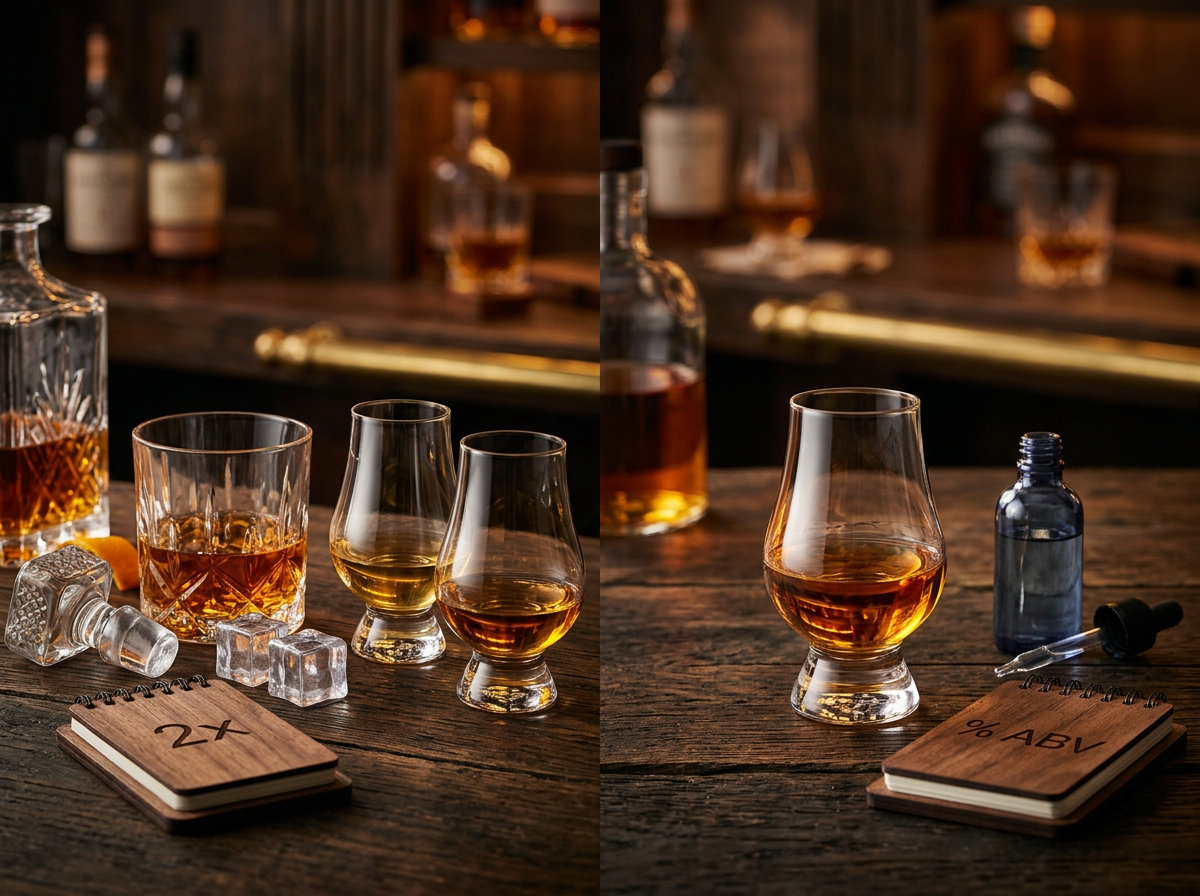
If you're looking at a modern bottle of bourbon produced in Kentucky, the math is delightfully simple. In the United States, the "Proof" is exactly double the ABV. If a whiskey is 50% alcohol, it is 100 Proof. If it is 43% alcohol, it is 86 Proof. This 2-to-1 ratio was formalized in 1848, largely because it made life easier for customs houses and tax collectors to do quick mental math. If you remember that "Double is Proof," you’ll never be confused by an American label again.
However, if you are a collector of vintage bottles or you spend time browsing European auctions, things can get a bit "math-heavy." Until 1980, the United Kingdom used a different system based on that 57.1% "gunpowder" mark. In the old British system, 100 Proof was equal to 57.1% ABV. This means a British "100 Proof" whiskey was significantly stronger than an American "100 Proof" whiskey. Thankfully, the European Union moved to the standard ABV percentage decades ago, but the confusion remains for those diving into the history of Scotch.
To keep things simple for your next trip to the liquor store, here is a quick "Cheat Sheet" for the most common American whiskey strengths you’ll encounter:
- 80 Proof = 40% ABV: The legal minimum and most common entry-level strength.
- 86 Proof = 43% ABV: A classic "Step Up" often used by heritage brands like Old Forester or Macallan.
- 90 Proof = 45% ABV: The "Premium Standard" for many flagship bourbons.
- 100 Proof = 50% ABV: The hallmark of "Bottled-in-Bond" whiskey.
- 101 Proof = 50.5% ABV: The iconic strength of Wild Turkey.
- 110+ Proof: Entering the territory of high-proof and barrel-strength expressions.
While some parts of the world, like Latin America or parts of Europe, occasionally use "Degrees" (written as °), almost everyone has now aligned with the ABV percentage. When in doubt, look for the "%" symbol. That is your international constant.
Alcohol as a Flavor Carrier: The Science of the "Kentucky Hug"
Why don't we just drink 20% alcohol whiskey? It would be easier on the throat, right? The problem is that flavor doesn't like water—it likes alcohol. Ethanol is an incredibly effective solvent. During the years a whiskey spends inside an oak barrel, the alcohol acts like a chemical sponge, pulling out essential oils from the charred wood and the toasted grain. These oils contain vanillins (the source of vanilla notes), guaiacol (smoky notes), and various esters (fruity notes).
When you drink a higher-proof whiskey, you are literally consuming a more concentrated solution of these flavor oils. This is why high-proof whiskeys often have a "thicker" or more "syrupy" mouthfeel, a quality known as viscosity. Because the distiller hasn't added as much water to bring the proof down, the fatty acids and oils remain in the liquid. This richness is what enthusiasts crave. It coats the tongue and allows the flavor to linger for minutes after you’ve swallowed, a characteristic known as the "finish."
Then, there is the sensation of the "Kentucky Hug." When you swallow a high-proof bourbon, you might feel a glowing warmth spreading from your throat down into your chest. This isn't just your imagination. Alcohol is a vasodilator, meaning it causes your blood vessels to expand. When that concentrated spirit hits your esophagus and stomach, it causes a localized rush of blood flow that feels like a warm, internal embrace. It’s one of the most celebrated parts of the whiskey-drinking experience, provided it’s not accompanied by a harsh, stinging burn on the tongue.
However, there is a "Flavor Paradox" at play. While more alcohol means more flavor molecules, it also triggers the trigeminal nerve—the nerve responsible for sensing pain and temperature. If the alcohol is too high and you take too large a sip, your brain stops saying "Hmm, I taste caramel" and starts saying "Danger! Fire!" This numbs your taste buds and ruins the experience. The goal of every great distiller is to find the point where the flavor is maximized but the "pain" is minimized. This is where how to drink high proof whiskey becomes an art form (more on that in a bit).
The Standard Levels: From Entry-Level to Cask Strength
Whiskey isn't a "one size fits all" category. Depending on the proof, a bottle can serve a completely different purpose. Understanding these tiers will help you choose the right bottle for the right moment.
80-86 Proof (40-43% ABV): The "Session" Whiskeys
These are your daily drinkers. At this level, the whiskey is approachable, light, and easy to sip. Most of these whiskeys undergo "chill-filtration," a process where the liquid is cooled and filtered to remove those fatty oils that can cause the whiskey to look cloudy when ice is added. While you lose some texture, you gain a very smooth, consistent experience. These are perfect for a casual highball or for someone just starting their journey.
90-100 Proof (45-50% ABV): The "Sweet Spot"
Most premium flagship whiskeys live in this range. At 90 to 100 proof, the whiskey has enough "backbone" to stand up to a cocktail, but it’s still gentle enough to enjoy neat. This is where you start to see the complexity of the barrel really shine. You’ll find more spice, more oak, and a longer finish here than in the 80-proof tier.
100+ Proof: The "High Proof" Experience
Once you cross the 100-proof line, you are entering the world of the enthusiast. These whiskeys are bold and often spicy. They demand your attention. This category includes the "Bottled-in-Bond" expressions, which are prized for their reliability and punchy flavor profiles.
Cask Strength / Barrel Proof: The Raw Experience
Now we’re talking. When you see cask strength whiskey explained, it simply means the whiskey was taken out of the barrel and put into the bottle with zero water added. If the whiskey came out of the barrel at 128.4 proof, it was bottled at 128.4 proof. This is the "honest" version of the spirit. It’s uncut, unfiltered, and incredibly intense. It’s designed for the drinker who wants to experience exactly what the master distiller tasted in the warehouse.
"A 'Hazmat' whiskey is any bottle over 140 proof (70% ABV). These are so high in alcohol that they are technically classified as flammable solids and are illegal to take on commercial flights. Drink with caution!"

The Bottled-in-Bond Act: A Historical High-Proof Guarantee
In the late 1800s, the American whiskey industry was a bit like the Wild West. There were very few regulations, and "rectifiers" (people who bought cheap grain neutral spirits and sold them as whiskey) were everywhere. To make their fake whiskey look and taste like the real thing, they would add things like tobacco spit, prune juice, iodine, and even sulfuric acid. It was dangerous, and it was ruining the reputation of honest distillers like Colonel E.H. Taylor, Jr.
Taylor fought for years to pass the Bottled-in-Bond Act of 1897. This was America’s first real consumer protection law, predating even the FDA. To earn the "Bottled-in-Bond" (BiB) stamp, a whiskey had to meet very strict criteria. It had to be the product of one distillation season (January–June or July–December) by one distiller at one distillery. It had to be aged in a federally bonded warehouse for at least four years. And, most importantly for our discussion, it must be bottled at exactly 100 proof (50% ABV).
But why 100 proof? The government chose this number for two reasons. First, it made tax collection easy. Second, it was seen as the "Gold Standard" of quality. At 100 proof, the whiskey had enough strength to prove it hadn't been tampered with or overly diluted. Even today, many bartenders consider the bottled in bond meaning to be a guarantee of "cocktail-readiness." Because BiB whiskeys are 50% ABV, they have the "backbone" to hold their own when mixed with sugar, bitters, or citrus. They don't disappear into the drink; they lead the way.
When you buy a Bottled-in-Bond bottle today, you aren't just buying a high-proof whiskey; you’re buying a piece of history. It’s a promise from the distiller that the liquid in the bottle is pure, aged, and exactly the strength that the law—and Colonel Taylor—intended.
Releasing the Serpent: The Magic of Adding Water
One of the most common mistakes beginners make is thinking that adding water to whiskey is "cheating." In reality, knowing how to drink high proof whiskey often involves a pipette or a small pitcher of water. Even master blenders rarely taste whiskey at full strength; they usually dilute it down to 20% ABV to "open it up" and find defects or hidden notes.
There is a fascinating bit of chemistry that happens when water hits high-proof whiskey. Many of the flavor molecules in whiskey are "hydrophobic," meaning they don't like water. When you add a few drops of water to your glass, it "breaks" the surface tension of the alcohol. This causes a miniature eruption inside the glass, pushing those hydrophobic flavor molecules (like smoky guaiacol) to the surface where they can be easily smelled. If you look closely, you’ll see swirling, oily patterns in the glass—this is sometimes called the "Serpent" or "Viscosity Lace."
I always recommend the "Penny Drop" method for high-proof whiskeys. Start by taking a tiny sip of the whiskey neat. If the alcohol heat is too distracting, add exactly one drop of water. Swirl the glass, wait thirty seconds, and sip again. Repeat this until the "sting" of the ethanol disappears and the "sweetness" of the grain and oak emerges. You’ll be amazed at how a whiskey that tasted like "fire" at 120 proof suddenly tastes like "chocolate-covered cherries" at 110 proof.
A quick note on ice: Temperature matters! Cold numbs your palate. If you take a high-proof whiskey and dump it over a pile of ice, the cold will kill the "burn," but it will also kill most of the flavor. If you want to truly taste the whiskey, stick to room-temperature water. If you just want a refreshing drink on a hot porch, go for the ice—just know that you’re trading complexity for refreshment.
The Angel's Share and the Devil's Cut: How Aging Changes Proof
The proof on the label isn't just about what the distiller decided to do at the bottling line; it’s also a result of the whiskey’s life inside the barrel. Barrels are made of oak, which is a porous material. As the years go by and the seasons change, the whiskey breathes in and out of the wood. This leads to evaporation, which we poetically call the "Angel's Share."
Interestingly, the climate where the whiskey is aged determines whether the proof goes up or down. In Scotland, the climate is cool and very humid. In those damp conditions, the alcohol evaporates faster than the water. As a result, Scotch usually goes *down* in proof as it ages. A barrel might enter the warehouse at 63.5% ABV and come out fifteen years later at 46% ABV.
In Kentucky or Tennessee, the opposite happens. The summers are hot and the warehouses (rickhouses) can get quite dry. In a dry environment, the water molecules are smaller and escape through the wood staves faster than the larger alcohol molecules. This means the whiskey actually becomes more concentrated. A bourbon might enter the barrel at 125 proof and come out six years later at a staggering 135 proof! This is why many American "Barrel Proof" whiskeys are so high in alcohol—the Kentucky heat has literally cooked the water out of the barrel.
Then there is the "Devil's Cut." This refers to the whiskey that gets absorbed into the wood of the barrel itself. Some distillers have even developed methods to "sweat" the whiskey out of the wood after the barrel is emptied. This "cut" is often incredibly high in wood sugars and tannins, adding even more intensity to the final blend. Whether it’s the angels taking their cut from the air or the devil taking his from the wood, the proof of your whiskey is a direct reflection of the environment it was born in.
Conclusion: Finding Your Personal Proof Preference
At the end of the day, the numbers on a whiskey bottle are just a map. They can tell you where the journey might go, but they can't tell you if you’ll enjoy the scenery. There is no "correct" proof to drink. On a Tuesday night after a long day of work, an easy-going 80-proof bourbon might be exactly what you need. On a Friday night with a group of friends and a fine cigar, a 130-proof "hazmat" bottle might be the highlight of the evening.
My best advice is to experiment. Try the "Vertical Challenge": find a brand that offers the same whiskey at different proof points. For example, try Old Forester 86, then their 100-proof Signature, and finally their 1920 Prohibition Style (which sits at 115 proof). You’ll start to see how the extra alcohol changes the texture, the intensity, and the flavor profile of the exact same recipe. It’s the best way to train your palate to see past the heat and find the fruit, the spice, and the oak underneath.
If you're a beginner, don't feel pressured to dive into cask-strength monsters right away. Build your tolerance slowly. As your palate becomes accustomed to the ethanol, you’ll find that "the burn" disappears, leaving only the complex, beautiful flavors behind. Whiskey is a journey of discovery, and now that you understand the difference between ABV and Proof, you have the compass you need to navigate it. So, the next time you see those numbers on a label, don't be intimidated—be curious. Pour a dram, maybe add a drop of water, and enjoy the warmth. Cheers!