Whisky's 'Ghost' Casks: Unearthing Rare Maturation Secrets
Explore the intriguing world of casks that are no longer in production, offering a glimpse into lost flavors and rare bottlings.
Defining the 'Ghost' Cask: More Than Just a Silent Distillery
If you’ve spent any time browsing the shelves of a high-end whisky shop or scrolling through the latest releases on DramNote, you’ve likely encountered the term "Ghost Distillery." It’s a hauntingly beautiful phrase used to describe silent distilleries—those legendary sites like Port Ellen or Rosebank that closed their doors decades ago, leaving behind only a dwindling supply of maturing spirit. But there is another, perhaps more mysterious layer to this ethereal world: the ghost cask.
While a ghost distillery refers to the entire facility, a ghost cask is an individual vessel with a history that simply cannot be replicated. We aren't just talking about old wood here; we are talking about "extinct wood." These are casks crafted from specific forests or oak subspecies that are no longer harvested for cooperage. Whether due to modern conservation laws, shifts in climate that have altered growth patterns, or the simple fact that the traditional forests were over-harvested a century ago, these casks represent a physical connection to a lost botanical era.
To understand why we are seeing these treasures surface now, we have to look back at the 1980s—a period known in the industry as the "Whisky Loch." During this time, a massive oversupply of Scotch met a global decline in demand. The result was catastrophic for many producers, leading to the closure of dozens of iconic sites. Thousands of casks were essentially abandoned or tucked away in the back of dunnage warehouses, forgotten as the industry struggled to survive. Today, those survivors are reaching their peak maturity, offering us a rare whisky maturation profile that is 30, 40, or even 50 years in the making.
These casks provide what I like to call "temporal terroir." Most people think of terroir as a sense of place—the soil, the water, the air. But these ghost casks offer a snapshot of a specific era in industrial and agricultural history. The way a cask was charred by hand in 1965, the thickness of the staves from a forest in the Caucasus mountains, and the chemical stability achieved over half a century of slow interaction—these are variables that modern, high-volume production can never truly mirror. They are the true "ghosts" of the industry, haunting our palates with flavors that are slowly fading into legend.
The Legacy of the Silent Stills: Port Ellen and Brora
When we talk about the pinnacle of old and rare scotch, two names inevitably rise to the top of the conversation: Port Ellen on Islay and Brora in the Highlands. Both met their demise in the infamous 1983 closures, yet both have achieved a level of cult status that far exceeds the reputation they had while they were still operational. For collectors, tracking down Port Ellen whisky is the ultimate quest—a chance to taste a style of Islay smoke that simply doesn't exist anymore.
The story of these "lost barrels" is one of the great accidents of history. In the 1970s and early 80s, the spirit from Port Ellen and Brora wasn't necessarily destined for prestige single malt bottlings. Much of it was intended to be the smoky backbone of premium blends like Johnnie Walker. When the distilleries closed, these stocks were often sold off or moved to large central warehouses. It was only decades later, as the "whisky boom" took hold, that blenders and warehouse managers rediscovered these casks. They realized that what they had wasn't just blending stock; they had a liquid goldmine of lost distillery flavors.
What makes these specific ghost casks so special is the evolution of their peat profile. Over 40 years of rare whisky maturation, the aggressive, medicinal phenolic compounds of young Islay spirit begin to break down and transform. In a ghost cask of Port Ellen, the smoke becomes "waxy," "farmy," and incredibly subtle. It loses its bite but gains a deep, oily complexity that coats the tongue. Brora, similarly, is famous for its "sheep dip" and "beeswax" notes—flavors that are almost impossible to find in modern whiskies, which tend to be bottled much younger or aged in more aggressive, active wood.
The industry has taken note of this obsession. The Johnnie Walker Blue Label 'Ghost and Rare' series is a perfect example of how these stocks are being utilized today. By blending spirit from silent distilleries like Pittyvaich, Cambus, and Glenury Royal, they allow enthusiasts a glimpse into these disappearing profiles. However, if you want a single cask, be prepared for a shock. The whisky investment trajectory for these ghosts is staggering. A single cask of Port Ellen that might have been worth a few thousand pounds in the 1990s can now command well over a million pounds at auction. We are no longer just buying a drink; we are buying a piece of liquid history.
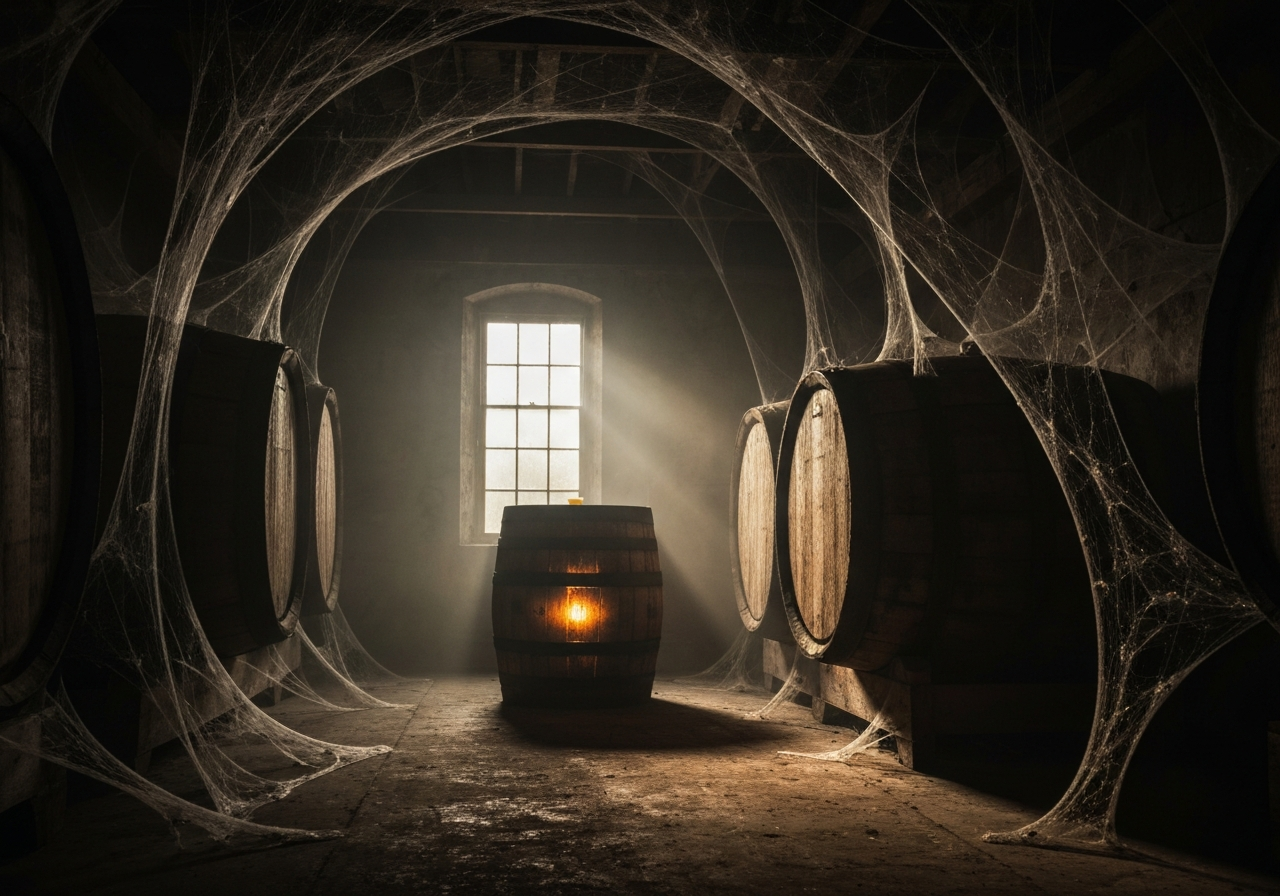
Discontinued Cooperage: The Lost Art of the 'Paxarette' Cask
One of the most fascinating "secrets" of ghost casks isn't just the spirit inside, but the way the wood was treated. If you’ve ever tasted a Sherry-matured whisky from the 1950s or 60s and wondered why it tastes so much "thicker" and "funkier" than modern Sherry bombs, the answer might be Paxarette. This was a concentrated, dark, boiled sherry wine that coopers used to "season" casks rapidly. By pressure-treating the wood with Paxarette, they could infuse it with intense sweetness and color.
The Scotch Whisky Association (SWA) largely phased out or effectively banned this practice in the late 20th century to ensure the purity of the spirit. This created a dividing line in history. Casks treated with Paxarette—often called "Dirty Sherry" casks by enthusiasts—offer a deep, sulfuric richness and a dark chocolate bitterness that modern seasoned casks struggle to replicate. These are the true ghosts of the cooperage world. When you open an old and rare scotch from this era, you are tasting a method of production that is officially extinct.
Furthermore, the very nature of how sherry was transported has changed. In the "Golden Age," sherry was shipped to the UK in "Transport Casks." These were barrels that actually held wine for months as they traveled. Once emptied in London or Leith, they were sent up to Scotland to be filled with whisky. These casks were old, seasoned by time and travel, and had thick, high-quality staves. Today, almost all Sherry casks are "Bespoke Seasoned Casks," meaning they are made specifically for the whisky industry, filled with sherry for a year or two, and then emptied. They are excellent, but they lack the decades of deep-seated "funk" found in the old transport ghost casks.
Even the wood itself was different. Before the World Wars, Russian Oak (Quercus Robur) from the Caucasus region was a staple of European cooperage. It was known for its tight grain and subtle spice. However, geopolitical shifts and over-harvesting made it almost impossible to source for new maturation. When you find a ghost cask made of Russian Oak or extremely old-growth European forest timber, you’re experiencing a tannin structure and a "heavy char" profile that modern automated laser-charring processes simply can't simulate. It is craftsmanship from a time when the master cooper’s intuition was the only guide.
The Chemistry of the 'Dead' Cask: Why Old Wood Behaves Differently
There is a point in a whisky’s life—usually around the 30-year mark—where it enters what scientists and master blenders call the "Third Stage" of maturation. At this point, the cask is often considered "exhausted" or "dead" in terms of what it can give the spirit in terms of vanillins or wood sugars. However, this is exactly where the magic of the ghost cask begins. The wood becomes a fragile vessel for "micro-oxygenation," where the spirit breathes through the porous staves at a glacial pace.
This slow oxidation leads to the development of rancio, a flavor profile most commonly associated with ancient Cognacs. In rare whisky maturation, rancio manifests as notes of tropical fruit (think overripe mango and pineapple), forest floor, leather, and dried mushrooms. It is a savory-sweet complexity that only time can create. This is why a 40-year-old ghost cask often tastes more like a tropical fruit basket than a piece of wood; the wood has stopped contributing "oakiness" and has instead started facilitating the transformation of the spirit’s own esters.
One of the most interesting aspects of these old casks is the relationship between ABV and flavor concentration. Due to the "Angel’s Share" (evaporation), a ghost cask may have a significantly lower ABV—sometimes dipping close to the legal minimum of 40%. However, the flavor concentration is often inversely proportional to the strength. The mouthfeel of these whiskies is incredibly oily and viscous, a texture that modern, younger whiskies cannot emulate regardless of their proof. It’s a "liquid velvet" sensation that is the hallmark of lost distillery flavors.
But managing these ghosts is a high-stakes game. There is a constant risk of "over-oaking," where the tannins eventually overwhelm the spirit, making it taste like a dry toothpick. Warehouse managers must be masters of their craft, sampling these casks annually to identify the exact "Goldilocks" moment to bottle them. When you consider that a 50-year-old cask might only yield 50 to 100 bottles due to evaporation, the rarity becomes clear. Every drop is a survivor of a half-century-long battle against the elements.
Rare Wood Varieties: The Ghost of Mizunara and Historical Scottish Oak
While Scotland is the heart of the ghost cask world, we cannot ignore the "ghosts" of the East. Mizunara Oak (Quercus crispula) is perhaps the most legendary example of rare whisky maturation. During World War II, Japanese distillers were cut off from importing American and European oak. In an act of "desperation," they turned to their native Mizunara. It was a nightmare for coopers—the wood is incredibly porous, prone to leaking, and the trees take 200 years to reach maturity.
Because so many of those early Mizunara barrels leaked or failed, the survivors are true ghosts. It takes decades for Mizunara to impart its signature "temple incense," sandalwood, and coconut profile. Today, Mizunara is the most expensive and sought-after wood in the world, but it is those original, wartime-era ghost casks that set the standard for what Japanese whisky could achieve. They represent a moment of necessity that turned into a global pinnacle of luxury.
Back in Scotland, there is a quiet revival of another ghost: Scottish Oak. For centuries, the industry abandoned local timber in favor of straight-grained, easy-to-work American and European oak. Scottish Oak is knotty, difficult to shape, and rare. However, some independent bottlers and experimental distillers are unearthing ghost stocks that used 100-year-old local timber. These whiskies have a much more aggressive, spicy tannin structure compared to the sustainable plantation oak used today.
We also occasionally see "ghost" bottlings that utilized historical European woods like Chestnut or Acacia. These were common in the 19th century but fell out of favor as the industry standardized. When a cask like this surfaces today, it offers a flavor profile that is completely "off-profile" for a standard distillery release. It’s a reminder that the "Scotch flavor" we know today is a relatively modern invention, and the ghosts of the past were much more varied and experimental.
The Independent Bottlers: Guardians of the Ghost Stocks
If the distilleries are the creators of these spirits, the Independent Bottlers (IBs) are their guardians. Companies like Gordon & MacPhail, Signatory Vintage, and Hunter Laing played a crucial role in preserving the ghost casks we enjoy today. In the 1960s and 70s, when many distillery owners saw their maturing stock as "surplus" or just something to be sold off for cash flow, these family-owned businesses were buying it up and laying it down in their own casks.
This is why you’ll often find that an independent bottler has more "ghost" stock than the original distillery owner. A prime example is Gordon & MacPhail’s "Generations" series. They managed to release an 80-year-old Glenlivet—the ultimate ghost of a bygone era. They had the foresight to keep that cask in a cool, damp warehouse in Elgin for eight decades. Without their dedication to the long game, many of these lost distillery flavors would have been blended away and disappeared into history long ago.
There is, however, a hot debate in the whisky community regarding "re-casking." Sometimes, a ghost cask begins to fail; the staves might be leaking, or the wood is no longer contributing anything positive. In these cases, the spirit is often moved to a modern, active Sherry butt for a "finishing" period. Is it still a "ghost" if it’s been finished in modern wood? Most purists say the heart of the whisky remains the same, but it highlights the fragility of these old stocks. The goal is always to preserve the original character while ensuring the whisky remains palatable.
Sometimes, these casks are found through pure serendipity. Take the revival of Benromach, for instance. When the Urquhart family (owners of Gordon & MacPhail) bought the distillery in the 90s, they found "lost" barrels tucked away in the back of dunnage warehouses that hadn't been touched in years. These discoveries are the stuff of legend in the whisky world—finding a liquid time capsule that was forgotten by a previous owner who simply lost track of their inventory during a merger or closure.
The Collector’s Market: Investing in Liquid History
It’s impossible to talk about ghost casks without addressing the elephant in the room: whisky investment. According to the Knight Frank Wealth Report, rare whisky has frequently outperformed gold, fine wine, and even classic cars as a luxury asset class. The "Ghost Cask" category is the primary driver of this trend. Because these casks represent a finite, non-renewable resource, their value only goes in one direction as they are opened and consumed.
This has led to a bit of a dilemma for the true enthusiast: the "Drinking vs. Investing" struggle. Many of these ghost casks are now becoming "trophy bottles," destined to sit in glass cases or climate-controlled vaults rather than being poured into a Glencairn. However, there is a growing movement of "whisky nerds" who make it their mission to open these bottles at festivals and tastings. They believe that whisky is a performance art—it only exists when it is being experienced. If you ever get the chance to attend a "Ghost Cask" tasting, take it. It might be your only chance to taste that specific piece of history.
With high prices comes the risk of fraud. Authentication is a massive part of the whisky collecting trends today. Laboratories now use Carbon-14 dating to verify the age of the spirit and gas chromatography to analyze the chemical "fingerprint" of a ghost cask. This ensures that the Port Ellen in your glass is actually from 1982 and not a clever modern imitation. For the serious investor, provenance—the documented history of who owned the cask and where it was stored—is just as important as the liquid itself.
The psychology of scarcity plays a huge role here. There is a unique emotional value in knowing that a flavor can *never* be made again. When the last cask of original Hanyu (the famous Japanese "Card Series") was bottled, a chapter of history closed forever. Those bottles now sell for hundreds of thousands of dollars, not just because they taste good, but because they are the final echoes of a silent distillery. It’s the ultimate expression of "FOMO" (Fear Of Missing Out), fueled by the reality that these ghosts are eventually going to disappear.
The Future of the Past: Can Ghost Flavors Be Replicated?
As we look toward the future, the big question is: can we recreate these lost distillery flavors using modern technology? We live in an era of "accelerated aging" and ultrasonic maturation, where some startups claim they can replicate decades of aging in a matter of weeks. But ask any seasoned blender, and they’ll give you the same answer: No. You can’t simulate fifty years of seasonal temperature shifts, the slow breakdown of lignin, and the gentle oxidation that occurs in a cold Scottish warehouse.
However, we are seeing a fascinating "Resurrection" movement. Distilleries like Port Ellen and Rosebank are being rebuilt and reopened. While they aim to replicate the "ghost" profile using historical records and modern engineering, the spirit they produce today will be a new creature. It will be influenced by modern barley varieties, different yeast strains, and, most importantly, different wood. They are not making the ghost; they are making the successor.
The wood is only half the story, of course. Many ghost casks from the 60s and 70s were filled with spirit made from "heirloom" barley varieties like Golden Promise, which provided a rich, oily base that modern high-yield barley struggles to match. The combination of these extinct grains and the "extinct wood" of the ghost casks is what created that "Golden Age" flavor. We are currently living through a unique window where these casks are still available, but they are becoming rarer every day.
In the end, the ephemeral nature of whisky is what makes it so beautiful. The fact that these casks will eventually be gone makes every sip more meaningful. They are the ultimate bridge between the industrial past and the luxury future of the whisky industry. So, the next time you see a "Ghost and Rare" bottling or a vintage release from a silent distillery, take a moment to appreciate the journey that liquid has taken. It’s not just a dram; it’s a ghost story told in amber, and we are the lucky ones who get to hear it.
Practical Tip: If you're looking to explore ghost flavors without the five-figure price tag, look for independent bottlings of "undisclosed" malts from Islay or the Highlands. Often, these are casks from famous distilleries that were sold under a pseudonym to protect the brand's primary market value. You might just find a ghost hiding in plain sight.