Whiskey's Watermark: Decoding Source & Mineral Impact
Discover how the unique mineral composition of water shapes the character of your favorite whiskies.
The Invisible Ingredient: Why Water is the Soul of the Spirit
When we talk about whisky, we usually spend our time debating the merits of Sherry casks versus Bourbon barrels, or the heavy smoke of Islay peat versus the delicate orchard fruits of a Speyside malt. We talk about the grain—the barley, corn, or rye—and how its sugars provide the foundation for everything we love. But there is a silent partner in this process, an ingredient that often accounts for more than 60% of what is actually in your glass at a standard 40% ABV. That ingredient is water.
To many, water is seen merely as a neutral solvent, a necessary but uninteresting medium for the "real" flavors. However, in the world of professional distilling, water is far from neutral. It is the "Three Waters" of production that dictate the destiny of a spirit. First, there is the water for steeping, used during the malting process to awaken the grain. Next is the water for mashing, which extracts those vital sugars and begins the whisky fermentation chemistry. Finally, there is the reduction water, added just before bottling to bring the spirit down to a drinkable strength. Each of these stages requires a specific chemical profile to succeed.
At DramNote, we like to talk about "Hydro-Terroir." This concept suggests that water is not just a liquid; it is a geological record. As water travels through the earth—seeping through ancient limestone, dancing over granite, or soaking through thick layers of peat—it picks up a unique chemical fingerprint. It collects minerals, ions, and organic compounds that it then carries into the distillery. This geological journey is so vital that, historically, the siting of a distillery was determined by the water source above all else. A distillery could ship grain by rail and move barrels by cart, but they could not easily transport the thousands of gallons of pure, local spring water needed daily. The "burn" or the "well" was the lifeblood of the operation.
The very name of the spirit reflects this reverence. From the Latin Aqua Vitae to the Gaelic Uisge Beatha, we have always called it the "Water of Life." In the early days of distilling, the purity and mineral profile of local water were seen as divine gifts, often credited with medicinal properties. While we now have science to explain why one spring produces a better dram than another, the sense of magic remains. Your favorite bottle is, quite literally, a liquid map of the landscape from which it was born.
The Chemistry of Hardness: Calcium, Magnesium, and Yeast Health
To understand the mineral impact on whisky, we have to look at the concept of "Hardness." In the world of distilling, "hard" water is water rich in dissolved minerals, primarily calcium and magnesium, often picked up from limestone or chalk deposits. "Soft" water, conversely, is low in these minerals, typically having moved through harder rocks like granite that don't dissolve easily.
For a long time, there was a school of thought that soft water was always superior for Scotch, but chemistry tells a more nuanced story. Calcium (Ca2+) is a hero in the mash tun. During the mashing process, enzymes called alpha-amylases are responsible for breaking down complex starches into the simple sugars that yeast can eat. Calcium ions act as stabilizers for these enzymes, allowing them to work more efficiently and at higher temperatures. Without enough calcium, the conversion can be sluggish, leading to a lower yield of alcohol and a different profile of residual sugars.
Then we have magnesium, which is a vital nutrient for yeast. Think of magnesium as a multivitamin for the fermentation process. If the whisky water source is too deficient in minerals, the yeast can become "stressed." Stressed yeast is a distiller’s nightmare; it doesn't just work slowly—it produces off-flavors. When yeast is unhappy, it can throw off compounds that smell like burnt rubber, sulfur, or even wet plastic. A healthy dose of minerals ensures a clean, vigorous fermentation that produces the fruity esters we desire.
Furthermore, minerals act as a buffer for pH levels. During fermentation, the "wash" naturally becomes more acidic. If it becomes too acidic too quickly, the yeast can stall. Carbonates found in harder water act as a natural buffer, keeping the acidity in a "sweet spot" that allows the yeast to thrive for longer. While the traditional Scotch profile leans toward soft water, there is a famous "Hard Water Outlier": Glenmorangie. Their use of the mineral-rich Tarlogie Springs is legendary. The hard water contributes to the specific mouthfeel and complexity of their spirit, proving that "hard" water isn't a flaw—it's a flavor tool.
"Water is the soul of the spirit; the minerals are its personality." — Anonymous Distiller
The Limestone Legacy: Why Kentucky is the Bourbon Capital
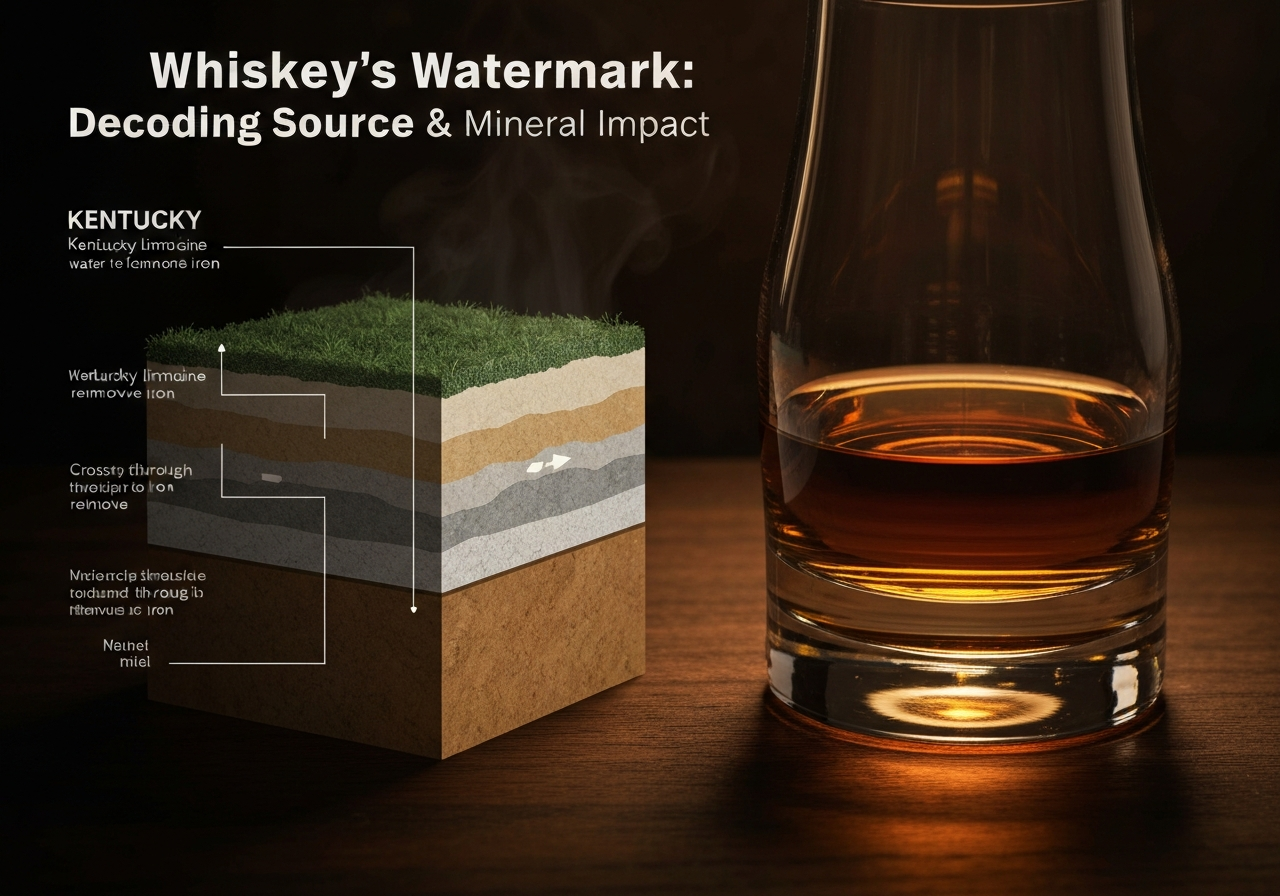
If you ask a Master Distiller in Frankfort or Bardstown why Kentucky makes the best bourbon in the world, they won't start with the corn. They will start with the dirt—specifically, the Ordovician limestone shelf that sits beneath the Bluegrass region. This ancient geological formation is the secret weapon of American whiskey. This limestone acts as a massive, natural carbon filter, but it does two very specific things that are essential for the limestone water bourbon profile.
First, it removes iron. In the world of whiskey production, iron is the "Enemy Number One." If water contains even trace amounts of iron, it reacts with the tannins in the oak barrels during maturation. The result? The whiskey turns a terrifying, inky black color and develops a metallic, astringent taste that no amount of aging can fix. The limestone shelf in Kentucky naturally strips iron from the water as it passes through, ensuring a clean slate for the distiller.
Second, the limestone adds an abundance of calcium. As we discussed earlier, calcium is great for yeast, but in bourbon production, it plays an even more specialized role in the "Sour Mash" process. Because bourbon distillers reuse a portion of the spent mash (the "backset") from the previous distillation to start the next batch, the acidity can be difficult to manage. The calcium-rich water provides a consistent, buffered environment that helps regulate this acidity, leading to a more reliable and repeatable flavor profile. This is why brands like Buffalo Trace or Woodford Reserve have such a distinct, dependable character.
There is also a tactile quality to limestone water. Many tasters find that Kentucky water contributes to a "crisp" or "zippy" quality on the palate, particularly in high-rye bourbons. This minerality cuts through the heavy sweetness of the corn and the charred oak, providing balance. We can trace this scientific understanding back to Dr. James C. Crow in the 1830s. Crow was a Scottish chemist who brought a scientific rigor to Kentucky distilling. He was among the first to realize that the relationship between the minerals in the water and the health of the ferment was the key to moving bourbon from a crude "moonshine" to a world-class spirit.
The Scotch Paradox: Peat, Granite, and the Power of Soft Water
While Kentucky prizes its mineral-heavy water, the majority of the Scotch whisky industry historically prizes hard vs soft water scotch in favor of the latter. This is largely a result of Scotland's geography. Much of the Highlands and the islands, like Islay, sit on a foundation of ancient granite and basalt. These rocks are incredibly hard and non-porous, meaning the water that runs over them picks up very little mineral content. The result is water that is soft, pure, and low in calcium.
This soft water creates a different "canvas" for the distiller. With fewer minerals to interfere, the extraction of the grain's character is more delicate. In the Speyside region, for instance, the water from the River Spey and its tributaries is often described as having a "snowmelt" quality. This ultra-clean water allows the fruity esters—the notes of green apple, pear, and honey—to shine through without being weighed down by mineral "heaviness." It’s why Speyside malts are often celebrated for their elegance and clarity.
However, soft water in Scotland often comes with another passenger: peat. As rainwater falls on the moors and travels toward the distillery, it often seeps through thick layers of peat bogs. This water picks up organic acids and soluble phenolics, turning it the color of a dark tea. This is the famous "peat wash." While most of the smoky flavor in a whisky comes from drying the barley over peat smoke, some distillers believe that using peat-stained water in the mashing process adds a foundational earthy layer to the spirit that cannot be replicated elsewhere.
Consider the difference between a mountain spring source and a lowland burn. A distillery drawing from a high-altitude granite spring in the Northern Highlands will have a spirit that feels "tight" and "bright." Conversely, a distillery on Islay using dark, boggy water might find a more "viscous" and "savory" quality in their new-make spirit. Even without the smoke, the water itself tells the story of the Scottish terrain—rugged, ancient, and relatively low in the "clean" minerals found in Kentucky's limestone.
Distillation Interaction: Water Ions and the Copper Still
The role of water doesn't end once the fermentation is finished. During distillation, the mineral ions present in the wash engage in a complex dance with the copper stills. This is where we see the distillation copper interaction really come into play. Copper is not used just because it’s a great conductor of heat; it is used because it is chemically "sacrificial." It reacts with sulfur compounds produced during fermentation—those nasty smells of rotten eggs or struck matches—and neutralizes them.
The mineral content of the water influences how this interaction happens. Specifically, if the water used in the mash is high in minerals, it can lead to the formation of "scale" or "furring" inside the still (much like the lime build-up in your kettle at home). While too much scale is a maintenance headache, a thin layer of mineral deposits can actually alter the thermal conductivity of the still. This changes how the liquid boils and how much "reflux" occurs—reflux being the process where vapors condense and fall back down to be re-distilled. Higher reflux generally leads to a lighter, purer spirit, while lower reflux leads to a heavier, oilier one.
Furthermore, ions like chlorides and sulfates can be quite aggressive toward copper. Water with high levels of these minerals can cause the copper to wear away faster, but in doing so, it catalyzes certain chemical reactions more intensely. Scientific studies have shown that mineral ions can actually act as catalysts for esterification—the process where acids and alcohols combine to create those wonderful fruity aromas—during the boiling process inside the still. This means that the minerals in your water are helping to "cook" the flavors of your whisky while it is still a vapor.
So, when you see those gleaming copper stills, remember that they aren't just containers. They are active chemical participants, and the minerals delivered by the whisky water source are the fuel for those reactions. The thickness of the still, the shape of the neck, and the minerals in the water all conspire to create a spirit that is either "heavy" and "sulfuric" or "light" and "floral."
The Final Cut: How Reduction Water Redefines the Palate
Perhaps the most controversial and influential use of water is the "final cut." This is the reduction water whisky addition that happens after the spirit has spent years in the barrel. When a whisky is pulled from the cask, it is often at a "cask strength" of 55% to 65% ABV. To bring it down to the standard 40% or 46%, water is added. This water is never heated, never fermented, and never distilled. It is the first thing that hits your tongue when you take a sip.
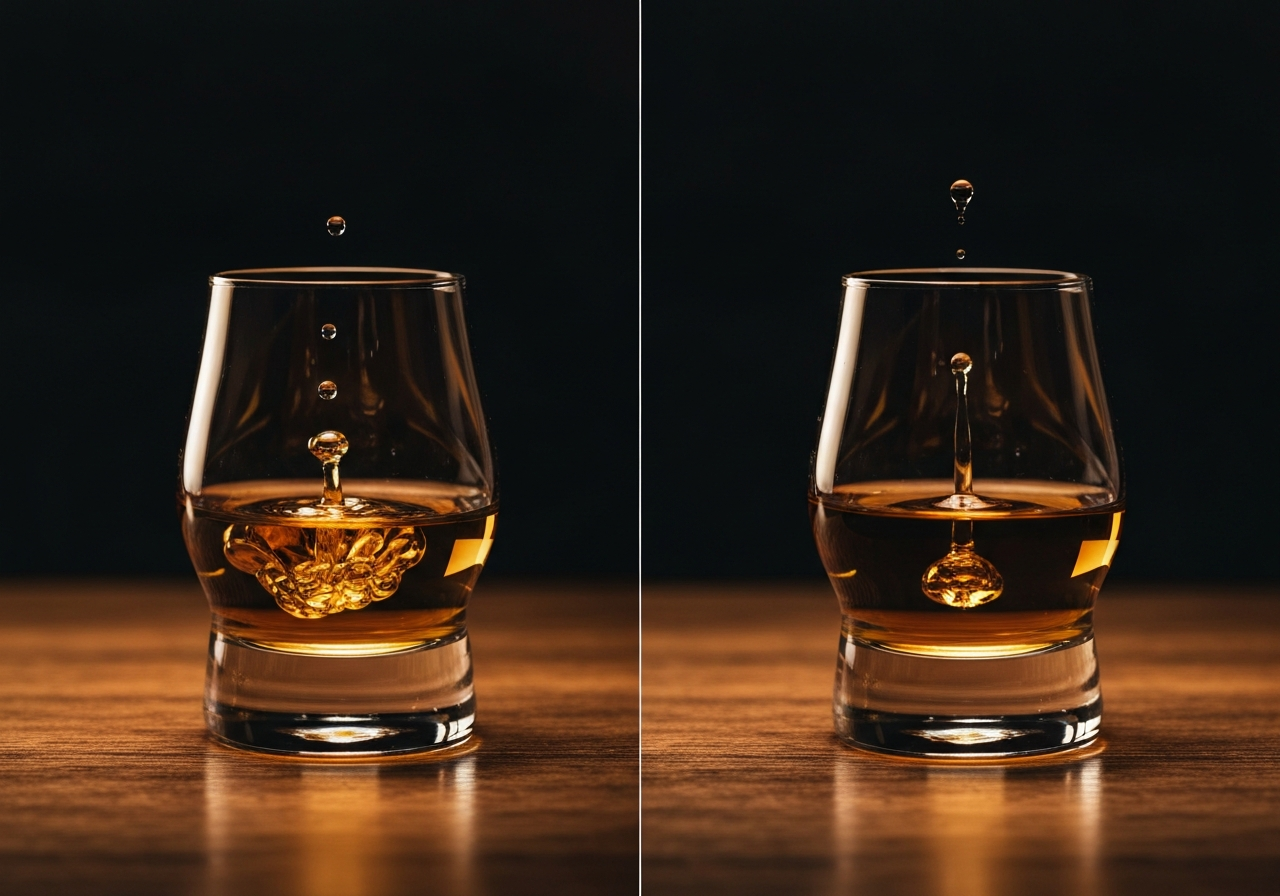
When you add water to a high-strength spirit, a fascinating chemical reaction occurs. It’s often called "breaking" the spirit or "blooming." Because many of the aromatic compounds (esters and phenols) are hydrophobic (water-fearing), the addition of water forces them out of the liquid solution and into the air. This is why a drop of water can suddenly make a whisky smell much more intense. However, the *type* of water used for this reduction matters immensely.
In the modern era, many large distilleries use De-mineralized or Reverse Osmosis (RO) water for reduction. They do this for consistency—they want every bottle of their 12-year-old to taste exactly the same, regardless of where it is bottled. But some purists argue that RO water leaves a whisky feeling "thin" or "flat." Natural spring water contains electrolytes and trace minerals that contribute to the "surface tension" of the liquid. This surface tension dictates the mouthfeel—how the whisky coats your tongue and how long the "legs" are on the side of the glass. A whisky reduced with natural, mineral-rich water often feels "oilier" and more substantial than one reduced with laboratory-pure water.
Some distilleries are now leaning back into the old ways. They will transport their original whisky water source hundreds of miles to the bottling plant just to ensure the reduction water matches the mashing water. This preserves the "vibrancy" of the spirit. When you’re tasting at home, try this: take a high-proof whisky and split it into two glasses. Add a splash of tap water to one and a splash of bottled spring water to the other. You will be amazed at how the mineral profile of the water can either "shut down" or "open up" the delicate top notes of the dram.
Global Variations: From Japanese Volcanic Rock to Alpine Glaciers
The story of water isn't just a Scottish or American one. As whisky has gone global, new mineral impact on whisky profiles have emerged. Take Japan, for example. The legendary Suntory Yamazaki distillery was built in the outskirts of Kyoto specifically because of the water of "Rikyu." This water is famously soft and pure, filtered through the bamboo-covered mountains. In Japanese culture, there is a phrase "mizu-no-gotoshi," meaning "like water." This refers to a spirit that is so silky and effortless that it flows across the palate without any friction. That silkiness is a direct result of the lack of aggressive minerals in the local source.
In other parts of the world, we see the impact of volcanic geology. Distilleries in Iceland or certain parts of Japan use water filtered through volcanic basalt and ash. This water is extremely pure, but it often contains high levels of silica. This gives the spirit a unique "slickness" on the tongue—a texture that feels almost glassy. It’s a profile you won't find in a Kentucky bourbon or a Speyside malt because the "Hydro-Terroir" is fundamentally different.
Then we have the "Alpine" profile. New craft distilleries in the European Alps use glacial meltwater. This water is not just low in minerals; it is incredibly high in dissolved oxygen because of the turbulent, cold environment it comes from. High oxygen levels in the initial water source can lead to very different yeast behavior during the early stages of fermentation, often resulting in "brighter," more acidic spirits that have a high-toned, floral quality.
Interestingly, some modern "new-world" distillers are becoming "water architects." Distilleries like Starward in Australia or Westland in Seattle are operating in urban or unique environments where the local water might not match a traditional profile. Some of these distillers use "brewing salts" to manipulate their water, adding calcium or magnesium to recreate the mineral profile of Islay or Kentucky. While some might call this "cheating," others see it as the ultimate expression of whisky fermentation chemistry—using science to ensure that the water, the "ghost ingredient," is performing at its absolute best.
The Taster's Guide: Identifying the Watermark in Your Glass
So, how can you, as a taster, begin to identify the "watermark" in your glass? It takes practice, but there are certain sensory clues to look for. When you are using the DramNote app to record your next tasting, try to pay attention to the transition from the mid-palate to the finish. That is often where the minerals reveal themselves.
Sensory clues for hard water: Look for a "chalky" or "mineralic" finish. Harder water often provides a certain "weight" or "heaviness" on the mid-palate. You might notice a very quick, clean transition from sweetness to spice. In bourbons, this often manifests as a "zing" or a "crispness" that feels refreshing rather than heavy.
Sensory clues for soft water: Look for a "slick" or "oily" mouthfeel that seems to linger on the sides of the tongue. Soft water often allows the fruity esters to be more prominent and "sing" on the top notes. The finish is usually more gradual and "soft," without that sharp mineral "snap."
If you want to take your education further, try the "Water Test." Pour three small drams of the same whisky (something bottled at at least 46% ABV works best).
- Taste the first one neat.
- Add a few drops of your local tap water to the second (which likely contains chlorine and fluoride).
- Add a few drops of a bottled spring water with a known mineral content to the third.
There is even a niche market now for products like "Uisge Source," which sells bottled spring water from specific regions of Scotland (Islay, Highlands, Speyside) so you can dilute your whisky with the same water that was used to make it. While it might seem like overkill to some, for the dedicated enthusiast, it is the final piece of the puzzle. Understanding the watermark in your whisky deepens your appreciation for the spirit. It reminds us that whisky isn't just a factory product; it is a collaboration between human craft and the ancient, geological secrets of the earth's water.