Whisky's Watermark: Decoding Source & Mineral Impact
Discover how the water used in whisky production subtly shapes its character.
The Forgotten Ingredient: Why Water is the Soul of the Spirit
When we hold a glass of liquid gold up to the light, our minds often drift to the rolling fields of golden barley or the dark, toasted staves of a sherry cask. We talk about "wood management" and "mashing regimes" as if they are the sole architects of flavor. But there is a silent giant in that glass, an ingredient that constitutes approximately 60% to 90% of the final liquid in a bottle of whisky. Despite this overwhelming volume, water remains the most underappreciated and least marketed component of the spirit. It is, quite literally, the soul of the spirit.
Historically, water wasn't just an ingredient; it was the law. Before modern logistics and piping, the placement of a distillery was dictated entirely by its proximity to a reliable whisky water source. Legendary sites like Ardbeg on Islay or Glenmorangie in Tain don’t just happen to be where they are; they exist because of the specific springs and burns that flow nearby. If the water moved, the distillery died. This proximity created a deep, chemical bond between the land and the liquid that we still taste today.
Beyond its sheer volume, water serves as the master solvent. It is the medium that carries every aromatic molecule and flavor compound from the grain and the wood to your olfactory receptors. Its chemical structure—the specific arrangement of minerals and ions—determines how those aromatic molecules are released or suppressed. Think of water as the stage upon which the other ingredients perform; if the stage is warped or vibrating, the performance changes entirely.
This leads us to the concept of the "Watermark." Just as a piece of fine stationery has a hidden signature revealed only when held to the light, every distillery has a unique chemical signature derived from its local catchment area. This fingerprint is a result of whisky distillation science and geology, and it cannot be perfectly replicated elsewhere. To truly understand whisky, we must look at the three stages where water intervenes: the initial steeping and mashing, the cooling during condensation, and the final dilution that brings the spirit to bottling strength.
Geological Filtration: From Rainwater to Distiller’s Source
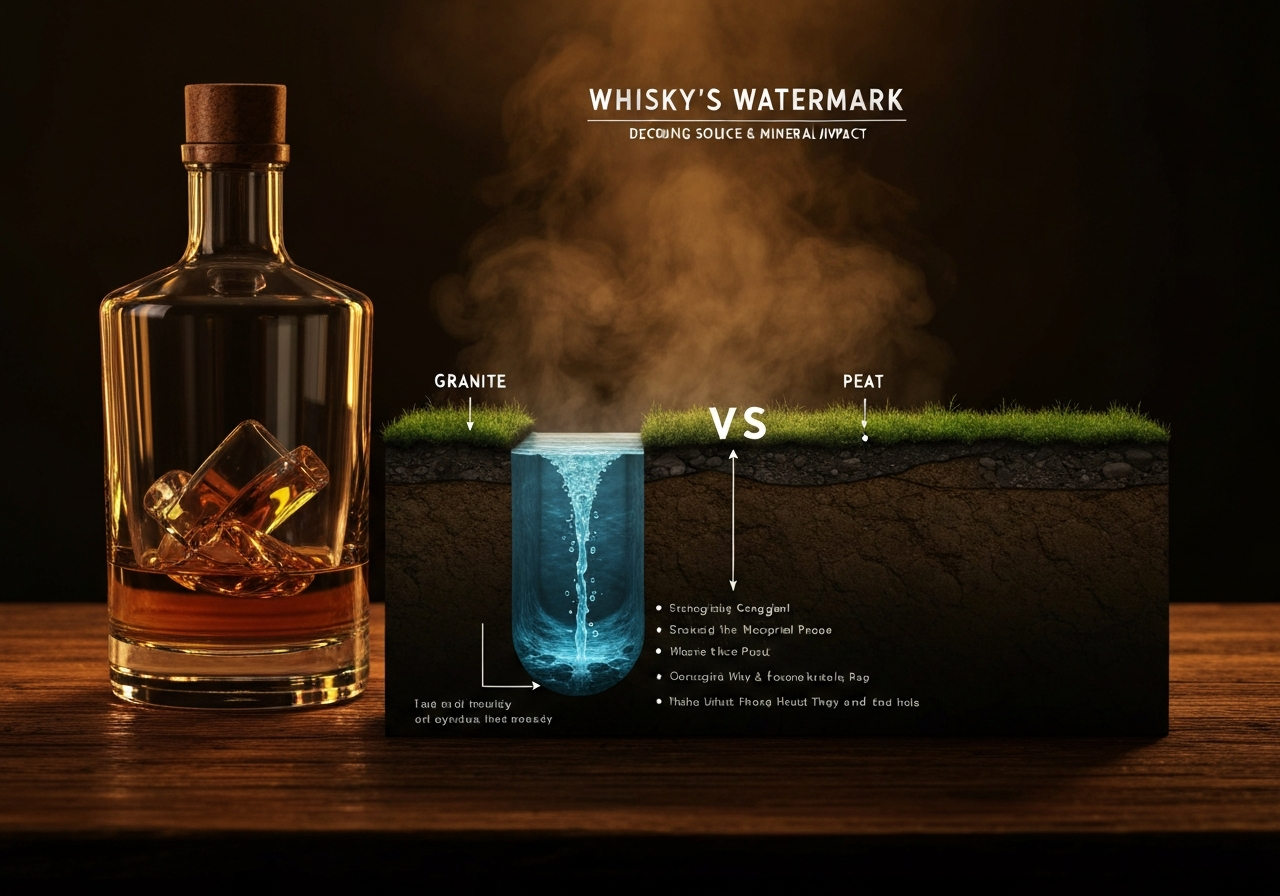
The story of whisky water begins long before it hits the mash tun. It starts as rain or snow, falling onto the rugged landscapes of Scotland, Ireland, or Kentucky. From there, it embarks on a journey through the earth, and the rocks it encounters define its destiny. This geological journey is what creates the mineral impact on whisky that connoisseurs spend decades trying to decode.
In the Scottish Highlands, water often flows over hard, igneous rocks like granite. Because granite is relatively insoluble, the water picks up very few minerals, resulting in "soft" water. Conversely, in the blue-grass state of Kentucky, water frequently filters through deep layers of limestone. This creates limestone water bourbon is famous for—water that is "hard," mineral-rich, and heavy with calcium. These two extremes create fundamentally different canvases for the distiller to work upon.
We also have to consider the difference between surface water and groundwater. Many Highland and Islay distilleries use "burn water"—surface water from streams and rivers. This water is alive and temperamental; it changes temperature with the seasons and carries organic runoff from the surrounding flora. Groundwater, or aquifer water, is a different beast. Drawn from deep underground, it remains thermally stable year-round and is usually much more mineral-heavy because it has had centuries to "digest" the rock around it.
There is a persistent myth that the "brown water" of Islay, which has filtered through thick peat bogs, is the source of the whisky’s smoky flavor. In reality, while this water carries organic acids and tannins that add an earthy, vegetal weight to the spirit, it doesn't contain the smoky phenols we associate with peat. Those come from the kiln. Some distilleries, like Scapa in Orkney, go to great lengths to avoid this "peaty" water altogether, piping in water from a distance to ensure their spirit remains bright and honeyed. It goes to show that the choice of water is an intentional act of flavor engineering.
Finally, we cannot ignore the "seasoning" provided by the soil. As water trickles through layers of heather, moss, and bracken, it picks up subtle organic esters. While these might seem microscopic, they contribute to the "terroir" of the spirit. When a distiller says their whisky tastes like the glen, they aren't just being poetic—they are describing the organic chemistry of their water source.
The Chemistry of the Mash Tun: Minerals and Enzymatic Power
Once the water enters the distillery, the real mashing water chemistry begins. This is where the minerals picked up during the water's geological journey start to interact with the malted barley. The star of the show here is Calcium. Calcium ions (Ca2+) are the unsung heroes of the mash tun; they stabilize alpha-amylase, the enzyme responsible for chopping up long starch chains into fermentable sugars. Without enough calcium, the enzymes become sluggish, leading to a poor yield and a "thin" wort.
The pH balance is the next critical factor. For the enzymes to work at their peak, the mash needs to be slightly acidic, ideally in the range of 5.2 to 5.5. Minerals like magnesium and sulfates act as natural buffers, helping to lock the mash into this "sweet spot" of acidity. This is a primary reason why the debate of hard vs soft water whisky is so important. Hard water, with its high calcium and magnesium content, often leads to a more efficient extraction of sugars, potentially creating a heavier, more complex wort that carries more "stuff" into the fermentation tank.
"The minerals in your water don't just sit there; they are active participants in the birth of the alcohol itself."
However, there is one mineral that every distiller fears: Iron. Iron is the ultimate enemy of quality spirits. Even in tiny amounts, iron reacts with the polyphenols in the grain and the oak to turn the liquid an unappealing blackish-purple and introduce metallic, "bloody" off-flavors. This is why Kentucky’s limestone is so prized. Limestone is a natural filter that effectively strips iron out of the water while pumping it full of the "good" minerals like calcium. In Scotland, where limestone is rarer, many distilleries favor soft water with less than 50ppm of minerals to ensure a cleaner, more predictable process, relying on the quality of the malt itself to drive the flavor.
Fermentation Fuel: Water as Yeast Nutrient
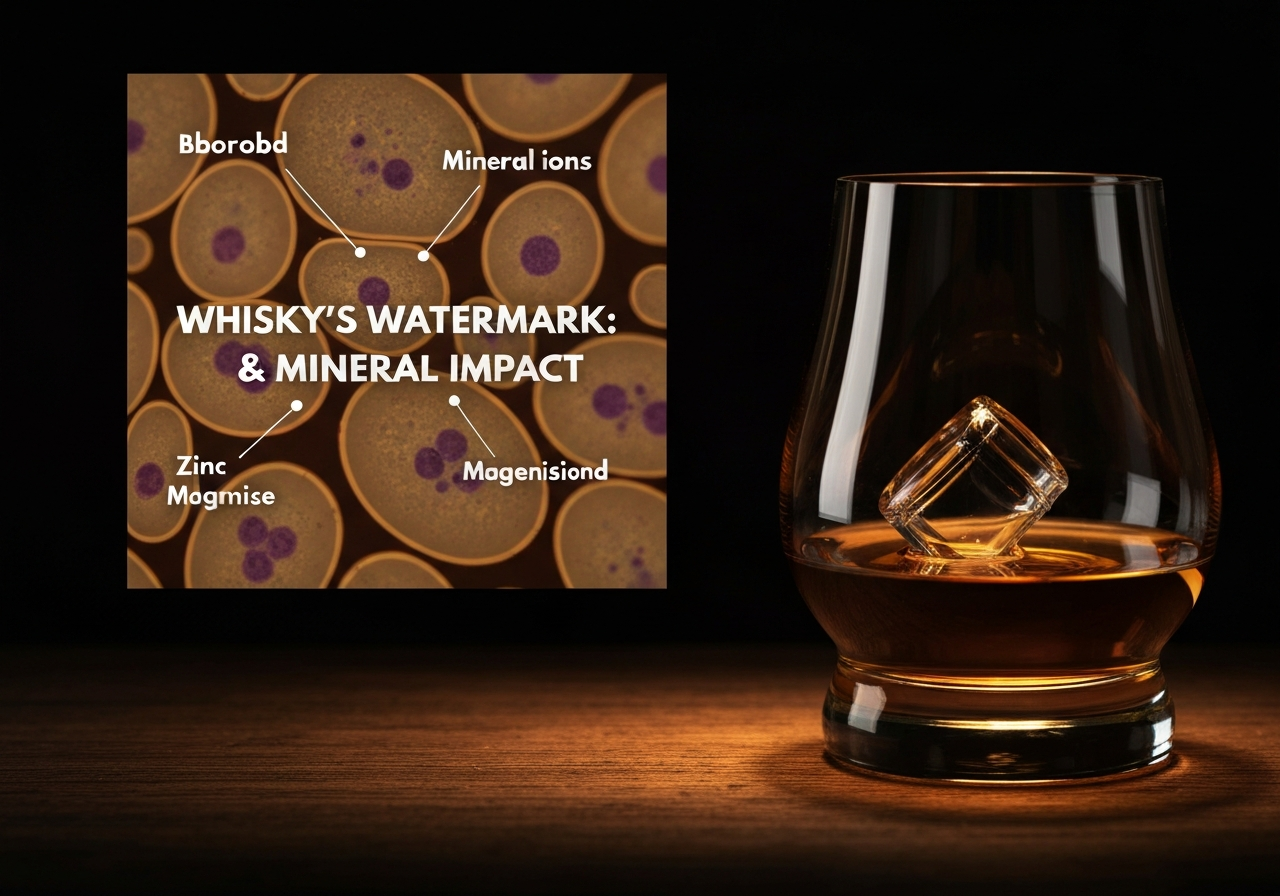
We often talk about yeast as if it’s a chemical powder, but it’s a living, breathing organism. Like any athlete, yeast needs a balanced diet to perform. While the barley provides the calories (sugar), the water provides the vitamins and minerals—specifically Zinc, Copper, and Magnesium—that keep the yeast healthy and "clean."
Zinc is particularly vital for ethanol tolerance. In a high-gravity wash (a liquid with lots of sugar), the environment becomes increasingly toxic for yeast as the alcohol level rises. Sufficient zinc levels in the water allow the yeast cell walls to remain strong, enabling them to survive longer and finish the fermentation without producing "stress congeners"—those harsh, funky flavors that occur when yeast is dying. Higher alcohol yields and a cleaner "wash" are the direct results of well-mineralized water.
Furthermore, there is a fascinating correlation between water minerals and ester production. Esters are the chemical compounds responsible for those beautiful fruity, floral, and spicy notes in your dram. When yeast is exposed to specific mineral balances, it changes its metabolic pathway, often producing more diverse esters. If a water source is "too pure"—like some modern demineralized sources—distilleries might actually "season" their water with mineral salts. It’s the distillery equivalent of adding a pinch of salt to a pot of pasta water; it brings out the best in everything else.
The Peat Water Myth: Deconstructing Color and Smoke
If there’s one thing I hear most often on distillery tours, it’s the idea that the water is what makes Islay whisky smoky. Let’s set the record straight: this is a fallacy. Scientific analysis of spirit has shown time and again that the smoky "phenols" come almost entirely from the kilning of the barley. If you distilled a mash made with peaty water and un-peated malt, you wouldn't get a "smoky" whisky; you’d get something quite different.
The confusion arises because water that has run through peat bogs looks like strong tea. This dark color comes from humic and fulvic acids. While these don't provide "smoke," they do contribute significant "earthy," "mossy," or "vegetal" notes. They also affect the mouthfeel. Take the Kilbride Stream used by Laphroaig. It is incredibly rich in organic matter and minerals. This doesn't make the whisky smoky (the peat fire does that), but it does contribute to that legendary "medicinal" or "lanolin-like" texture that coats the throat. It provides the "viscosity" that allows the smoke to linger.
There is also the matter of "cooling water." Much of the water used in a distillery never touches the mash; it is used to cool the copper stills and condense the vapor back into liquid. If a distillery uses peaty water in its cooling tanks (worm tubs), it has zero impact on the flavor of the spirit inside the pipes. However, the organic matter in the *process* water can interact with the copper during the boil. This can alter how effectively the copper strips away unwanted sulfur compounds, meaning the water indirectly shapes the "purity" of the final spirit.
Mouthfeel and Texture: The Mineral Weight
The next time you’re doing a side-by-side tasting, pay attention to the "weight" of the whisky on your tongue. Is it light and ethereal, or does it feel like whole milk? This is where the mineral impact on whisky truly shines. Generally speaking, soft water sources tend to produce spirits that are more delicate and top-note heavy. Hard water sources, like Glenmorangie’s famous Tarlogie Springs, produce a more robust, "chewy" spirit.
Glenmorangie is a fantastic case study. While most Speyside distilleries use soft water, the Tarlogie Springs water is hard, sitting at about 190ppm of minerals. This high mineral content is a major factor in why Glenmorangie, despite being distilled in the tallest stills in Scotland (which usually suggests a light spirit), has such a distinctive, creamy mouthfeel. It’s a physical sensation that simply isn’t present in whiskies made with softer water.
We should also talk about sulfates and salinity. High sulfate content in water—a process sometimes called "Burtonization" in the brewing world—can accentuate a crisp, dry finish. It brings out a hop-like bitterness in the malt that makes the whisky feel refreshing rather than cloying. Meanwhile, coastal distilleries often deal with higher sodium and chloride levels in their water due to sea spray and salt-heavy aquifers. This subtle salinity acts like a flavor enhancer, brightening the fruit notes and adding a savory "zing" to the finish.
The science here involves surface tension. Minerals change how the liquid interacts with your taste buds. A mineral-heavy whisky has a different surface tension, changing how it coats the tongue and how quickly it releases its "volatiles"—the tiny molecules that float up into your nose. Water is the reason some whiskies "explode" in the mouth while others slowly unfold.
The Final Touch: Reduction and Proofing Water
We’ve talked about water in the mash and water in the stills, but the most critical intervention might be the very last one. Unless you are drinking a "Cask Strength" release, the whisky in your glass has been reduced with water before bottling. This "reduction water" is never boiled, never fermented, and never distilled. It is added raw, meaning its own flavor profile remains 100% intact in your glass.
Think about the math for a second. If you reduce a whisky from 60% ABV (cask strength) to 40% ABV (standard bottling), you are adding a volume of water nearly equal to half the spirit. At that point, the water is the dominant liquid you are consuming. This is why many connoisseurs are skeptical of the industry-wide shift toward Reverse Osmosis (RO) water. Many large brands use demineralized RO water for bottling to ensure "brand consistency" and to prevent "floc"—the cloudy calcium precipitation that can happen in the bottle. While efficient, it strips away the "terroir."
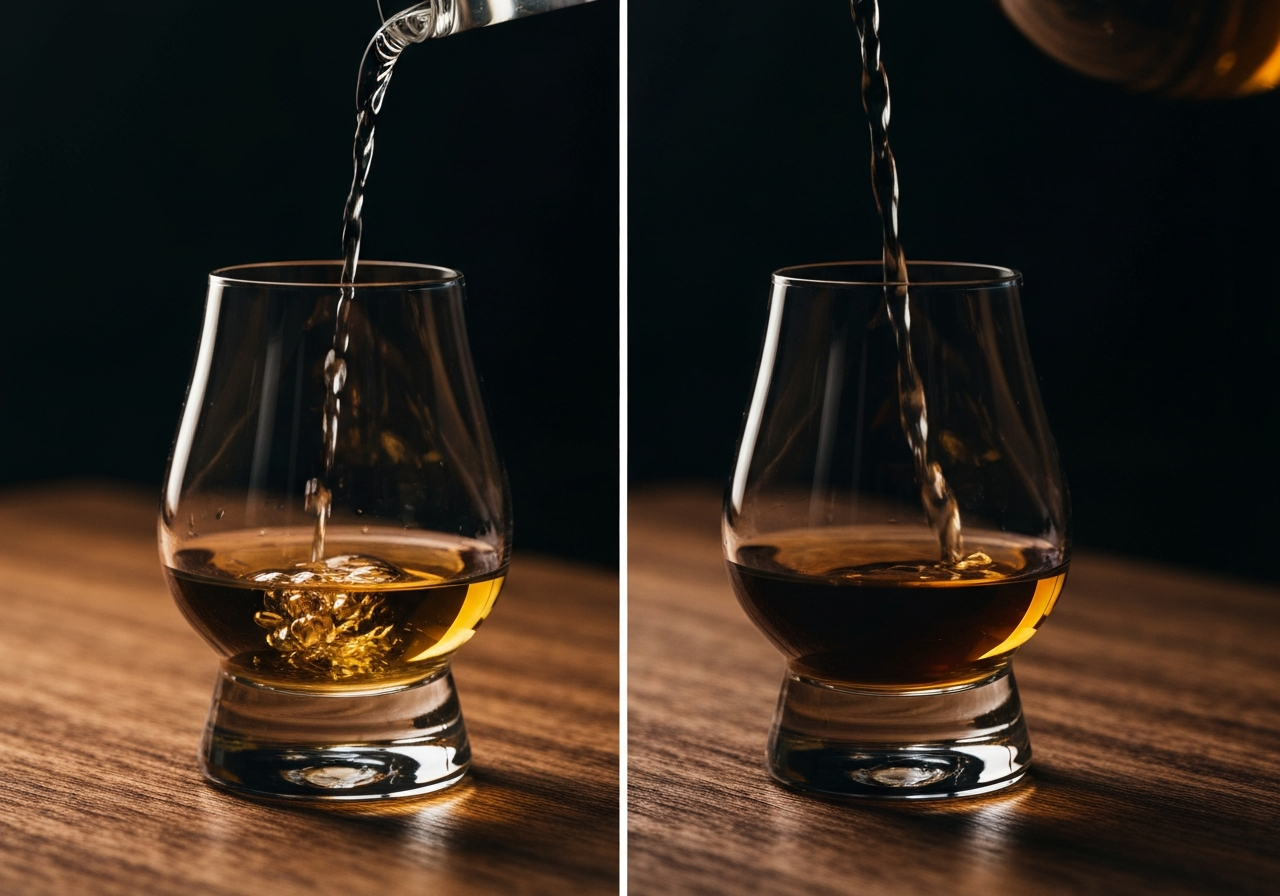
Fortunately, there is a growing "Small Water" movement. Boutique distilleries are increasingly insisting on bottling their spirit using the same spring water used for mashing. They want that local character—the minerals, the organic "soul"—to be preserved. When you add a few drops of water to your own glass at home to "open it up," you are performing a mini-version of this process. Pro tip: if you really want to see how much water matters, try adding a drop of hard tap water to one glass and a drop of distilled water to another. The difference in how the aromas are released will shock you.
Sustainability and the Future of Whisky Water
As much as we love the romance of the "burn," the reality of distillery sustainability is becoming a pressing concern. Climate change is beginning to threaten the ancient water sources we rely on. In recent years, Scotland has seen unprecedented heatwaves that have actually forced famous distilleries like Blair Athol and Edradour to temporarily cease production. When the burns dry up, the whisky stops flowing. It’s a stark reminder that whisky is an agricultural product, vulnerable to the whims of nature.
The efficiency of water use is also under the microscope. It takes a surprising amount of water to make a single liter of whisky—anywhere from 15 to 40 liters when you factor in the water used for cooling the stills and cleaning the equipment. Modern distilleries are finding innovative ways to be better stewards. Bowmore, for example, famously uses the waste heat from its distillation process to warm the local community swimming pool. Others are moving toward "closed-loop" cooling systems that recycle water rather than dumping it back into the local ecosystem.
Rising temperatures also change the water’s chemistry. As rainfall patterns shift, the mineral concentration in traditional springs can fluctuate, subtly altering the flavor profile of the spirit over decades. This is why many distilleries are now buying up the land surrounding their water sources. By owning the hills and the moors, they can prevent agricultural runoff, industrial contamination, or reforestation projects that might alter the delicate chemical balance of their aquifers. Protecting the water is, quite literally, protecting the future of the brand.
Conclusion: Decoding the Liquid Fingerprint
From the granite peaks of the Highlands to the limestone basins of Kentucky, water is far more than just a "neutral" base. It is the architect of texture, the fuel for fermentation, and the final "Watermark" that defines a distillery’s character. We’ve seen how minerals like calcium and magnesium drive the mashing water chemistry, how organic acids in peaty burns create mouthfeel, and how the final reduction water can make or break a dram.
If you take one thing away from this exploration, let it be this: don't be afraid to experiment. The next time you sit down with a bottle, try adding different types of water—hard, soft, or even "whisky-specific" spring waters. Notice how the shape of the spirit changes. While the oak barrel may provide the "clothes" for the whisky—the fancy colors and the spicy outfits—the water is the "skeletal structure." It determines the shape, the posture, and the fundamental identity of the spirit.
The Gaels called it *Uisge Beatha*—the Water of Life. They didn’t call it "Barley of Life" or "Oak of Life." They knew, even hundreds of years ago, that the source was the foundation of everything. As we look toward a future of changing climates and shifting landscapes, our appreciation for these ancient, pure water sources must only grow. Every drop in your glass is a geological record, a history of rain and rock, waiting to be decoded. Cheers to the source!